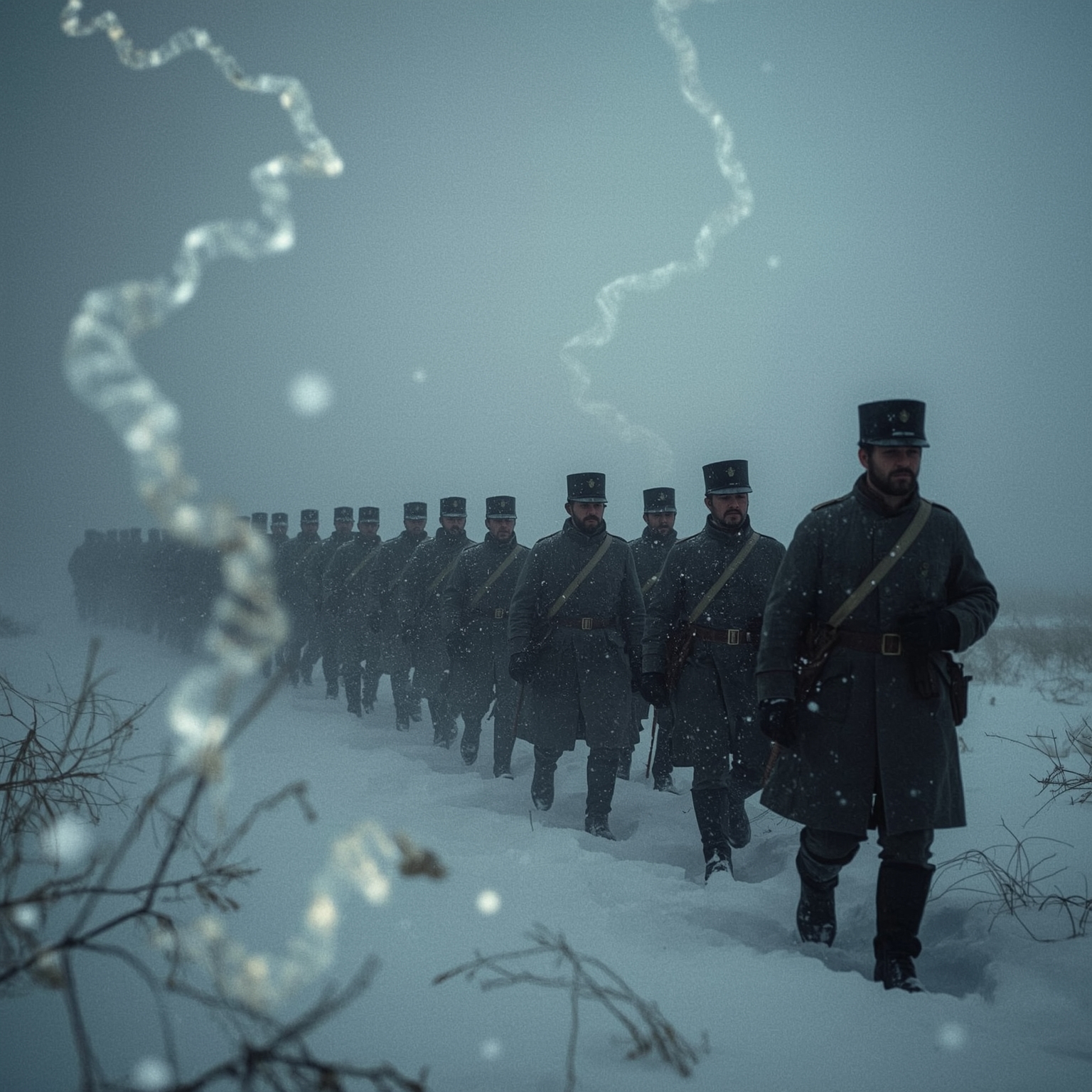
Napoleon’s fateful retreat from Russia in 1812 remains firmly etched into world history as one of the most catastrophic military withdrawals ever undertaken. What began as a triumphant march into Moscow ended in a harrowing descent across the frozen wastelands of Eastern Europe, decimating the once‑formidable Grande Armée. Modern scholarship has long attributed the disaster mainly to the combined ravages of bitter cold, starvation, and exhaustion. However, newly unearthed research now strengthens the notion that invisible foes—infectious diseases—played a pivotal and perhaps underestimated role in magnifying the scale of Napoleon’s defeat.
A collaboration between French and Estonian scientists has yielded remarkable genetic evidence embedded in the skeletal remains of soldiers who perished during that punishing retreat. Through advanced paleogenomic techniques, the researchers have identified traces of two notorious pathogens associated with paratyphoid fever and relapsing fever. Although their investigation does not reveal the full prevalence of these infections among Napoleon’s troops, it nevertheless isolates biological culprits that could explain the symptoms of fever, fatigue, and digestive distress so vividly depicted in eyewitness accounts from the shattered army. In other words, the scientific findings offer tangible molecular confirmation of what historians had long surmised only through records and speculation.
The retreat from Russia unfolded between October 19 and December 14, 1812—nearly two months that transformed one of history’s most formidable fighting forces into a beleaguered shadow of itself. According to the study, published in *Current Biology*, the loss was almost total, with roughly 300,000 men perishing. Historians emphasize that it was not solely continuous skirmishes with Russian forces that decimated Napoleon’s expedition, but rather a lethal alliance of natural and physiological adversaries: the pitiless frost of the Russian winter, the unyielding scarcity of food, and the rapid spread of disease through weakened ranks living in unsanitary conditions.
In a carefully controlled analysis, scientists extracted and sequenced DNA from the teeth of thirteen soldiers previously exhumed in Lithuania—individuals who most likely died of infectious causes during the retreat. Their molecular testing revealed the presence of two distinct pathogens. The first was a subspecies of *Salmonella enterica* identified as Paratyphi C, the organism responsible for paratyphoid fever, a disease characterized by high fever and gastrointestinal inflammation. The second was *Borrelia recurrentis*, the bacterium behind relapsing fever, which manifests in cyclical bouts of fever and severe weakness. These discoveries constitute the first direct genetic confirmation that members of Napoleon’s army suffered from such infections. Specifically, four individuals tested positive for *S. enterica* Paratyphi C, while two carried *B. recurrentis*. Both illnesses produce symptoms aligning closely with descriptions recorded by surviving contemporaries—accounts of soldiers wracked by persistent fever, debilitating exhaustion, and digestive ailments. When one considers that these men were already battling starvation, exposure, and moral despair, it is evident how disease could have swiftly compounded the army’s collapse.
Still, the scope of infection remains uncertain. Because only thirteen sets of remains were examined out of the estimated 300,000 casualties from the campaign, the researchers caution that they cannot yet determine how many deaths these pathogens directly caused. Nevertheless, the identification of such microbes in the remains offers compelling evidence that contagion significantly worsened the catastrophe, acting as a silent but omnipresent killer alongside frostbite, hunger, and fatigue. As the researchers themselves remark, the presence of these previously undetected pathogens reveals that infectious diseases likely contributed substantially to the devastation that consumed Napoleon’s retreating forces in 1812.
Beyond its historical significance, this research carries notable contemporary relevance. By examining the genomic patterns of pathogens that influenced pivotal past events, scientists illuminate the evolutionary trajectories of infectious agents and the ways in which they adapted to—or exploited—conditions of human hardship. Nicolás Rascovan, co‑author of the study and head of the Microbial Paleogenomics Unit at the Institut Pasteur, emphasized in an official statement that recovering and decoding ancient microbial DNA not only helps reconstruct historical tragedies but also informs modern medicine about the origins and mutations of disease. Such work reinforces the view that epidemics have shaped human history as powerfully as political or military choices.
Rascovan and his colleagues’ research thus bolsters the longstanding hypothesis that Napoleon’s monumental failure was not a matter of strategy alone but the consequence of a complex intersection of environmental misery, logistical insufficiency, and microbial invasion. The study, in a broader sense, also deepens our comprehension of the cyclical nature of military hubris. The painful lessons of 1812—namely the peril of underestimating the Russian winter and the toll of inadequate preparation—were tragically ignored over a century later by Adolf Hitler during Operation Barbarossa, when German troops faced freezing conditions and logistical collapse eerily reminiscent of Napoleon’s ordeal. In revealing both the human and microbial dimensions of one of history’s most infamous retreats, the new findings unite medicine, archaeology, and history, demonstrating how the smallest of organisms can alter the fate of empires.
Sourse: https://gizmodo.com/dna-from-dead-soldiers-sheds-new-light-on-napoleons-russian-nightmare-2000677481


