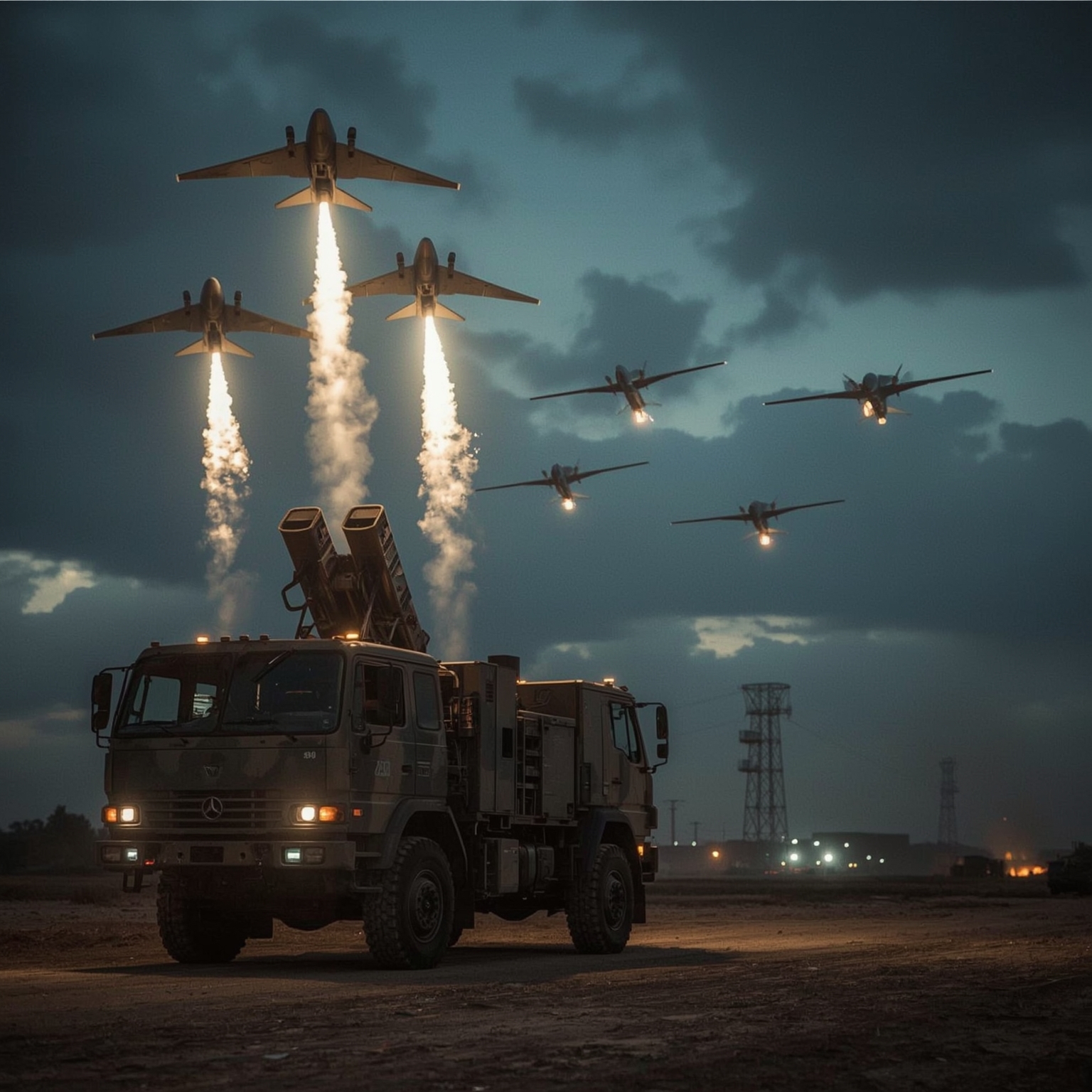
The People’s Liberation Army (PLA) has released a rare and revealing video segment showcasing an ASN-301 drone being launched from a sophisticated, truck-mounted multiple launch vehicle system. This short but telling piece of footage provides an uncommon look at one of China’s more advanced loitering munitions as it transitions from rest to active deployment — offering observers a momentary but insightful glimpse into the country’s evolving military drone capabilities. The recording, broadcast over the weekend by China Central Television (CCTV), was described by the state-run media network as part of a live-fire training session specifically conducted for the purpose of familiarizing newly recruited drone operators with real-time combat conditions and operational controls.
Within the video, which was subsequently reviewed by Business Insider, two imposing 6×6 military trucks can be seen positioned on a desolate, sandy battlefield landscape, most likely a desert training ground. Each vehicle carries an array of six cylindrical launch containers, hinting at an ability to sequentially or simultaneously deploy multiple drones from a single platform. The camera captures the moment one of these vehicles initiates a launch sequence: a delta-wing ASN-301 bursts from its launch tube, propelling itself rapidly upward with a sharp and steady trajectory, an image indicative of both the power of its propulsion system and the precision of its flight control mechanisms. Moments later, the footage cuts to a striking aerial sequence. The loitering munition, having acquired altitude, is then seen plunging downward in a controlled dive toward what appears to be a mock target area — specifically resembling a simulated airfield complete with a nearby shelter or hangar. A bright detonation follows, conclusively demonstrating the drone’s destructive potential. These clips spread swiftly across international social media, generating widespread interest and discussion within defense analysis circles.
Observers immediately noted that the ASN-301 bears a noteworthy visual and structural similarity to a number of well-known foreign drones. While its pronounced delta-shaped wings bring to mind the Iranian-designed Shahed-136, analysts agree that China’s model more directly mirrors Israel’s Harpy loitering munition. The resemblance extends beyond superficial design: both the ASN-301 and the Harpy are designed with the specialized capability to detect and engage targets by homing in on specific radio frequency emissions, particularly those emitted by enemy radar systems — an attribute that distinguishes them from general-purpose kamikaze drones such as the Shahed, which are built primarily for one-way explosive strikes without such electronic intelligence functions.
This technological connection may have roots in historical defense cooperation. During the 1990s, Beijing purchased approximately one hundred Harpy drones from Israel Aerospace Industries. The acquisition drew attention and subsequent concern from Washington, as U.S. defense officials feared the possibility that proprietary or sensitive Israeli technology might be transferred or reverse-engineered for Chinese use. Under U.S. pressure, Israel later ceased upgrades for the original Harpy units delivered to China. Nonetheless, over the following years, Chinese engineers appear to have developed their own derivative systems. The ASN-301, a clear evolution of that earlier platform, began making its public debut around 2017 during various Chinese defense trade shows. It was formally presented by China National Aero-Technology Import & Export Corporation (CATIC), a major exporter of Chinese military hardware. According to CATIC’s promotional materials, the eight-foot-long unmanned aircraft is capable of either remote piloting by human operators or fully autonomous mission execution, allowing it to perform reconnaissance or attack operations without direct input once deployed.
At the time of its introduction, CATIC detailed several of the drone’s technical parameters: the ASN-301 — also referred to domestically as the JSW-01 or by its evocative trade name, the Flying Dragon 300A — can sustain flight for approximately four hours while scanning a radius of about 15.5 miles for enemy radio emissions. Additional performance statistics suggest impressive endurance and range: it reportedly travels at maximum speeds reaching 136 miles per hour, weighs roughly 440 pounds, and can cover distances up to 170 miles. When these specifications are compared to regional geography, a sense of strategic significance emerges. The Taiwan Strait, dividing mainland China from Taiwan, measures around 110 miles across at its narrowest point, while Taiwan’s widest landmass spans about 90 miles. In theory, these figures mean that an ASN-301 launched from coastal mainland China could potentially reach the greater Taipei area without requiring midcourse assistance or refueling.
Although CCTV’s report made no mention of Taiwan directly, it did note that the exercise was carried out by a brigade belonging to the PLA’s Eastern Theater Command, the military jurisdiction tasked with operations facing Taiwan and the broader western Pacific region. The detail implies a deliberate training scenario emphasizing readiness for contingencies in that sensitive geographic zone. A similar promotional video was previously circulated by the China North Industries Corporation (Norinco), the major state-owned conglomerate responsible for manufacturing China’s armored vehicles and missile launchers. That earlier release — combining live-action and computer animation — featured the ASN-301 being deployed from another 6×6 truck-mounted launcher, confirming its adaptability to various mobile firing platforms. The November 2024 promotional footage further highlighted certain aerodynamic characteristics of the drone: a noticeable bulb-shaped nose section and a rear-mounted propeller, both consistent with previously published images and descriptive reports.
The global spotlight on this new demonstration also reflects broader international interest in delta-wing drone technology. Over the last several years, such drones have attracted intense attention, particularly following Russia’s widespread deployment of the Shahed-type drones—renamed locally as the Geran-2—throughout its campaign in Ukraine. These low-cost, expendable drones, adapted from Iran’s original designs, have become one of the central components of Moscow’s nighttime bombardment strategy. Russian forces frequently launch them in large swarms, numbering in the hundreds, in an effort to saturate and overwhelm Ukrainian air defenses. Military commentators and strategists have noted that this approach, though relatively inexpensive compared to traditional missile strikes, forces defenders to expend high-value interceptors and munitions against cheaper targets, creating a lopsided economic dynamic on the battlefield.
Looking ahead, Russia is also reported to be developing a faster, jet-powered version of the same concept — the so-called Geran-3, adapted from Iran’s Shahed-236. Russian military officials have publicly claimed that this iteration could achieve speeds approaching 500 miles per hour, a significant increase compared to the propeller-driven Geran-2’s top velocity of around 115 miles per hour. The potential mass production of such drones would amplify the threat they pose, enhancing both their ability to penetrate layered air defense networks and their psychological effect on targeted populations.
Ukraine’s countermeasures to this aerial onslaught have been correspondingly inventive. The country has assembled a layered defense system that blends conventional missile interceptors with rapid-response light arms fire and even small anti-air quadcopters, demonstrating the adaptive improvisation typical of protracted modern warfare. The confrontation between inexpensive drones and costly interceptor systems has consequently reshaped global military thinking. Nations around the world are re-evaluating how they organize their air defenses and effort allocations. Taiwan, observing these developments closely, announced plans during the summer to purchase around 100,000 unmanned aerial vehicles of various sizes, including tens of thousands of small quadcopters modeled on the systems that have proven effective in Ukraine. It is within this larger context of rapidly evolving drone warfare that China’s unveiling of the truck-launched ASN-301 must be understood — as both a demonstration of technological sophistication and a statement of intent within an increasingly drone-dominated future battlespace.
Sourse: https://www.businessinsider.com/china-rare-look-shahed-like-drone-asn-301-launcher-truck-2025-10


