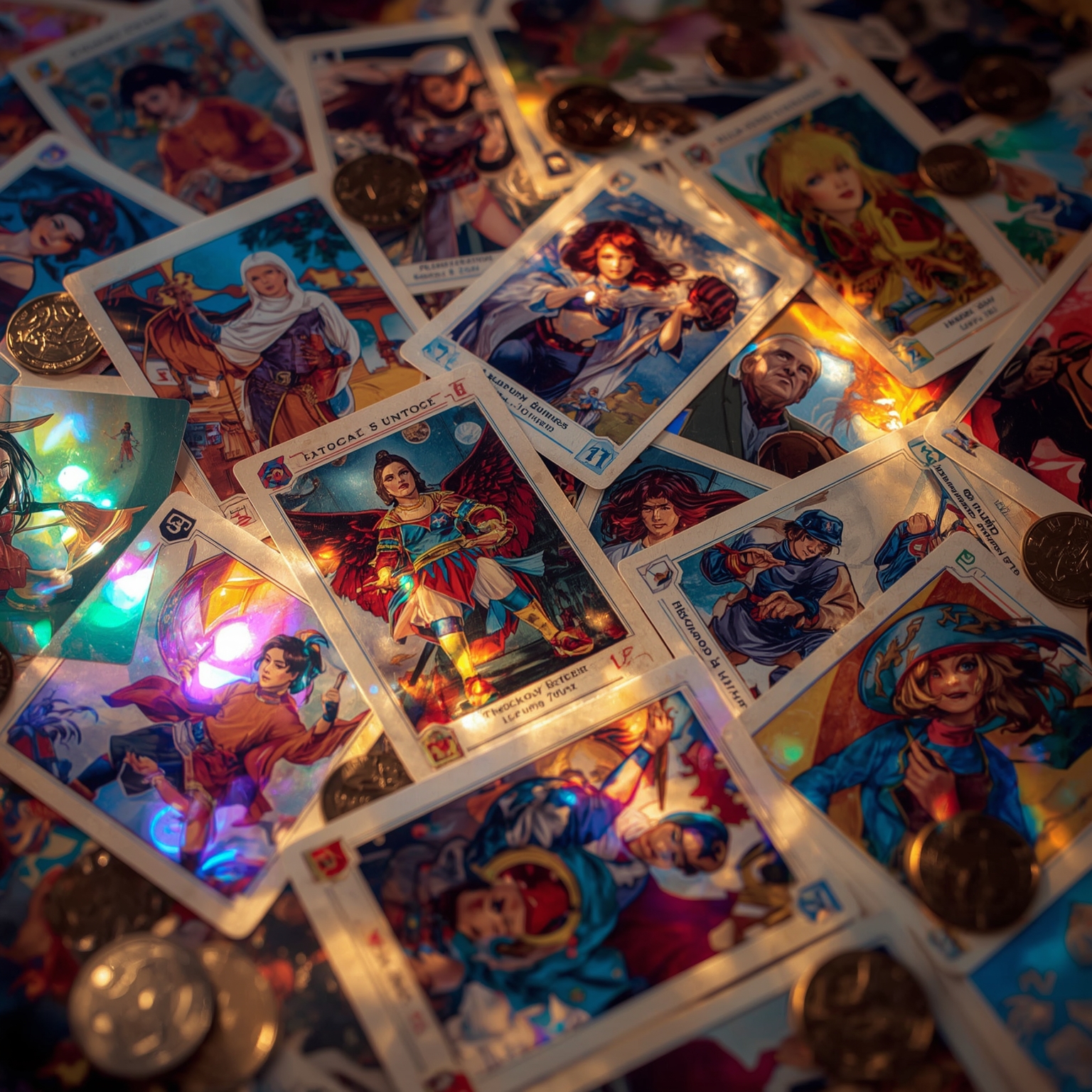
Although I am not a licensed financial advisor, my professional background as an attorney has placed me close enough to the world of finance and markets to recognize just how erratic, volatile, and unpredictable they can be. Over the years, I have observed that even the most carefully crafted strategies can be upended by fluctuations no one could have foreseen. So when I recently found myself with a modest surplus of disposable income, I began searching for an investment opportunity that would stand apart from the usual suspects. I wanted to allocate that extra cash into something distinctive, something that would satisfy not only my financial curiosity but also my desire to explore alternative forms of value. I had no interest in entrusting my funds to the roller coaster of the stock market, to the slow movements of government bonds, to the mercurial swings of cryptocurrency, or even to the seemingly safer—but often cumbersome—real estate sector.
After exhausting every conventional possibility, I decided to consult a rather unconventional source for guidance. In what began almost as a whim, I turned to artificial intelligence, curious to see if the same technology that has recently streamlined so many aspects of my life could also illuminate some new path for my money. Over the past year, AI tools have quietly crept into my daily routine, helping me plan international trips with uncanny efficiency, manage complex workloads with organized precision, and even refine my writing style in ways that feel both personal and mechanical. So I wondered: if AI can assist in crafting eloquent sentences and optimizing itineraries, could it also offer insight into investing?
With that question in mind, I opened ChatGPT and presented it with a direct yet imaginative prompt: “Tell me something creative to invest in—something most people wouldn’t think of.” Immediately, the program produced its obligatory disclaimer, warning me in calm, neutral language that none of what followed should be construed as financial advice. Then, after a brief digital pause—as if the algorithm were taking a contemplative breath—it confidently proposed an idea I could never have predicted: to purchase trading cards, and more specifically, to invest in Pokémon cards.
My initial reaction was a mix of disbelief and laughter. It sounded absurd, almost as though the machine had been trained on the collective dreams of nostalgic millennials. The suggestion seemed like the setup to an online joke: “AI offers the investment advice of a ten-year-old.” Yet, as I continued to engage with the chatbot and pressed for elaboration, my amusement slowly gave way to genuine intrigue. The explanation it provided was remarkably detailed. ChatGPT cited economic and cultural factors such as scarcity, emotional value, cross-generational nostalgia, and even the enduring stability of the Pokémon intellectual property. It referenced data indicating that certain cards had historically performed as strongly as major stock indexes like the S&P 500. All of this, taken together, transformed what had initially seemed ridiculous into a curious hybrid of play and portfolio management—a whimsical hedge fund made entirely of cardboard, imagination, and childhood longing.
Fascinated, I began to explore the thriving and surprisingly intricate ecosystem of Pokémon card trading. What I discovered was far from the simplistic hobby I remembered from my childhood. The market is meticulously organized around rarity, edition, and condition. Within its structure exist layers of nuance—first-edition base sets from the late 1990s, rare Japanese exclusives, and elusive holographic “shadowless” variants that only seasoned collectors can accurately distinguish from their reissued counterparts. The community operates with an attention to precision that rivals any professional trading floor: a single imperfection—a tiny scratch on the foil or a millimeter of off-centering—can cut a card’s value by half.
Professional grading firms such as PSA, Beckett, and CGC have institutionalized this process, inspecting every detail with almost forensic rigor and assigning a score from 1 to 10. Cards that achieve the coveted “Gem Mint 10” certification routinely sell for thousands or even tens of thousands of dollars. Interestingly, the phenomenon extends to brand-new releases as well. Freshly printed cards are almost immediately graded, listed for sale, and traded in frenetic cycles that resemble a miniature version of day trading—but fueled by sentimental energy rather than corporate earnings. Even unopened booster packs or sealed starter decks have evolved into their own speculative instruments, treated as sealed potential whose mystery alone accrues value. As availability narrows, prices climb, and collectors hoard these sealed boxes the way investors pursue undervalued assets.
Online analytic platforms now chart these prices with the sophistication of stock software. Graphs plot the rising market trajectory of iconic cards—like Charizard—as though they were high-tech equities such as Apple. Immersing myself in these charts, I began to realize how closely the psychological patterns of collecting mirrored those that drive traditional investing. It felt increasingly less like a casual rediscovery of childhood and more like a fully functioning nostalgic micro-economy.
Encouraged but cautious, I decided to test the theory in a modest way. If I were going to follow ChatGPT’s advice, I wanted to do so at a level that minimized my exposure to risk. My first instinct was to see whether I already possessed some forgotten assets. I called my mother back home in Mexico and asked whether, by chance, the shoebox of Pokémon cards I used to keep under my childhood bed had survived all these years. She searched the room and, to my astonishment, discovered it still intact—dusty but sealed shut with yellowed tape. She sent me photographs, revealing a small trove of bent corners and faded edges. Most of the cards had seen better days, but one item immediately captured my attention: an Eon Ticket, a promotional card linked to the Ruby & Sapphire generation of the early 2000s, which dedicated collectors still trade for meaningful sums. I cleaned it carefully and listed it on eBay for $300, not really expecting a windfall but eager to see if nostalgia could, in fact, be monetized.
Next, I turned to local stores in London to purchase new cards, hoping to continue my modest experiment. What I assumed would be simple—a matter of walking into any toy or gaming store—proved unexpectedly difficult. Shelves that once overflowed with packs were either empty or stocked only with common, modern sets. After checking several locations, I eventually managed to acquire two sealed starter decks. Rather than open them, I decided to keep them intact, treating them as a test case to observe whether time alone might increase their value, exactly as the AI had posited.
During this process, and after a period of reflection, I realized something subtle yet profound. The AI’s suggestion was not, as I had initially thought, naïve. It was perceptive in a distinctly human way. ChatGPT had not uncovered a secret algorithm for outsmarting financial markets; it had simply mirrored our collective behavior—our innate attraction to nostalgia, our love for collecting, and our strange comfort in possessing tangible fragments of the past. AI may lack emotional intuition, but it understands patterns: it recognizes how stories, memories, and feelings influence economic decisions just as much as data or balance sheets do. What I had interpreted as randomness was, in fact, a reflection of ourselves.
The algorithm probably did not recommend Pokémon cards because it foresaw them as the next Bitcoin or because it had any predictive insight into future valuations. Instead, it did so because these cards encapsulate a universal investment principle—the same force that underpins every market from gold to crypto to real estate: belief. Markets, in essence, are built upon collective conviction. The AI merely reminded me of that fundamental truth through a medium wrapped in nostalgia.
So, while I cannot tell others to rush out and buy Pokémon cards—unless, of course, they happen to find an old Eon Ticket hidden away in an attic—I can say that this small experiment taught me more about value than I expected. Sometimes, the cleverest machine in the room brings us full circle, leading us back not to a futuristic opportunity but to a simple and enduring realization: that behind every investment, speculation, or financial system lies something profoundly human—our stories, our memories, and our willingness to believe.
Sourse: https://www.businessinsider.com/why-i-chose-pokemon-cards-over-stocks-investment-2025-10


