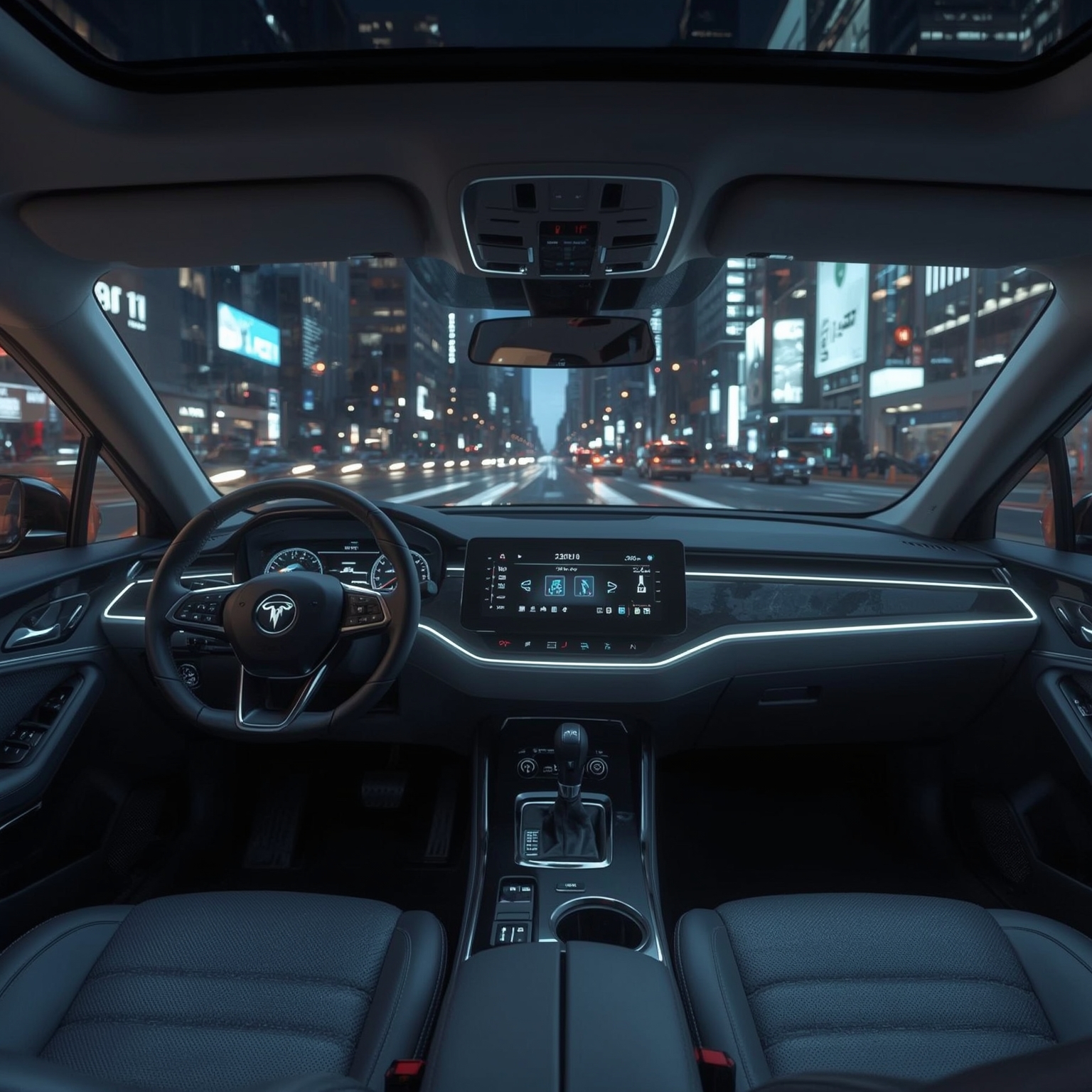
Tesla’s much-anticipated Cybercab, the company’s bold foray into the next phase of autonomous transportation, is not projected to reach mass production until 2026. Yet, even before its assembly lines begin operating, the futuristic vehicle seems likely to inherit a characteristic emblem of traditional driving—a steering wheel. Though such a feature belongs to an era that the automobile industry is rapidly striving to transcend, it may still find itself embedded within a machine meant to symbolize the very opposite: complete autonomy.
Admittedly, steering wheels remain ubiquitous in the cars we navigate today. Their circular forms continue to serve as extensions of human control, connecting driver and road. However, Tesla originally envisioned the Cybercab as a radical step forward—a purpose-built autonomous vehicle designed from inception to function without human intervention. From this perspective, retaining a steering wheel feels incongruous, almost like leaving a vestigial tail on a creature evolved to live in an entirely new environment.
This credibility gap came to light when Robyn Denholm, Tesla’s chair of the board, inadvertently revealed in a Bloomberg interview that the Cybercab might, despite its self-driving credentials, need to incorporate the very device it was meant to render obsolete. Regulatory bodies, Denholm explained, remain reluctant to approve vehicles entirely devoid of manual controls. Federal crash safety regulations, crafted for human-operated vehicles, still assume that drivers need access to steering and braking mechanisms. To sell cars outside these requirements, automakers must request specific exemptions, a bureaucratic process marked by delay, uncertainty, and strict limitations. “If we have to have a steering wheel, it can have a steering wheel and pedals,” Denholm conceded, gesturing toward Tesla’s willingness to compromise in exchange for getting the car on the market.
The Cybercab’s unveiling in Hollywood last year underscored Tesla’s ambitions to redefine mobility. Elon Musk presented it as a sleek, elegantly simple two-seater—more an intelligent node in a vast digital ecosystem than a mere automobile. The absence of a steering wheel during its reveal was itself symbolic, signaling Tesla’s confidence in its autonomous technology and its conviction that a new era of vehicular design had truly begun. This car, Musk emphasized, was not one that would oscillate between driver control and automation—it would be built exclusively for full autonomy. No pedals, no wheel, no fallback to human command. Yet such purity of vision, while intellectually compelling, embodies serious commercial and logistical risks.
Regulatory precedent has shown that vehicles lacking traditional controls face daunting approval challenges. General Motors’ experience with the Cruise Origin serves as a cautionary tale. GM sought federal exemptions for its steering-wheel-free, pedal-less shuttle, hoping to pioneer a fleet of shared autonomous pods. Instead, the project stalled under regulatory review for years, tangled in safety concerns and public skepticism. The prolonged delay eventually led to the Origin’s quiet shelving and contributed to the dissolution of GM’s entire Cruise unit following a series of safety incidents. For Tesla, encountering a similar fate would jeopardize its strategic aim to dominate the intersection of artificial intelligence, robotics, and mobility.
Even if Tesla were to obtain the necessary regulatory exemption, existing federal rules would limit the company to producing only 2,500 units per year under such conditions. This threshold—minuscule by automotive industry standards—would severely restrict Tesla’s ability to scale the Cybercab into a commercially viable enterprise, let alone the cornerstone of a new autonomous taxi platform. Thus, the inclusion of a steering wheel may represent less a step backward in innovation than a pragmatic concession to legislative inertia.
Officials at the U.S. Department of Transportation, under Secretary Sean Duffy, have expressed intentions to streamline the exemption process to accelerate the deployment of fully autonomous vehicles. However, Duffy’s department cannot unilaterally raise the production cap on exempted models; doing so requires congressional approval. Unfortunately, legislative gridlock in Washington, combined with lawmakers’ chronic inability to pass major transportation reform, makes such progress improbable in the near term. The irony is palpable: while technology races ahead, policy trudges behind, leaving innovators to navigate the friction between imagination and law.
Adding to these obstacles is an emerging interpersonal rift between Musk and Duffy. Earlier this year, the two appeared aligned during Duffy’s visit to Tesla’s sprawling Austin headquarters, expressing mutual enthusiasm for advancing U.S. leadership in both electric and autonomous vehicles. But the dynamic has since soured. Following Duffy’s appointment as interim administrator at NASA, disagreements reportedly arose surrounding a SpaceX contract, straining professional ties between the two high-profile figures. This clash of egos underscores how grand technological initiatives can hinge precariously on the temperaments of a handful of powerful, and at times thin-skinned, men.
In the end, Tesla’s Cybercab stands as a microcosm of our current technological moment—caught between a visionary drive toward automation and the gravitational pull of convention. Whether the car ultimately rolls off the production line equipped with a steering wheel or not, its journey illuminates the complex dance between invention, regulation, and human pride that defines the evolving story of mobility.
Sourse: https://www.theverge.com/news/809056/tesla-cybercab-steering-wheel-denholm


