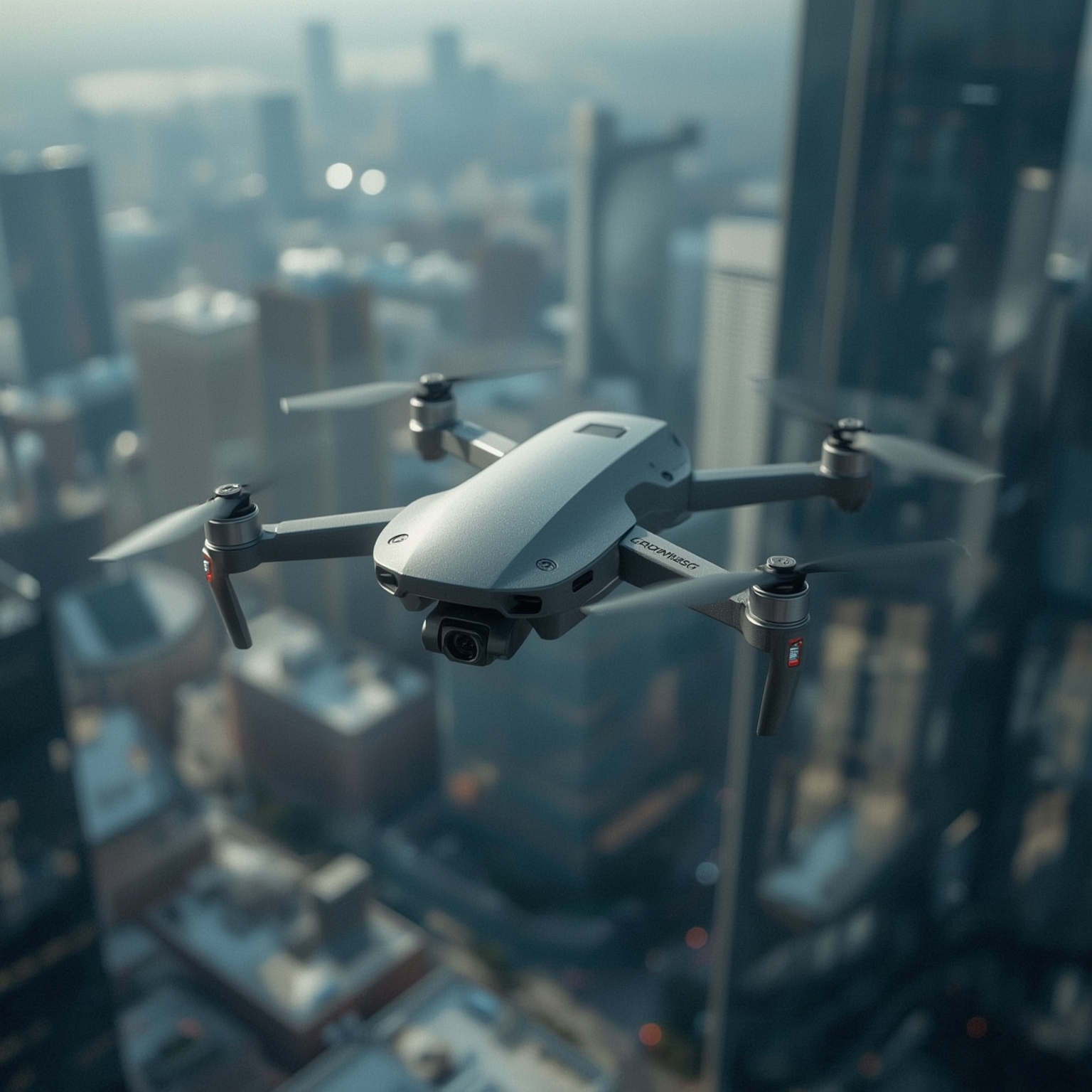
DJI has officially unveiled the Neo 2, a significantly refined successor to its Neo selfie drone, which first appeared on the market in September of last year at an accessible price of $199. While the original Neo was designed to appeal to a wide audience through affordability and simplicity, it did not include some of the advanced capabilities that many enthusiasts had hoped for. The new Neo 2 directly addresses those limitations by introducing intelligent gesture-based controls and a robust active obstacle avoidance system—transformations that represent a substantial leap in the drone’s usability and overall autonomy. Instead of relying merely on a crash-resistant design that could withstand minor collisions, the Neo 2 proactively prevents them, thus offering pilots a far more secure and reliable flying experience.
Physically, the DJI Neo 2 has grown slightly larger, reflecting both the addition of new hardware and the demands of improved performance. Its total weight has increased by sixteen grams, reaching 151 grams overall. However, this modest increment is far from a disadvantage; rather, it is a rational tradeoff in exchange for the inclusion of a more powerful battery and a sophisticated set of integrated sensors. These sensors form the core of the Neo 2’s obstacle detection and avoidance system: forward-facing LIDAR is used to map the environment ahead, while downward-pointing infrared sensors monitor the ground beneath. Working together, these instruments give the drone the ability to sense its surroundings with heightened precision, maintaining a stable trajectory whether it is moving forward or sideways in its smart follow modes. The propellers remain fully encased within sturdy protective guards, just as they were in the initial design, offering peace of mind for novice pilots while expanding the range of environments in which the drone can operate safely.
In terms of speed and responsiveness, DJI has made notable progress. The Neo 2 is capable of pursuing a subject at a remarkable 12 meters per second, translating to nearly 27 miles per hour—an impressive improvement over the first Neo’s top following speed. Even after the earlier model received a firmware enhancement last November that pushed its maximum speed to about 18 miles per hour, the new unit’s performance still marks a significant jump. In addition, the Neo 2 has been engineered to perform more reliably in less-than-ideal weather. During testing, the original drone frequently struggled to maintain position when exposed to mild gusts, sometimes drifting unpredictably. This issue has been largely mitigated in the updated model. DJI states that the Neo 2 can now hold a stable hover in winds approaching 24 miles per hour, meaning that photographers and videographers can trust it to deliver consistent results even in breezier outdoor conditions.
The fundamental concept behind the Neo series remains unchanged: to allow users to capture cinematic-quality aerial footage without requiring advanced piloting skills. The Neo 2 continues to support DJI’s RC-N3 controller, its intuitive motion controller, and the immersive Goggles N3 headset. However, gesture controls—one of the most user-friendly upgrades—now make interaction with the device more natural and immediate. By simply moving their hands in specific ways, users can command the drone to reposition itself, adjust its distance, or shift its angle while hovering nearby. DJI has also replaced the LED indicator-based interface of the original Neo with a small built-in display, which clearly communicates the drone’s current mode, thus reducing confusion and improving the overall user experience.
Another tangible improvement lies in flight endurance and onboard storage. Equipped with a larger 1,606mAh rechargeable battery, the Neo 2 extends its flight duration to as long as nineteen minutes—providing several extra minutes of operation compared to its predecessor. Internal memory has been expanded substantially, from 22GB to 49GB, allowing users to record longer sessions of high-quality footage without dependence on external storage options. At the heart of the imaging system, the half-inch sensor remains the same, yet the new dual-axis gimbal ensures noticeably greater stability and smoother motion capture. Furthermore, the upgraded camera delivers a wider field of view and supports recording in stunning 4K resolution at up to 60 frames per second. When operated manually, it can even achieve 100 frames per second, providing ample flexibility for both cinematic sequences and dynamic action shots.
Altogether, these refinements make the DJI Neo 2 a compelling proposition in its category, positioning it as an attractive and more affordable alternative to competing drones like HoverAir’s X1 entry-level model. Its combination of enhanced safety, extended battery life, and high-definition imaging invites comparison with professional devices costing considerably more. However, similar to DJI’s recently announced Osmo Mobile 8 smartphone gimbal, the Neo 2’s initial release is limited exclusively to the Chinese market. Prices for the standalone model start at 1,499 Chinese Yuan—approximately $211—representing a small increase of around $28 compared to the first version. Beyond the base edition, DJI is offering multiple bundles designed for different user needs: one option includes additional batteries and a multi-charger for 1,999 Yuan (roughly $282), while the premium package combines the drone with its motion control joystick and Goggles N3 headset for 3,699 Yuan (around $521). Through these options, DJI continues to enhance accessibility for a broad range of consumers, from casual content creators to enthusiastic hobbyists, reaffirming its leadership in user-focused drone innovation.
Sourse: https://www.theverge.com/news/810125/dji-neo-2-selfie-drone-gestures-lidar-obstacle-avoidance-gesture-control


