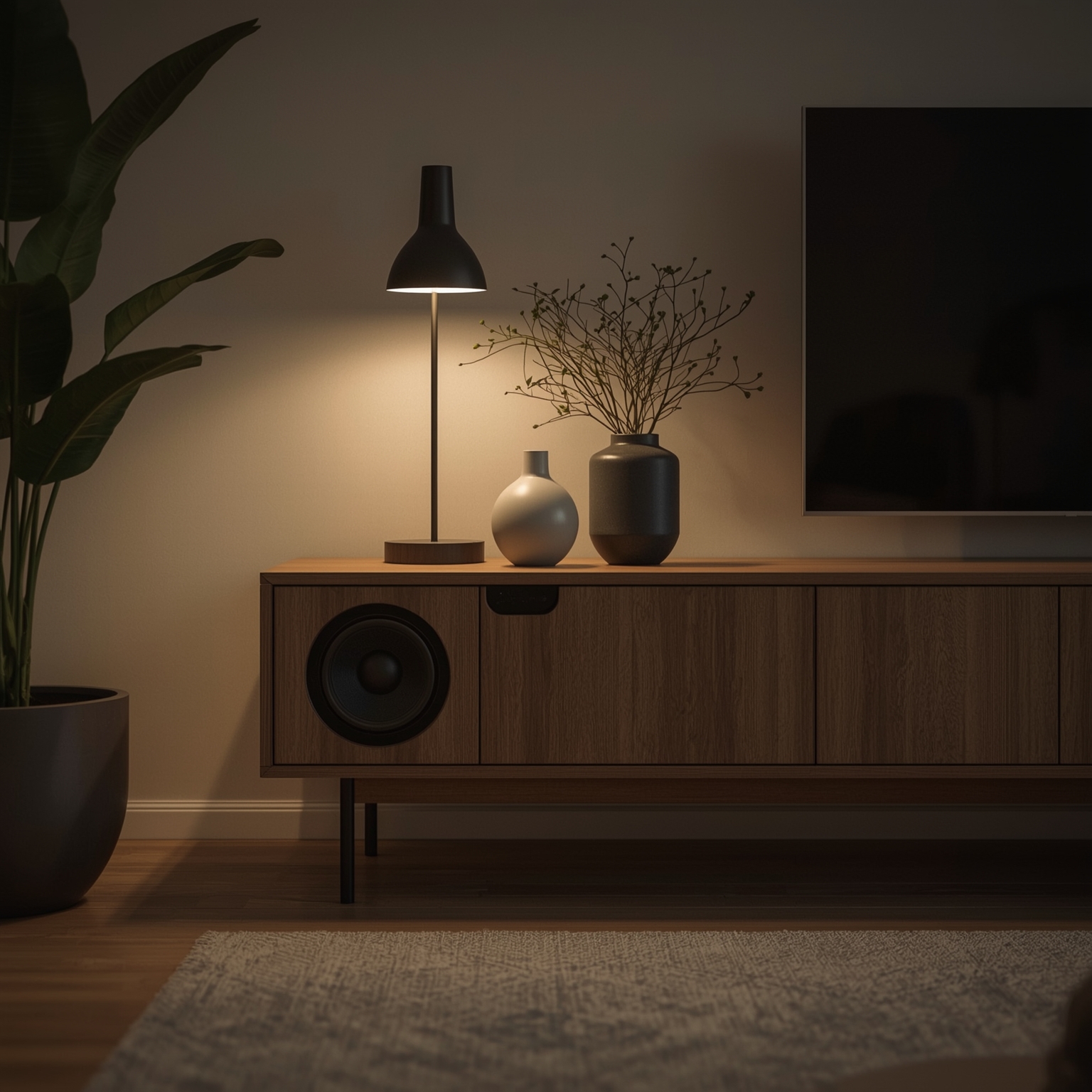
Embedding modern gadgets into pieces of everyday furniture is, strictly speaking, far from a necessity—but it is undeniably entertaining. There’s a whimsical pleasure in imagining your ordinary household items gaining unexpected superpowers. Perhaps that’s why companies like Ikea have ventured into delightfully hybrid creations such as speaker lamps and air-purifying side tables. The concept taps into our shared fascination with seamless convenience and clever design. Yet, the joy of merging technology with home decor often dissolves once you confront the practical complications of such integrations. Combining a tech device with a piece of furniture requires negotiating a fragile equilibrium between aesthetics, utility, and ergonomics. How does one design an end table that not only purifies the air in a small apartment but also functions gracefully as an elegant stand for a glass of juice? The task is both humorous and self-imposed, but when executed correctly, it can generate surprisingly satisfying results. When it fails, however, the outcome can feel awkward, if not downright counterproductive.
This brings us to the DecorTech Round Bluetooth Speaker End Table—a product whose name reveals almost everything you need to know about it. It’s an end table that also serves as a Bluetooth speaker, oriented toward those who desire multi-functionality at home. Unfortunately, the existence of such an object raises a philosophical question: should speaker end tables even exist? On paper, it boasts several enticing features, including wireless charging capability and a built-in FM radio, all neatly housed within its circular form. Yet, when we look beyond the novelty, the concept starts to unravel.
My own encounter with the DecorTech Bluetooth Speaker End Table was born of curiosity more than necessity. The design doesn’t attempt to imitate high-end Scandinavian craftsmanship, yet it remains neutral enough to blend into most living rooms without clashing. Seen in isolation, it could easily be mistaken for an electronic drum or a peculiar minimalist stool, but once placed beside a sofa, the design begins to make sense, at least visually. The illusion of ordinary furniture, however, ends abruptly the moment your eyes drift to the tabletop. There lies a black control panel scattered with functional buttons—power, FM scan, play/pause, and separate keys for volume adjustments—elements conspicuously absent from traditional tables.
To its credit, the presence of these tactile controls delivers a small thrill. Though redundant in an age when everyone remotely adjusts audio via their smartphones, having manual buttons feels unexpectedly satisfying. The inclusion of a built-in radio adds a nostalgic flourish. For those, like me, who secretly cherish the ritual of tuning across airwaves, the physical radio function evokes a charm that streaming apps cannot replicate, even if digital alternatives are technically more efficient. Somehow, in the hierarchy of arbitrarily acceptable devices to house a radio, a Bluetooth table fits right in.
Still, innovation often drags a few inelegant details behind it. The DecorTech table’s FM antenna is a case in point: a conspicuously long cable trailing down its back, demanding attention in the least gracious way possible. One can position it for optimal signal reception, but this introduces dilemmas of placement—should it be taped to the wall, hidden beneath a rug, or awkwardly looped by a windowpane? No matter the solution, the hanging cable undermines what little visual harmony the furniture manages to maintain.
Another unexpected addition is a wireless charging pad at the table’s center, marked with a functional symbol to indicate its purpose. While the charging process is slow—just 10W—it does offer notable convenience for those of us glued to our devices. Simply placing your phone atop the table initiates a charge, eliminating the clutter of cords. For traditionalists, a built-in USB-A port is available as well, although, frustratingly, there’s no USB-C option, a curious omission in 2024.
Yet, none of these aspects are as fundamental to the product’s identity as the Bluetooth speaker itself, its titular feature. In terms of audio quality, the DecorTech table produces sound that is much better than one might anticipate from a $115 multifunctional item purchased from a major retailer. Its internal 6.5-inch subwoofer and 2-inch speaker generate respectable output, particularly for instrumental and ambient music streamed from platforms like Spotify. Genres emphasizing vocal clarity, however, can sound somewhat uneven—mid-tones occasionally drown out the balance between treble and bass. Nevertheless, as a secondary or casual listening device, this compact hybrid performs serviceably, even if it falls well short of dedicated audio brands like Bose or Sonos.
Herein lies a fundamental issue: placement. Speakers, by their very nature, rely heavily on position and orientation, as audio experience is inseparably spatial. Standard sound systems are designed to project forward, enveloping the listener from an intentionally curated direction. But an end table, as its name suggests, sits at the periphery—usually beside a couch. So, when the sound emanates from your seating flank rather than directly ahead, clarity suffers. Having tested the table in both conventional and experimental setups, I can attest that the difference in acoustic precision is immediately perceptible. Shifting the table to face directly forward does help, but then you create another issue: your end table no longer looks or functions like one. Its cable becomes an eyesore, and its proportions, intended to align with sofa arms, appear mismatched with its new role.
Ultimately, this spatial constraint exposes a deeper flaw in the entire premise. The defining purpose of an end table is to serve as a practical side surface—a place for a lamp, a drink, or a phone—not to project stereo sound. Forcing it into an audio role undermines both identities, resulting in a piece that serves neither function optimally. It’s a creative execution of a fundamentally flawed idea: a compelling experiment that nonetheless demonstrates one of design’s most crucial lessons—that novelty should never supersede purpose.
This is not to disparage the broader movement of tech-integrated furniture, which, at its best, embodies innovation, practicality, and aesthetic unity. Companies like Ikea have proven that functional hybrids can indeed thrive when properly conceived—a speaker lamp or an air-purifying coffee table fulfills two roles that harmonize rather than compete. But the DecorTech Bluetooth Speaker End Table crosses an invisible threshold where creative synthesis becomes conceptual overreach. The result is a novelty that, while well-built and occasionally delightful, reminds us that good design depends not on how many features can be packed into one object, but on whether those features belong together at all.
Sourse: https://gizmodo.com/putting-a-bluetooth-speaker-in-an-end-table-is-a-bad-idea-actually-2000678796


