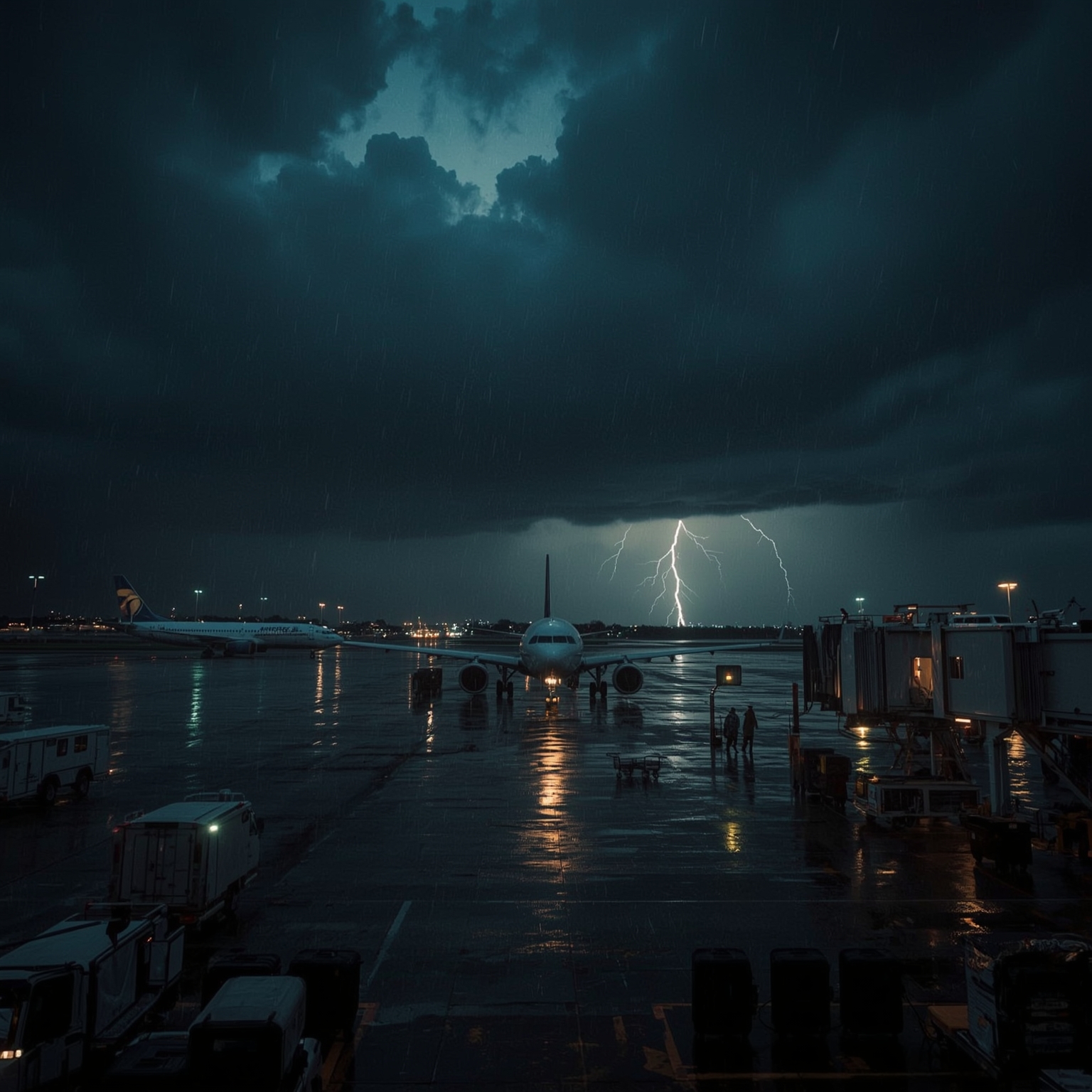
What began as an ordinary Thursday flight from New York’s LaGuardia Airport to Detroit slowly evolved into an unusual scene of conflicting wishes and quiet tension. Aboard Delta Flight 1122, the atmosphere resembled a subdued but palpable cheering match: half of the passengers silently advocating for takeoff into the stormy skies, while the other half longed for the aircraft to retreat to the terminal and bring the ordeal to an end.
Initially, everything seemed routine. The flight, officially marked as “on time” when boarding began around 12:15 p.m., gave passengers every reason to expect a prompt departure. Yet nature soon reminded everyone that air travel ultimately bends to weather’s will. As torrential rain lashed the tarmac and powerful gusts shook the aircraft, the plane inched across the labyrinth of taxiways in a slow, uncertain procession that lasted nearly three exasperating hours.
Among those onboard was Business Insider’s editor-in-chief, Jamie Heller, who would later describe the experience as resembling a “sports showdown,” a contest not of teams but of perspectives. On one side were passengers, like herself, who viewed returning to the gate as the more rational and even comforting choice; on the other, travelers desperate to complete the trip, no matter how much patience or delay it demanded.
For Heller, the decision to turn back held pragmatic relief. “Never will I be happier to be at LaGuardia than when I deboard this aircraft,” she wrote afterward, capturing the fatigue of a long day spent in motionless anticipation. Her connecting flight from Detroit had already departed, meaning that any onward travel would have forced her to spend an unplanned night in a hotel before attempting to return home the next day. Under those circumstances, remaining grounded in New York—despite the inconvenience—was the better outcome.
Not far from her seat, however, another passenger harbored a very different hope. Frank Granati, a resident of eastern Long Island, longed not for a return to the terminal but for a delayed yet completed journey. The purpose of his trip was heartfelt: he was eager to spend Halloween with his young granddaughter, whom he affectionately described as “three and a half going on thirty.” When uncertainty clouded the flight’s fate, Granati wistfully admitted, “I knew I shouldn’t have texted her and said pappa bear is coming.” His words captured the emotional weight of travel plans built around moments that cannot easily be postponed.
Ultimately, fate offered a compromise of sorts. Passengers were given the option either to deplane and end their journey early or to remain aboard in the hope of eventual departure. The aircraft did, in fact, take off later in the afternoon—several hours behind schedule—and was expected to reach Detroit over five hours late. Both travelers, in a sense, received their wish: Heller could return to solid ground, while Granati was granted a delayed but real chance to reunite with his granddaughter.
The situation was just one chapter in a much larger story of weather-induced chaos that day. Data from FlightAware showed that by early evening—around 7 p.m. local time—LaGuardia Airport had recorded more than 200 cancellations, representing over one-third of its scheduled flights, along with roughly 223 significant delays. Across the entire New York area, including the major hubs of JFK and Newark, nearly 400 cancellations painted a portrait of regional aviation turmoil.
Delta’s decision to bring aircraft back to the gate was not arbitrary. Federal regulations mandate that any commercial airline must provide passengers the option to deplane if a plane is held on the tarmac for three hours without taking off—both for safety and humanitarian reasons. Airlines nearly always adhere strictly to this rule, though exceptional circumstances occasionally arise. A notable example occurred in 2023, when a Delta aircraft, diverted to Savannah because of severe weather, remained grounded for over six hours simply because customs personnel were unavailable to permit passengers to exit.
Beyond New York, the ripple effects extended throughout the air system. Orlando International Airport, for instance, experienced some 200 disruptions, partly attributed to staffing issues that the FAA connected to the ongoing government shutdown. Many air traffic controllers, working under challenging circumstances without pay, had begun calling out, leaving key facilities understaffed and exacerbating operational bottlenecks.
Acknowledging the extensive disruptions, a Delta spokesperson issued a formal apology, assuring customers that anyone whose flight was canceled would be eligible for a full refund if they chose not to rebook. Passengers were automatically placed on the next suitable itinerary, and some, such as Heller, were offered the option between travel credit or reimbursement.
Such scenes, while deeply frustrating, are by no means rare in the broader landscape of U.S. aviation. Weather remains the single largest factor driving air traffic delays. According to Federal Aviation Administration data, meteorological disturbances—including thunderstorms, hurricanes, snow, and ice—account for nearly three-quarters of nationwide flight slowdowns each year. The Northeast corridor, one of the most congested airspaces in the world, is particularly vulnerable to such interruptions.
The aviation industry’s cautious approach is grounded in decades of tragedy-tinged lessons. Taking off into unsafe conditions can lead to catastrophic results, as evidenced by multiple historical accidents. Among these were the 1977 crash of a Southern Airways jet that entered a severe thunderstorm and the 1981 disaster involving a Dutch airliner that inadvertently flew into a tornado. Even further back, in 1968, a jetliner succumbed to structural failure when turbulence from an avoidable squall line overwhelmed the aircraft. Investigators eventually concluded that the plane had lifted off in clearly hazardous weather conditions—an error that the modern system is designed to prevent at all costs.
The storm that engulfed the Northeast on Thursday carried echoes of those historical warnings. Sheets of driving rain and unrelenting winds swept through the region, prompting the National Weather Service to issue flash flood warnings for New York City. The resulting disruptions, as inconvenient as they were, reflected not a breakdown of the system but rather the system functioning precisely as it should—prioritizing safety over speed.
Today’s pilots, dispatchers, and air traffic controllers are trained to default toward caution, fully aware that frustration on the ground is infinitely preferable to danger in the air. As a result, the sight of passengers waiting for hours on a stationary aircraft, though disheartening, ultimately demonstrates a culture of safety learned through hard experience.
For Heller, the saga did not conclude even after stepping off the aircraft. Her subway ride home was delayed as well, a final ironic twist to a day when both land and sky seemed united in obstruction. Yet in its own way, her experience mirrored that of countless travelers navigating America’s complex, weather-dependent transportation network: a reminder that patience, though often tested, remains the traveler’s most essential companion.
Sourse: https://www.businessinsider.com/severe-weather-causes-hundreds-of-flight-cancellations-across-east-coast-2025-10


