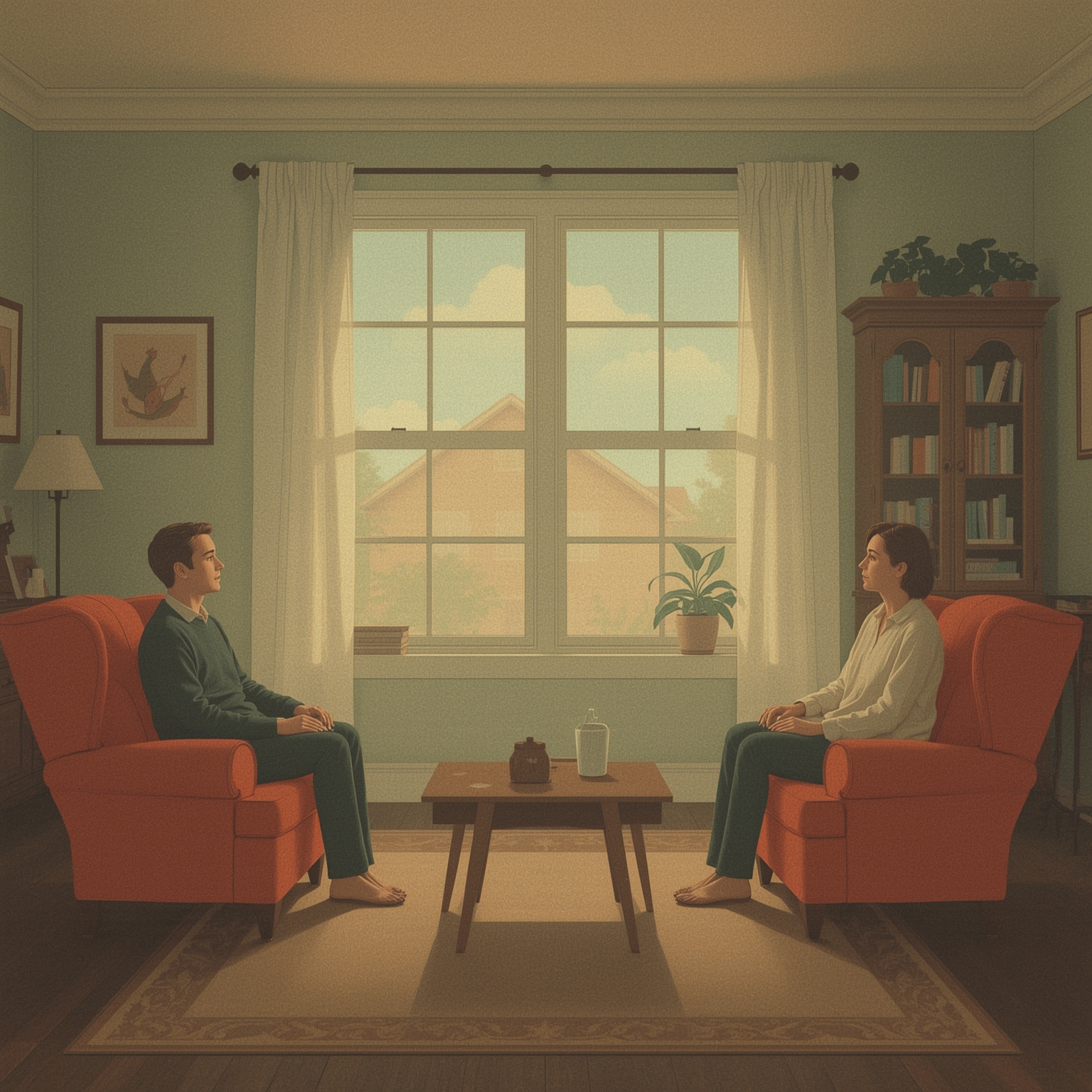
When my mother reached the age of seventy-six and I was fifty-two, she began to reassess the practical and emotional weight of maintaining her own home. Having spent decades navigating the endless cycle of lawn care, household repairs, and the quiet solitude of an aging neighborhood, she finally decided that it was time to release herself from the unrelenting obligations that come with homeownership. With that resolution, she prepared to leave behind her tightly woven Florida community—where familiar faces greeted her daily—and embark on a new adventure: relocating northward to live with me in the quiet, forested hills of upstate New York.
For thirty-five years, we had lived our lives 1,500 miles apart, bridged only by phone calls, holiday visits, and affectionate letters. In our minds, the idea of living together again felt idyllic, almost romantic. We had been so confident—perhaps foolishly—that the same easy affection we shared when I was a child and she visited me as an adult would translate seamlessly into cohabitation. Surely, we thought, the bond that had always brought laughter, shared meals, and inside jokes would blossom into domestic harmony. What we failed to recognize was how profoundly time and separate experiences can reshape two people who once knew each other so completely.
When my mother first arrived, I was overflowing with anticipation. The thought of reclaiming lost years felt exhilarating. I envisioned us spending leisurely afternoons reacquainting ourselves with each other’s stories, reminiscing about my childhood, and forging new memories to weave into the fabric of our relationship. Those first days were filled with warmth, lively conversation, and the pleasant rediscovery of shared history. Yet as the weeks gradually passed, reality tempered our enthusiasm. We began to discover with increasing clarity that the people we had become—she at seventy-six and I at fifty-two—were no longer the mother and daughter who had once shared a home when she was a youthful forty-one and I a restless seventeen.
Our dream of an effortless reunion began to dissolve when ordinary domestic routines exposed fissures we hadn’t realized were there. Take, for instance, the kitchen—once the heart of our relationship, now an arena for tension. I have long embraced vegetarianism, while my mother has remained a devoted omnivore who finds joy in preparing elaborate meals involving meat and fish. It led to some uncomfortable moments: moments when she stood happily at the counter, seasoning a roast, while I hovered at the periphery, clutching my disinfectant spray and cringing at the imagined threat of bacterial contamination. My anxious admonitions of “Don’t contaminate the faucet!” punctuated her attempts at culinary bliss, while her signature eye-rolls made it abundantly clear that I was trampling on her joy. Her kitchen, once her domain of comfort and mastery, had suddenly become a contested space that neither of us could fully claim without irritation.
Our differences extended beyond culinary choices. Whenever I tried to offer my mother suggestions about easing her day-to-day life—tools, shortcuts, or organization methods that I thought might help—she bristled. My well-intentioned advice, meant as gestures of care, landed instead as unwanted interference. Despite my desire to be the attentive daughter, she reminded me—sometimes with little more than a raised eyebrow—that she neither needed nor desired to be managed. She had spent six decades navigating her life independently and remained remarkably sharp, fiercely autonomous, and blessed with the same rebellious spark that had characterized her since my childhood. As I like to joke, she’s a grandmother with outlaw energy—self-sufficient, defiant, and unwilling to yield her freedom to anyone, including her adult child.
Even our biological rhythms seemed at odds: I am a lifelong night owl, my creativity and focus peaking long after midnight, rarely succumbing to sleep before one in the morning. My mother, in contrast, greets the dawn hours with vigor, often beginning her day before the first light has crept through the curtains. This mismatch required careful negotiation. I would tread softly through the silent hours, tiptoeing to avoid the sound of creaking floorboards, while she enclosed herself in her bedroom during the early morning so as not to disturb me. When I would finally stir at eight o’clock, groggy but content, she would sigh in mock amazement, joking that she couldn’t believe she had raised such a leisurely, time-squandering daughter.
Our temperaments diverged in much broader ways as well. My mother, having lived for decades in the same sunny Florida neighborhood, thrives on social connection. She has always been the kind of person who collects friends as naturally as one gathers seashells on the shore—talkative, magnetic, quick to laughter. In her community, neighbors looked after one another’s pets, shared homemade casseroles, and filled the air with the sounds of children playing and distant music drifting across lawns. She loved that bustle, that sense of being part of a living network.
I, by contrast, am most at peace in solitude. My home in the forests of upstate New York offers exactly what I seek: space, quiet, and invisibility. I purchased my property precisely because of its isolation, where thick trees form a tranquil barrier between me and the outside world. I can walk my dogs at dawn in flannel pajama pants emblazoned with enormous chihuahua faces, my hair in disarray, and never have to muster a polite smile or forced greeting before my first cup of coffee. Instead of human chatter, I am serenaded by the rustle of leaves, the distant crow of roosters, the rhythmic croak of frogs, and the absence of any man-made sound. For me, it is paradise; for her, it was a cage.
It soon became apparent that, despite our love for one another, the same four walls could no longer comfortably contain two women who had lived as independent matriarchs for decades. We had both grown accustomed to being the sole decision-maker in our respective homes, answering to no one. What surprised us most was not the friction, but how fundamentally we had evolved: I had transformed from a compliant daughter into a competent, self-reliant adult, while she had transitioned from a guiding parent into a freer, more spontaneous spirit.
Living together again forced us to confront the illusion that our relationship was immune to change. The long-cherished fantasy of perfect harmony gave way to the grounded truth of who we had become. I had always believed that my mother and I shared an unshakably positive bond—that I was the child who understood her best, and that when the time came, she would find comfort and belonging under my roof. Admitting that reality was more complicated was unexpectedly painful. In my middle-aged heart, the realization that I had sometimes disappointed her felt like a small heartbreak. She had envisioned the buoyant optimism of my youth; what she found were the muted tones of an older version of me, weathered by adulthood and self-determined routines.
Eventually, we recognized that living separately was not a failure but a wise recalibration of love. Today, we reside apart once more, and in that distance, we have rediscovered a healthier rhythm to our bond. We communicate constantly—texting about life’s joys and frustrations, cheering one another through daily triumphs and setbacks. We relate less as parent and child bound by expectation, and more as two adult friends—equal in spirit, connected by affection yet liberated by boundaries. In that balance, we have found something deeper: a renewed appreciation for the ways our similarities unite us and our differences define us. It is an ongoing dance, practiced with patience and humor, one that will likely last for as long as we share the world together.
Sourse: https://www.businessinsider.com/mom-lived-with-me-after-years-apart-discovered-differences-2025-11


