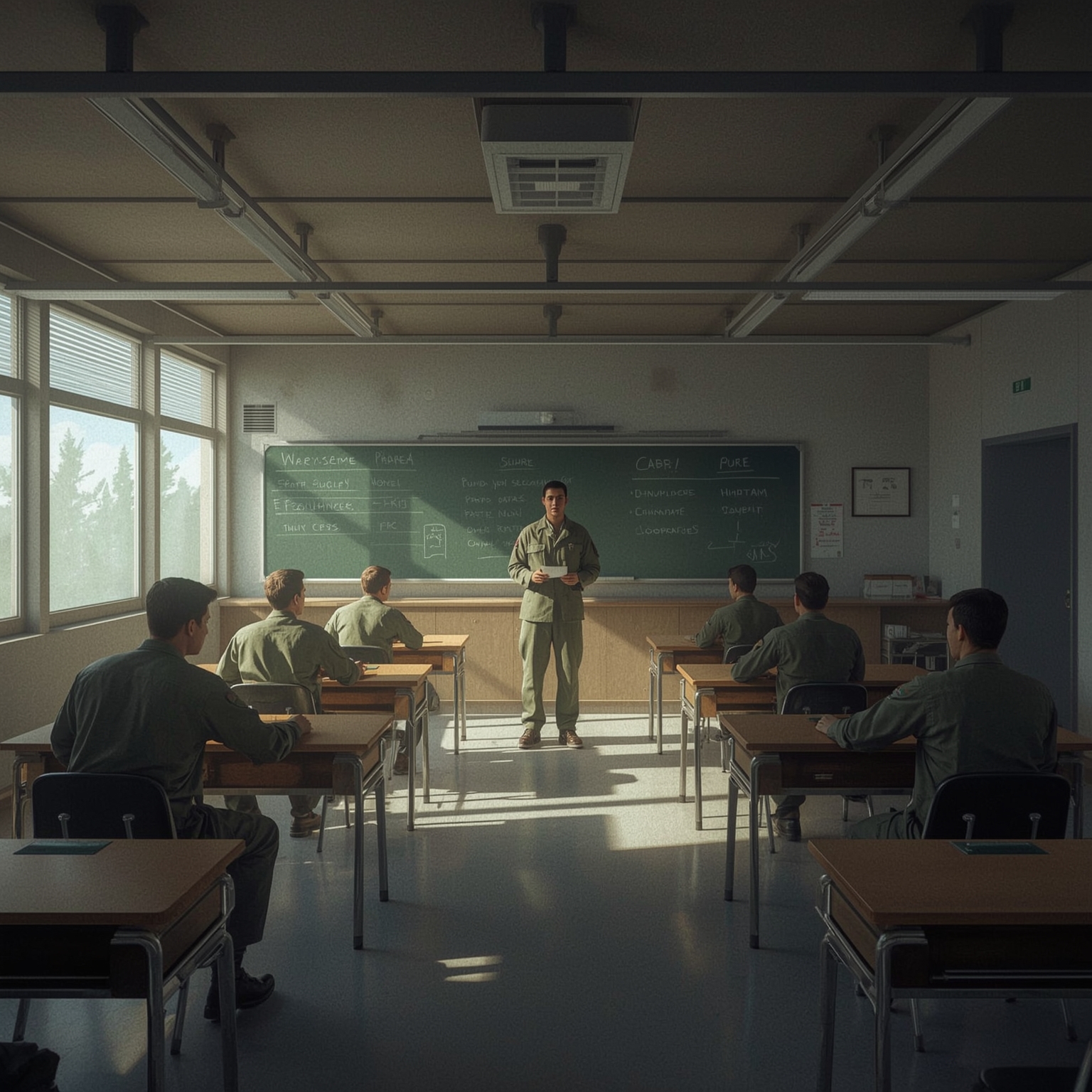
Across Europe, a wave of confusion has swept through neighborhoods where American educators reside, as local landlords struggle to comprehend why their usually reliable tenants can no longer pay rent. The explanation lies not in personal irresponsibility, but in a growing political crisis unfolding thousands of miles away — the United States government shutdown, threatening to become the longest in the nation’s history. As paychecks are frozen, teachers and other crucial support personnel stationed at U.S. military bases overseas find themselves trapped in financial uncertainty.
While the Trump administration successfully identified a pathway to ensure that active-duty American soldiers continue to receive temporary salaries, this decision has excluded an essential workforce of more than 14,000 civilian employees who keep military bases functioning day after day. Among them are educators, administrative aides, and maintenance staff who sustain daily life on these international installations. Five teachers employed by the Department of Defense Education Activity (DoDEA), stationed on various bases throughout Europe, confided to Business Insider that they have been forced into a desperate scramble — drafting letters translated into their landlords’ native languages to explain that their U.S. employer has halted payments. These educators describe the mounting anxiety of approaching utility bills, diminished savings, and the perplexity of local residents who find it incomprehensible that dedicated professionals are showing up to work without compensation.
According to Cathy Indresano, president of the Overseas Federation of Teachers and based in Italy, every member of the school community continues to fulfill their duties despite the absence of pay. “Our teachers, aides, and substitutes are all reporting to their schools each day,” she explained, emphasizing that many of these workers are also spouses of active-duty military service members. “We are all working — yet none of us are being paid.” Her testimony highlights both the professionalism and the personal sacrifices made by this overlooked segment of the federal workforce.
The ongoing shutdown reveals the vast and unpredictable consequences of a lapse in appropriations. Decisions about who continues to receive compensation — decisions being made unilaterally by the administration — have produced a patchwork of outcomes. Historically, Congress has enacted short-term spending measures to preserve funding for military operations during budget stalemates. This time, however, only soldiers and selected law enforcement officers remain on the payroll, leaving civilian support staff to endure the same hardship as hundreds of thousands of other federal employees affected by the impasse.
Jessica Tackaberry, the communications chief for DoDEA, explained that while the schools themselves are legally categorized as “excepted” and therefore remain open, employees are nonetheless working without pay. The agency, she added, remains dedicated to its educational mission and continues to “provide a high-quality, rigorous education” for students connected to U.S. military families, despite the fiscal instability. Tackaberry acknowledged the strain on staff morale, assuring that the organization is monitoring developments closely and offering guidance as best it can. Her statement underscores a dual reality: classrooms continue to operate normally on the surface, but the people sustaining them are living in growing economic distress.
Bobby Kogan, senior director of federal budget policy at the Center for American Progress, noted that this shutdown has left entire groups of federal workers stranded in bureaucratic limbo. The overseas civilian employees, in particular, stand as a stark example of those “left by the wayside,” enduring the consequences of political stalemate while remaining far from home.
The teachers interviewed by Business Insider occupy a uniquely difficult position — isolated geographically and financially from Washington politics, yet directly impacted by them. They describe tightening their household budgets, rationing basic needs, and, in the classroom, even scaling back on items as small as snacks for students. Many have had to explain repeatedly, to incredulous European neighbors, that they are indeed continuing their duties indefinitely without any income.
Desiree, a veteran educator who has spent roughly eleven years teaching abroad, remarked that she had never encountered a situation of such magnitude. Past U.S. government shutdowns had spared the Department of Defense workforce due to prior funding or emergency legislation guaranteeing pay. This time, she and her colleagues received abrupt notice that their paychecks would cease immediately. Her partial payment for a few days of September work covered only about one-third of her rent — a blow made worse by the simultaneous loss of the housing stipend that typically supplements off-base living costs. Facing the likelihood of missing her first rent payment, she reflected somberly, “Money simply isn’t coming in — it only keeps flowing out.” Necessities such as food and fuel, she added, cannot be deferred, no matter the circumstances.
For many teachers who recently relocated for the academic year, the timing could scarcely be worse. Relocation expenses have depleted savings, and the relative weakness of the U.S. dollar against the euro has further eroded purchasing power, leaving little room for financial resilience. One newer DoDEA employee admitted that their bank account had already fallen into the negative, predicting an inability to afford rent for the upcoming month. Compounding matters, several overseas educators are bound by employment restrictions that prevent them from taking on secondary work, unlike their stateside counterparts who might seek temporary income to offset missed pay. Geographic separation from family adds yet another layer of emotional strain. As Indresano observed, assistance networks that exist within the United States — such as food banks — are seldom accessible abroad, magnifying the uncertainty of how long individuals can sustain themselves.
Inside the classrooms, the effects of the shutdown ripple subtly but persistently. Parents and students recently fought to preserve extracurricular and athletic programs that risked cancellation due to the funding impasse. Even so, the daily rhythm of teaching reflects new austerity. Teachers, who often purchase classroom snacks and materials from their own pockets, are having to rethink those habits. “There are families that struggle with food,” one teacher explained. “Usually we’d provide something extra, but we simply can’t afford it now.” Desiree added that certain subjects — such as ceramics or art — might soon lack basic supplies like clay or paper if reimbursements are not restored.
James, a veteran instructor with more than two decades of experience teaching overseas, echoed these sentiments. Though he has weathered numerous shutdowns over the years, this marks the first instance in which his paycheck disappeared entirely. Active in his local community, he regularly encounters acquaintances who express sympathy mingled with disbelief. Many cannot fathom how an advanced nation could allow its educators — particularly those serving military dependents — to go unpaid because of congressional gridlock. “Their reasoning comes from a place of confusion,” he explained. “It’s hard for them to grasp how both the House and the Senate could fail to keep the government open.”
This prolonged shutdown, viewed from afar, exposes not only the fragility of political systems but also the resilience of individuals. The teachers and staff on these foreign bases continue to perform their duties with unwavering dedication, sustaining the educational and emotional stability of American children living abroad, even as their own livelihoods hang in the balance. Their perseverance serves as a poignant testament to the unseen cost of political paralysis — a reminder that even in times of national division, the quiet labor of public servants continues to uphold the values they are momentarily denied.
Sourse: https://www.businessinsider.com/government-shutdown-military-teachers-pay-overseas-unpaid-rent-2025-11


