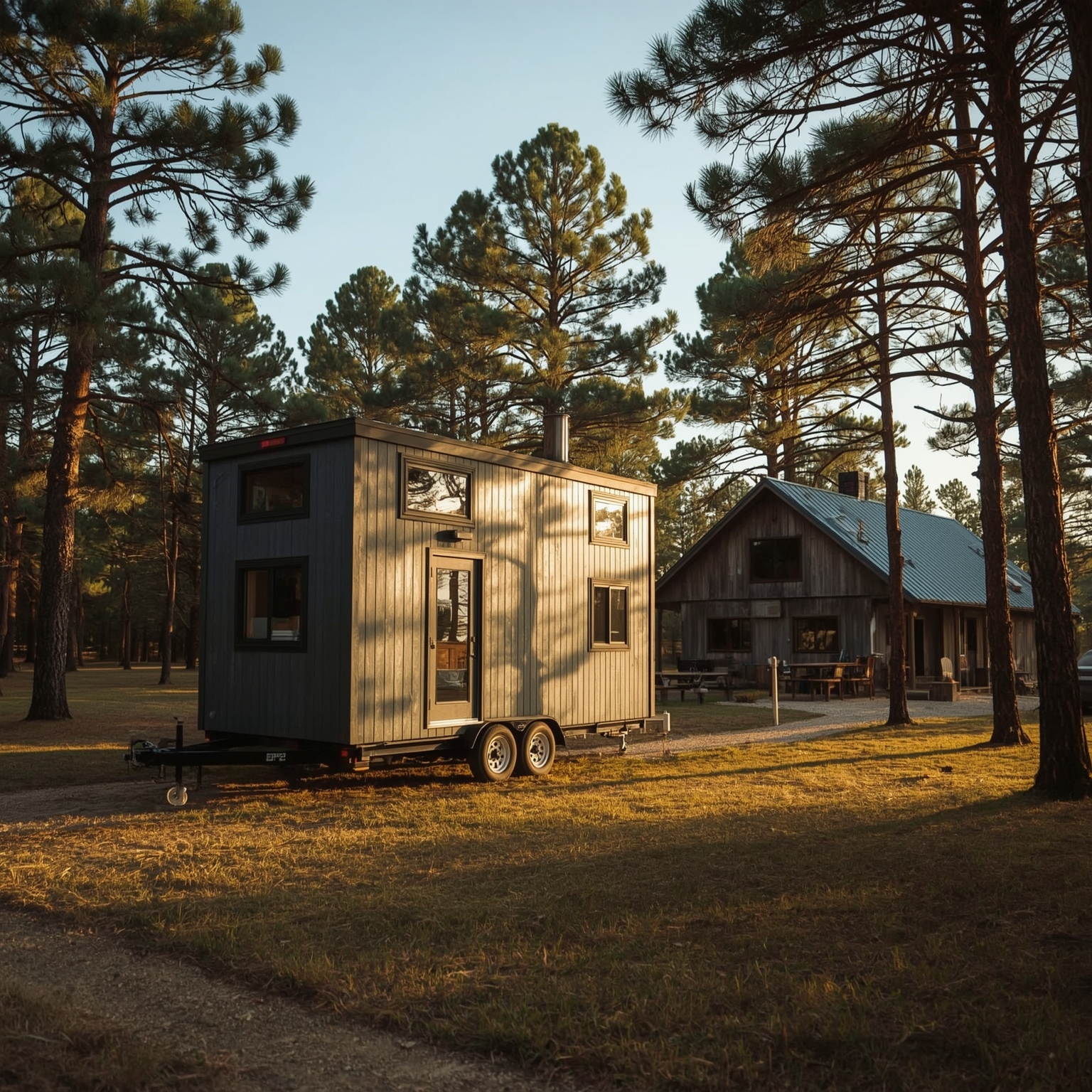
Julie Lennox’s enduring fascination with the concept of tiny homes was born from an unexpected chapter in her life. In 2019, she suffered a serious ACL tear while downhill skiing, an injury that abruptly shifted her active lifestyle and compelled her to spend months in recovery. During that long rehabilitation period, much of which unfolded on a stationary bike, she found herself drawn into the world of minimalist living through an online discovery. While pedaling through slow, repetitive sessions of physical therapy, she immersed herself in a YouTube series titled “Living Big in a Tiny House.” The program offered detailed tours of petite yet ingeniously designed dwellings, showcasing how individuals transformed spaces scarcely larger than postage stamps into fully functional, stylish, and inviting homes. To Lennox, the creative architectural solutions and remarkable cost efficiency depicted in each episode were both inspiring and thought-provoking.
The more she watched, the more captivated she became by this alternative way of living. What began as casual viewing soon deepened into a genuine obsession, as she later admitted. The notion of trading conventional housing for a smaller, more sustainable dwelling echoed deeply with her desire to live intentionally and to minimize her environmental footprint. As she put it, the idea simply felt “like a cool way to have a smaller footprint in the world.” Yet despite her enthusiasm, she initially regarded tiny living as an intriguing possibility rather than a real plan—at least until life circumstances pushed her to reconsider.
In 2021, a significant personal transition prompted Lennox to reevaluate her housing situation. Following the end of her relationship with her former partner, the couple decided to sell their shared three-bedroom home in Missoula, Montana. The timing coincided with an unprecedented surge in real estate demand across the Mountain West region. Property values in Missoula had soared to record highs, making even modest homes increasingly unattainable for many residents. With limited purchasing power in a hypercompetitive market, Lennox concluded that buying another traditional home was financially unrealistic. Seeking both refuge and opportunity, she moved onto her parents’ fifteen-acre property just outside the city. It was there, amid the sweeping Montana landscape, that she began sketching out serious plans to build a small dwelling of her own—an independent sanctuary that could reside in her parents’ backyard.
Professionally, Lennox serves as the head of a private school in Missoula, a demanding role that requires both leadership and adaptability. Perhaps those same qualities guided her as she researched builders and housing options best suited to her new circumstances. Her search eventually led her to Teacup Tiny Homes, a Canadian company specializing in prefabricated micro-houses. In 2022, she commissioned and received a mobile, pre-constructed home on wheels—an arrangement that provided flexibility and efficiency unmatched by traditional builds. Unlike typical stationary models, this dwelling was constructed atop a trailer chassis and designed to remain permanently portable. It could, if ever necessary, be attached to a vehicle and transported to another piece of land, a feature Lennox valued for the independence it offered.
This specific category of residence, known as a Tiny Home on Wheels (often abbreviated as THOW), became the foundation for her next life chapter. Over the past three years, this compact yet thoughtfully crafted space has dramatically reduced her overall housing expenses. Beyond the financial benefits, it has also allowed Lennox to live adjacent to her parents, providing the rare gift of closeness and mutual support. She regularly cooks dinners for them, blending family connection with personal privacy. Despite the proximity, she retains full autonomy and the option to relocate her home whenever new circumstances might arise. Lennox’s experience mirrors that of a growing community across the United States—particularly among older adults—who are choosing to downsize, simplify, and embrace alternative housing models that prioritize freedom over square footage.
The most immediate and tangible advantage, according to Lennox, is purely economic. She spent approximately 191,000 Canadian dollars—roughly equivalent to 146,000 U.S. dollars at the time—to purchase her tiny home. To prepare the site, she invested an additional 15,000 dollars creating a stable foundation pad, constructing a small wooden porch, and connecting the home to essential utilities such as water, sewage, and electricity. Remarkably, she managed all of these expenses without taking out a mortgage. Using the proceeds from the sale of her previous house, she paid every cost outright, freeing herself from the burdens of long-term debt. Today, her continuing housing expenses are minimal, limited mostly to utilities and the occasional repair. By her own estimate, maintenance costs have totaled less than 500 dollars over the past three years—a testament to the simplicity and efficiency of her new lifestyle.
Her energy expenditures are equally modest. Because of the home’s small footprint and efficient systems, Lennox has maintained an annual propane cost of about 600 dollars, a sum that covers cooking, home and water heating, and clothes drying. The home is electrically connected to her parents’ property, drawing power that runs her water pump and lighting. Her parents absorb the electric bill, a gesture of familial generosity, while Lennox reciprocates by covering the shared Starlink Internet plan for herself, her parents, and her sister. That service amounts to about 100 dollars per month. When all expenses are averaged together, her housing-related costs fall below 200 dollars per month—an extraordinary contrast to average American household budgets.
Of course, adjusting to life in a miniature residence requires learning new routines and coping with challenges that rarely arise in traditional homes. Heating a small space with propane demands attentiveness; tanks must be replaced and refilled every five or six weeks during winter. Frozen pipes also pose a seasonal risk, prompting her to keep faucets dripping periodically on the coldest nights. Downsizing her physical possessions presented another hurdle, as she parted with the majority of her belongings accumulated over years of conventional living. Nonetheless, Lennox insists she has not missed any of her old items. For bulkier gear such as skis or bicycles, she benefits from shared storage space in her parents’ garage.
The interior of the tiny home is efficiently arranged to maximize comfort and functionality. Lennox shares this compact space with Rizzo, her ten-year-old labradoodle, whose easygoing nature makes cohabitation uncomplicated. Together, they occupy a home that feels just right for two occupants. As Lennox admits with a laugh, adding another person might make the quarters “a bit more challenging.” Winters, she concedes, can feel especially confining, when short daylight hours and persistent cold encourage staying indoors. “It’s such a small area,” she explained, noting that the space can feel closed in during those long months. Yet summer in Montana completely transforms her lifestyle. Warmer weather extends her living space outward, as she spends significant time on her porch, enveloped by stately Ponderosa pines and Douglas firs, with expansive views of the nearby Blackfoot River. On tranquil evenings, surrounded by forest sounds and the flow of water in the distance, Lennox often reflects that she feels more as though she is camping than occupying a house in the conventional sense.
Through her journey, Julie Lennox has come to embody a growing movement that values sustainability, affordability, and intention. Her decision to downsize was born of necessity but evolved into a demonstration of resilience and creativity. In the process, she not only redefined what home means to her but also discovered a fulfilling balance of independence and familial closeness—living proof that smaller spaces can foster a larger, more meaningful life.
Sourse: https://www.businessinsider.com/gen-xer-tiny-home-saving-money-parents-backyard-2025-11