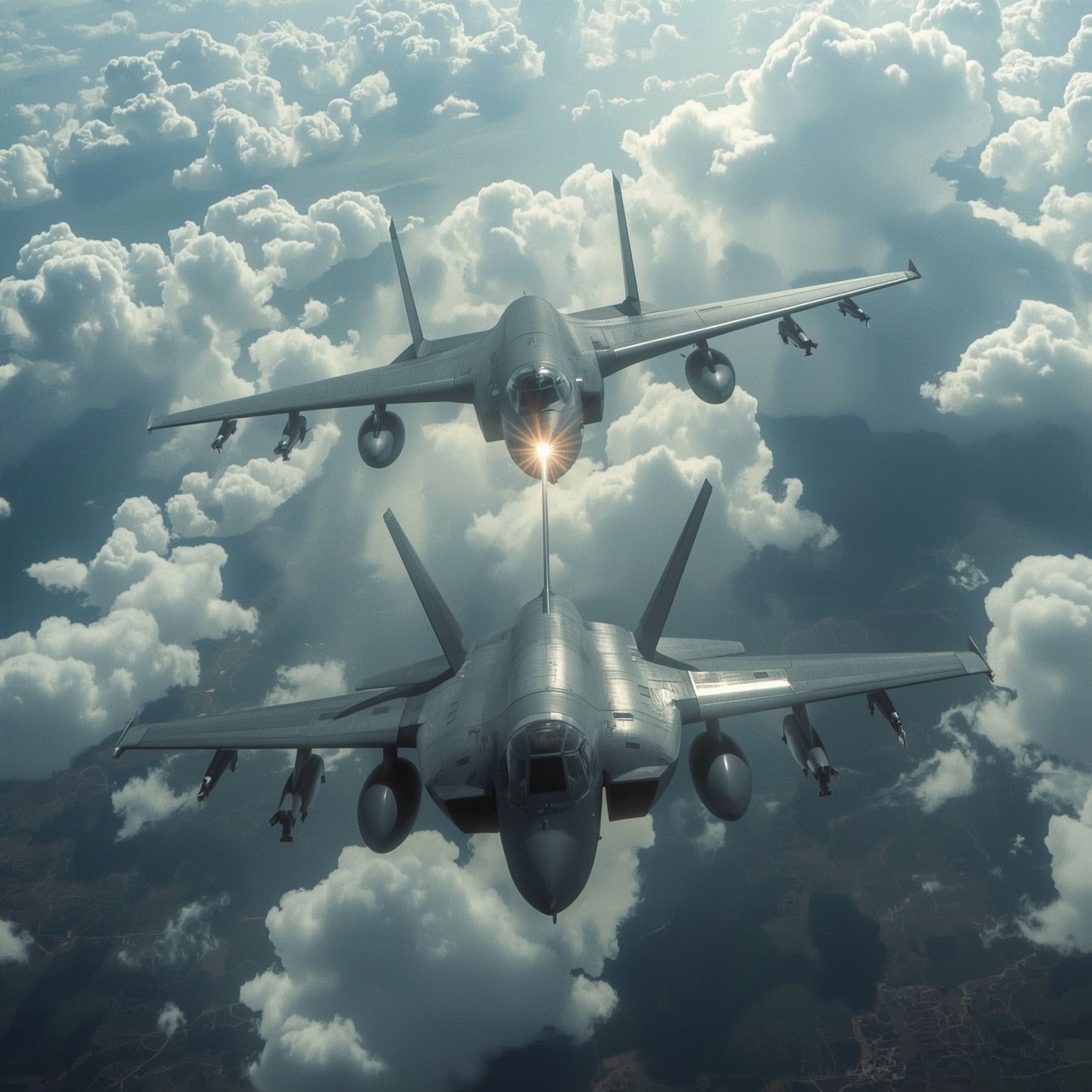
Soaring thousands of feet above the earth’s surface and slicing through the sky at speeds exceeding several hundred miles per hour, U.S. Air Force tanker aircraft execute one of aviation’s most delicate and high-stakes maneuvers: midair refueling. During these operations, which take place under both day and night conditions, massive aerial tankers close in until they are separated from fighter jets by as little as twelve feet—and, in certain instances, an astonishing eight feet, a distance shorter than the height of a standard basketball hoop. At such proximity, the margin for error is virtually nonexistent, and success depends entirely on the skill, concentration, and composure of the aircrews performing this technically demanding task.
The operation is widely recognized within military aviation as “inherently dangerous,” a phrase that encapsulates both the physical risks and the psychological stress involved. During an exclusive visit to RAF Mildenhall, the Air Force installation located in the English countryside north of London, a seasoned boom operator spoke candidly to Business Insider about the high-pressure nature of this work. The base serves as the headquarters of the 100th Air Refueling Wing—the Air Force’s sole tanker unit assigned to cover operations across Europe and Africa—and is home to the venerable Boeing KC-135 Stratotanker fleet. Speaking on the condition of anonymity, the operator explained that even the slightest lapse in judgment or reaction can have catastrophic consequences. Every movement of the hands, every command over the radio, must be executed with precision born from countless hours of training. Remaining calm under pressure is not a psychological luxury but a professional necessity, achieved through deliberate focus and trust in disciplined procedural training.
Despite their indispensable role, tanker aircraft rarely receive the public acclaim showered upon sleeker fighter jets, stealth bombers, or agile helicopters. Yet these comparatively unsung giants form the backbone of long-range air operations, enabling missions that would otherwise be impossible. To illustrate their significance, one need only recall a major event from June, when President Donald Trump disclosed that more than fifty tankers supported U.S. military aircraft during Operation Midnight Hammer—a complex and sustained bombing campaign targeting Iranian nuclear infrastructure. Those refueling aircraft made it possible for B-2 Spirit stealth bombers to remain airborne for an astonishing thirty-six consecutive hours, a feat that would have been inconceivable without aerial refueling support. Functioning quite literally as mobile gas stations in the sky, tankers transform the operational radius of military aviation, extending both range and endurance while preserving the element of surprise.
The concept of midair refueling revolves around an ingenious system known as the “boom,” a rigid, telescoping apparatus through which fuel is transferred from the tanker to the receiving aircraft. On the KC-135 Stratotanker, a platform originally developed from Boeing’s 367-80 prototype, this system has remained at the heart of Air Force refueling capability for more than six decades. Each Stratotanker, costing approximately sixty million dollars, can carry and deliver up to 200,000 pounds of fuel. This tremendous capacity allows American air power to project itself across continents and oceans without reliance on fixed refueling bases. Inside the aircraft’s tail section, the boom operator lies prone or sits facing rearward at a specialized control station, manually guiding the boom with precision into the fuel receptacle of the trailing aircraft.
In their conversation with Business Insider, the operator from the 100th Air Refueling Wing explained that typical flight schedules involve two or three refueling missions per week, though the frequency fluctuates according to training demands, operational tempo, and participation in either exercises or active combat missions. Once the KC-135 ascends and reaches its designated refueling zone—often a prearranged airspace corridor marked by altitude and geographic coordinates—the boom operator takes position in the aft cabin. There, they conduct an abbreviated pre-contact checklist ensuring that all control surfaces, signals, and hydraulic mechanisms are functioning properly before lowering the extendable boom. Communication becomes paramount: as the receiving aircraft approaches, the operator maintains constant radio contact, instructing the pilot to adjust altitude or speed by minute increments until the fighter or support aircraft is locked into ideal position.
At this stage, the separation between the two massive machines—each coursing through the air at 275 to 300 knots, or roughly 315 to 345 miles per hour—is typically no more than twelve feet. In comparison, that distance is shorter than the length of a mid-sized family sedan. Operating at altitudes between five and thirty thousand feet, the pilots and the boom operator maintain an unwavering focus to ensure complete stability before initiating the transfer. Smaller aircraft such as F-16 Fighting Falcons or F-35 Lightning IIs can receive about 5,000 pounds of fuel within only a few minutes, while larger aircraft or command platforms may remain latched on for half an hour or more, taking in upwards of 35,000 pounds of fuel. During one observation in July, Business Insider documented a vivid demonstration of this process: a KC-135 provided 40,000 pounds of fuel to a NATO E-3A Sentry—a sophisticated airborne early-warning and control aircraft derived from the Boeing 707 passenger jet—while cruising above Eastern Europe. The proximity was so intimate that the crew aboard the E-3 could clearly see the boom operator’s face through the window of the tanker.
Executing this high-stakes procedure demands not only technical perfection but also the ability to cope with the ever-present threat posed by atmospheric turbulence. The boom operator noted that mild turbulence is tolerable, but anything beyond light air disturbances may prompt the mission crew to abort refueling entirely. The air itself can become a volatile environment, shifting rapidly and unpredictably. Even subtle oscillations may cause the rigid boom to sway, increasing the risk of collision or damage to either aircraft. This delicacy underscores the intense concentration required of everyone involved.
The peril associated with aerial refueling is very real, as tragic historical incidents have demonstrated. In 2018, for example, a midair collision between a tanker and a Super Hornet over the Pacific Ocean underscored just how swiftly a minor miscalculation can escalate into a fatal catastrophe. For this reason, all participants—the tanker crew, the receiver pilot, and the mission controllers—must perform at absolute peak capability from takeoff to touchdown. “If the conditions make refueling difficult,” the boom operator acknowledged, “it can be stressful.” The challenge compounds when an inexperienced pilot attempts their first in-flight refueling; the operator must exercise exceptional patience and judgment to steady the situation.
To maintain this composure, the operator personally avoids stimulants such as coffee and nicotine, emphasizing that their focus must remain unwavering throughout each mission. Hydration, steady hands, acute visual awareness, and reliance on extensive preparatory training are key. The operator described a lengthy and rigorous training pipeline incorporating both simulation-based environments and months of live practice flights. Through repetition and gradual exposure to increasingly difficult conditions, confidence replaces apprehension, enabling experienced crew members to handle pressure with measured calm.
Even with such preparation, the inherent danger never truly disappears. Operating two aircraft in extremely close proximity at high velocity always carries a residual element of risk. Yet over time, seasoned boom operators develop an instinctive trust in both their technical proficiency and their teamwork with the flight crew. “At a certain point,” the operator explained, “you begin to believe in your training and in the people around you. If something goes wrong, you can call for separation, and your pilots will execute that move immediately.” This mutual trust—supported by discipline, communication, and continual practice—defines the essence of aerial refueling. It is an act of synchronized precision where courage, skill, and composure intersect thousands of feet above the earth, keeping the U.S. Air Force and its allied aircraft flying farther, faster, and longer than would otherwise ever be possible.
Sourse: https://www.businessinsider.com/how-air-force-boom-operators-keep-calm-inherently-dangerous-job-2025-11


