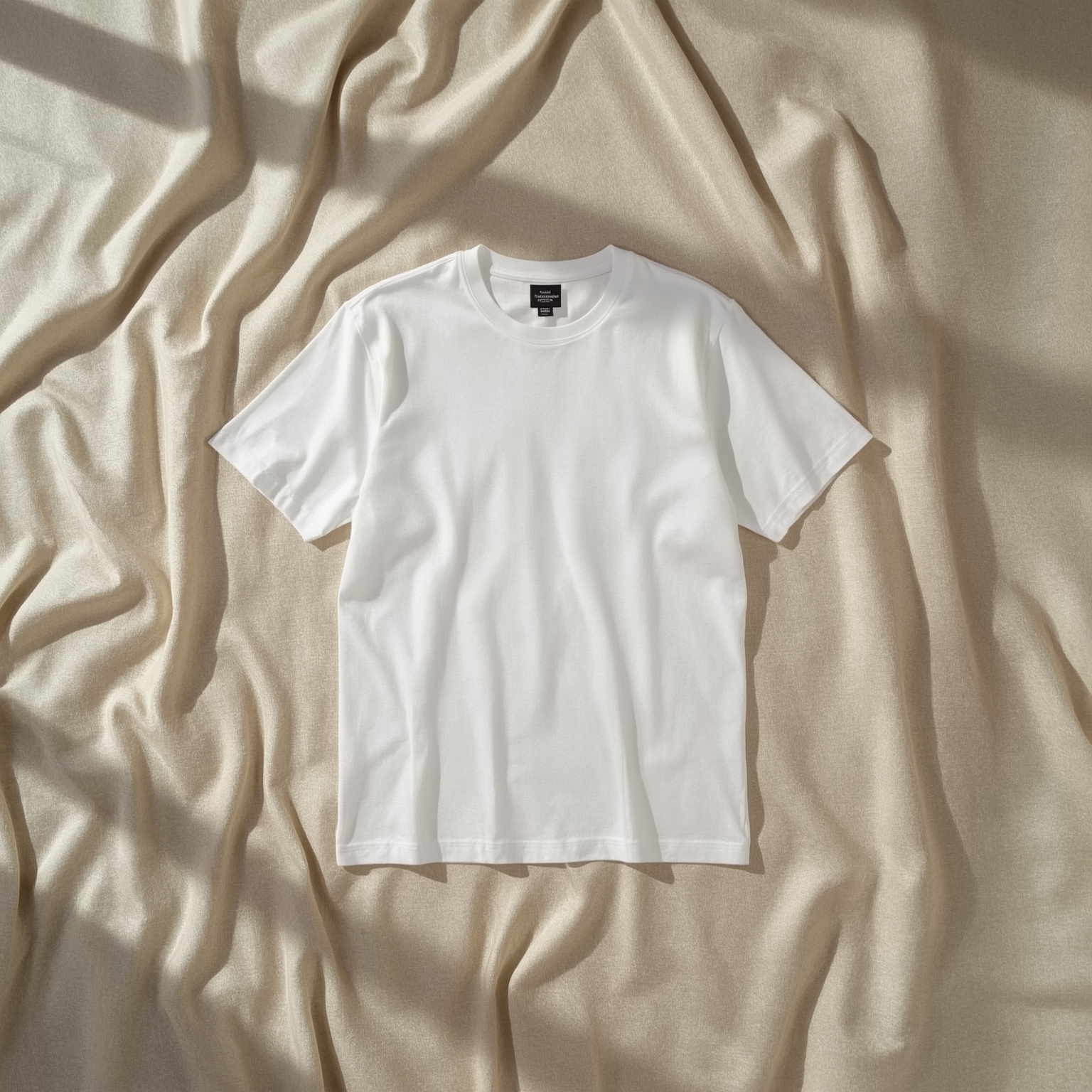
Just last month, hundreds of fashion enthusiasts and curious shoppers assembled outside The Row’s coveted Sample Sale, eager for the chance to purchase pieces from the renowned label founded by Mary-Kate and Ashley Olsen. Some dedicated attendees willingly waited for hours, while others outsourced the inconvenience by hiring professional line-sitters—individuals paid as much as $40 per hour—to hold their spot in line. Their reward for this investment of time and money was the opportunity to buy what, at first glance, appeared to be the simplest of garments: a plain white T-shirt with a minimalist cut and no visible logo, offered at the seemingly extravagant price of $130. Yet, in the world of luxury fashion, this modest sum was considered a relative bargain. After all, The Row’s standard Tori T-shirt—a midweight cotton creation distinguished by its carefully distressed neckline and tailored silhouette—typically carries a price tag of $520.
This discrepancy naturally provokes a broader question: what could possibly justify such a high valuation for one of the most commonplace items in a wardrobe? A traveler could cross the country on a round-trip flight from New York to San Francisco for that sum, or purchase a budget-friendly laptop. There is no trace of gold thread, fine silk, or rare cashmere embedded in the fabric; to an untrained observer, the garment’s only notable feature might be a single vertical stitch running cleanly down the back, a subtle hallmark of The Row’s aesthetic restraint. Nevertheless, this understated simplicity reflects a larger phenomenon—the dramatic inflation of luxury prices. Morningstar reported in September that from 2019 to 2023, the cost of select high-end handbags surged by as much as 100%, a level of increase deemed “excessive” by the firm’s analysts. Yet, what seems excessive to some may appear perfectly reasonable to others. As retail analyst Hitha Herzog explained, true luxury consumers—those devoted to brands like The Row—do not weigh price as an obstacle; they are often indifferent to cost when it comes to acquiring a desirable item that signals refinement or exclusivity.
In this rarified realm of commerce, pricing is a form of artistry rather than a formulaic calculation. Unlike global mass retailers such as Gap or Zara, which base prices on straightforward metrics like material and manufacturing expenses, luxury houses emphasize perception, craftsmanship, and the intangible allure of their brand identity. As Nicole Marra, founder and CEO of Fixer Advisory Group, succinctly expressed, no one truly needs a $500 T-shirt; what is being sold is not merely a product but a carefully constructed dream—an idea of perfection and status materialized in cotton.
To understand this allure, one might consider the statement, “All cotton T-shirts are not created equal.” For the average consumer, a shirt from The Row may seem indistinguishable from any other white tee on the surface. However, those who have handled one firsthand often describe a sense of admiration at the tactile experience—the almost ethereal softness of the fiber, the precision of the stitching, and the symmetry of its fit. Achieving that effortless hang, the “shrunken fit” that drapes elegantly without clinging, requires a design process that is both meticulous and expensive. Samples must be repeatedly developed, refined, and produced before the exact proportions are achieved—each iteration requiring premium materials and the attention of highly skilled designers.
Beyond design, the production journey further elevates cost. The Tori T-shirt, for instance, is constructed using exceptionally soft, high-grade cotton and manufactured in Italy, a country celebrated for its artisanal craftsmanship yet known for comparatively higher labor expenses than mass-production regions such as China or Bangladesh. Italian makers produce in small, exclusive batches, often hand-finishing each garment using techniques that ensure impeccable detailing. The result is a shirt where subtle refinements reveal the care and expertise woven into every stitch. As Marra noted, one can truly perceive the craftsmanship embedded in the fabric itself.
Yet, the creation of luxury extends far beyond the garment’s physical composition; the price also encapsulates the broader brand experience. The Row’s boutiques—nestled in polished neighborhoods such as New York’s Amagansett and the Upper East Side—are carefully designed environments where understated architecture, tranquil lighting, and highly trained sales associates collectively reinforce the brand’s serene sophistication. While The Row eschews overt marketing strategies such as billboard campaigns or celebrity endorsements, it still invests heavily in Paris fashion shows, editorial photo shoots, and tailored gifting to maintain its aura of exclusivity. As Herzog interpreted, all of these elements—from ambience to presentation—are “built into the price of that shirt.”
Even so, the profit margins are not necessarily astronomical. Shikha Jain, lead partner for consumer and retail at advisory firm Simon-Kucher, explained that while luxury garments have high sticker prices, their proportional markups often mirror those of mass-market counterparts. A $20 fast-fashion tee might yield a 50% margin—$10 of profit—while a $500 tee produces a similar percentage yet translates to $250 in dollar value. The difference lies not in percentage but in perceived worth.
Indeed, the most significant component of luxury pricing exists outside tangible production factors. The Row could likely sell its $520 T-shirt for $400 and remain profitable, or raise the price to $600 and still attract clientele. “A product is more than just its physical attributes,” Jain emphasized. “Especially in the luxury sphere, it embodies intangible elements—meaning, heritage, and emotional connection.” The Row’s reputation, built through the Olsen twins’ dedication to quiet refinement and disciplined aesthetic, holds substantial currency in itself.
This is where pricing transforms into both an art and a strategic signal. Determining a final figure requires coordination between merchandising, finance, and creative teams, all striving to align the brand’s perceived prestige with the value that its clients expect. As the Lyst Index recently reported, The Row ranked as the fourth most sought-after luxury brand in the third quarter, a testament to the power of its brand equity. Daniel Langer, CEO of Équité and professor of luxury strategy, elaborated that The Row’s $500 tee owes its worth not to cotton or thread but to what those elements represent—emotion, aspiration, and identity.
Equally important is competitive positioning. Within the luxury ecosystem, pricing serves as a coded message about status and quality. Were a peer label such as Khaite to offer its cotton tee at $300, consumers might interpret The Row’s $520 version as overpriced. Conversely, if Khaite priced its shirt at $700, shoppers might infer that its design and materials surpass The Row’s. Additionally, scarcity amplifies desirability. As Herzog observed, cultivating a sense of “FOMO”—the fear of missing out—can dramatically drive demand. The Row demonstrated this expertly with its $620 Ama slides, reminiscent of a minimalist reinterpretation of the Adidas shower shoe, which sold out swiftly after being produced in strictly limited quantities.
Despite methodical planning, pricing in luxury remains partially intuitive—a balance between market analysis and instinct. “It’s often still a gut feeling,” Langer admitted, describing it as a blend of observation, comparison, and brand narrative alignment. For affluent customers, however, these finely tuned figures are often irrelevant. As Marra concluded, if one has the means to purchase what is perceived as the perfect T-shirt—crafted from the most exquisite cotton, boasting flawless drape, and complementing a tailored blazer—then there is little reason to resist the indulgence.
In contextual terms, that $520 figure can even appear modest when measured against The Row’s broader offerings. For those wishing for an even more opulent version, the brand produces a cashmere T-shirt priced at an astonishing $1,050—a reminder that within the universe of luxury fashion, simplicity itself can become the ultimate marker of sophistication and exclusivity.
Sourse: https://www.businessinsider.com/why-the-row-white-cotton-t-shirt-cost-brand-expensive-2025-11


