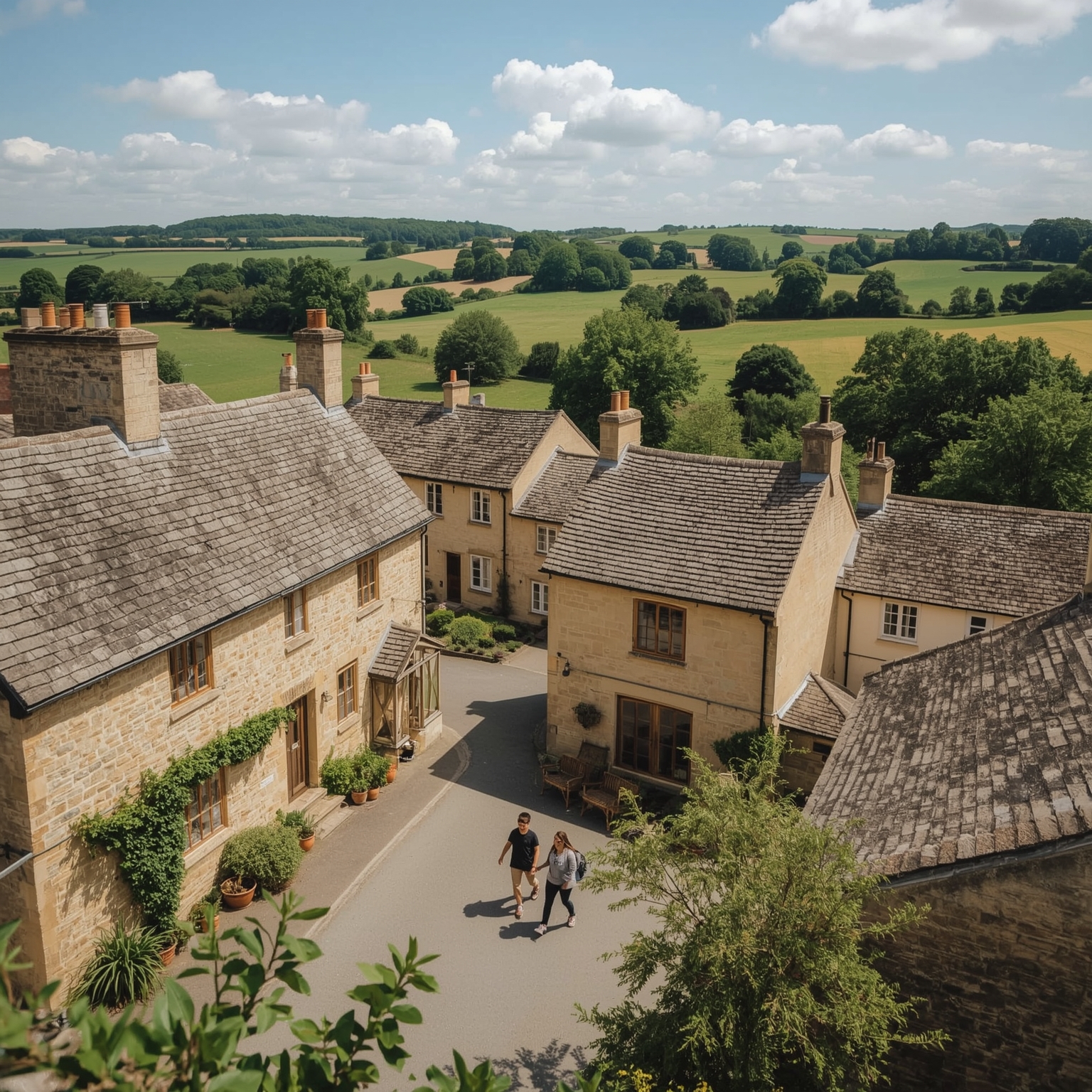
This essay draws its inspiration from an extended conversation with Audrey Ann Masur, a thirty-seven-year-old digital influencer and devoted mother of three originally from Indiana. For the past five years, she has made her home in the pastoral heart of England—the Cotswolds. Her reflections, carefully edited for both brevity and precision, provide a vivid portrait of cross-cultural adaptation, maternal experience, and the quiet revelations of rural British life.
Before her permanent relocation to the United Kingdom with her husband and young family, Audrey’s only encounter with the country had occurred during an earlier chapter of her life. At sixteen, she joined a cycling expedition with her church community, exploring the winding lanes and storybook villages of rural England. Even then, despite her youth, she felt an inexplicable sense of belonging—an intuition that the landscape, its rhythms, and its people resonated with something deeply personal. She left with a lasting conviction that she would one day return, that a part of her spirit felt at home there.
Her affection for British culture had long been nurtured through shared experiences with her grandmother, a self-professed Anglophile who had introduced her to every adaptation of Jane Austen’s novels. Later, with her husband, she immersed herself in beloved British media such as *Downton Abbey*, further deepening their fascination with English traditions, class histories, and countryside aesthetics. Both cherished slower, simpler pleasures, finding comfort in scenes of pastoral tranquility and the sense of continuity that radiates from the land. With these shared affinities, they began to imagine that the Cotswolds, with its verdant hills, honey-colored cottages, and centuries-old lanes, might one day become their home.
Audrey describes England as a place steeped in palpable history and long-standing custom. For someone who considers herself “an old soul,” such an environment serves as a daily reminder that life extends beyond the immediacy of the present moment. The weathered stones of ancient architecture, the lingering echoes of tradition—all bring her reassurance and a sense of temporal depth. In the United States, she notes, objects or buildings dating from the eighteenth century are treated with awe, for such antiquity there feels rare. England, in contrast, seems layered with memory, as if every corner whispers its own narrative.
Her husband, who had never set foot in Britain before, was determined to secure a work posting there through his employment with the U.S. military near Charleston, South Carolina. Yet, securing an assignment in the United Kingdom—particularly one situated close to the Cotswolds—proved exceedingly competitive. He submitted four separate applications before fortune finally favored them. At last, in the winter of 2020, amid a world altered by the pandemic, the Masur family realized their long-held aspiration and settled in their new home among the rolling hills.
Over the past five years, Audrey has discovered that British life—especially within the Cotswolds—contains a deeply embedded culture of inclusivity toward children. This ethos, she believes, has provided an invaluable sense of support and belonging in her role as a mother. Among the many towns and villages that make up this region, Stow-on-the-Wold stands out to her for its historical charm and sense of continuity, its stone-built beauty evoking England’s enduring heritage.
The family’s move, however, was not without its adjustments. Early on, Audrey confronted one of her greatest challenges: driving on England’s narrow, winding roads, particularly while adapting to traveling on the left-hand side. At first, the experience was daunting, even frightening. Yet she was struck by the patience of local drivers—an atmosphere far removed from the hurried pace of American highways. Over time, she grew accustomed to the calm; what once inspired anxiety gradually became a source of peace and normalcy.
Equally challenging was the search for a permanent home close to her husband’s base, given their unfamiliarity with the area. Their faith played a central role in their decision-making; as practicing Christians, they sought a village with an engaged church community and facilities that would enrich their children’s lives. When a colleague of her husband’s mentioned a small village nearby, they investigated and, in a stroke of providence, discovered a charming cottage available for rent. Just before Christmas of 2020, they moved in—marking both the culmination of long effort and the beginning of a new, uncertain adventure.
Their first weeks in England unfolded during the strictest period of the COVID-19 lockdown, when daily outdoor activity was limited to a single hour. At that time, Audrey found herself homebound with three young children while her husband fulfilled his duties on base. The isolation weighed heavily. She worried that their dream move would be overshadowed by confinement and that they might never have the chance to experience the country or connect with new friends.
Yet, even through that loneliness, despair never fully took hold. Audrey understood that friendships and belonging would come gradually, particularly as an outsider in a close-knit rural area. Her faith offered endurance, and ultimately it was their church community that opened the first doors. Through shared worship and kindness, local residents extended genuine care, helping the family bridge cultural and emotional distances.
Since establishing themselves in Gloucestershire—a county forming part of the larger Cotswold region—Audrey has met other Americans as well, including several expatriates from Los Angeles. Coming from rural Indiana, she notes that her own background feels more naturally aligned with local British sensibilities than with those of big-city Americans. Long accustomed to driving forty-five minutes just to reach a supermarket, she felt immediately at ease with the slower rhythms and scenic distances of country life. Ironically, she observes, moving to a U.S. metropolis might have been a far greater cultural shock than crossing the Atlantic.
Over time, her family has wholeheartedly embraced the region’s slower tempo. In contrast to the United States, where speed and consumption often dominate, the Cotswolds cultivates a culture that values walking, reflection, and appreciation of experiences not defined by cost. Although symbols of affluence abound—stylish boutiques, stately cars—the prevailing spirit encourages savoring humble pleasures: unhurried strolls, afternoon tea, and the soothing quiet of open fields.
Yet Audrey has also learned that beauty does not preclude hardship. Behind even the loveliest façades, people continue to grapple with daily struggles, anxieties, and personal heartache. As the mother of a child with additional needs, she resonates deeply with this reality. The landscape may offer solace—especially the sight of the lambs grazing near their cottage, whose seasonal growth reflects renewal and continuity—but it does not erase life’s challenges. Through these experiences, she has come to view the Cotswolds not as an escape, but as a restorative sanctuary where beauty and vulnerability coexist.
What has touched her most profoundly, however, is the deliberate inclusivity toward children that pervades British culture. Her children—aged two, six, and eight—are warmly welcomed in spaces that might elsewhere exclude them. Whether visiting museums, historical estates, or local trails, families often find organized activities designed specifically to engage young minds: scavenger hunts, interactive guides, or playful educational trails. This intentional inclusion gives her the feeling that being a mother enhances, rather than inconveniences, communal life. In the United States, by contrast, she often sensed a clear boundary between spaces designed for adults and those for children.
She has also been impressed by the structural support offered to parents, particularly mothers of young children. Longer maternity leaves and frequent community-based playgroups create an environment where women can recover from childbirth, forge friendships, and rediscover themselves outside their professional identities. Having given birth to her third child in the UK, Audrey especially appreciated the accessibility and warmth of such preschool gatherings, which transformed early motherhood from an isolating to a shared experience.
Today, Audrey describes the Cotswolds as nothing less than a “slice of heaven.” The only potential reason for returning to the United States, she admits, would be to remain close to their extended family. For now, however, her heart is firmly rooted in this landscape. Each morning, she drives her children to school along roads that wind through fields of grazing sheep and centuries-old hedgerows. After drop-off, she and her husband sometimes take peaceful walks through the grounds of stately homes, finding quiet joy in what surrounds them.
Still, she acknowledges the subtle truth that perfection is an illusion. Even in places that seem idyllic, life’s sorrows persist, reminding her that no setting can insulate us from human difficulty. For those considering a similar move, she advises carrying both hope and realism—the understanding that a change of scenery can enrich and heal, but not absolve life’s trials.
Nevertheless, the overarching sentiment that permeates Audrey’s story is one of gratitude. The Cotswolds, with its gentle pace, sense of community, and profound beauty, has provided her family with the nurturing atmosphere they sought. And above all, it has allowed her to grow into motherhood with renewed strength and serenity, surrounded by a culture that values not just children—but the deeper, often unseen labor of love that raising them entails.
Sourse: https://www.businessinsider.com/moved-family-cotswolds-hamptons-england-better-mom-support-2025-11


