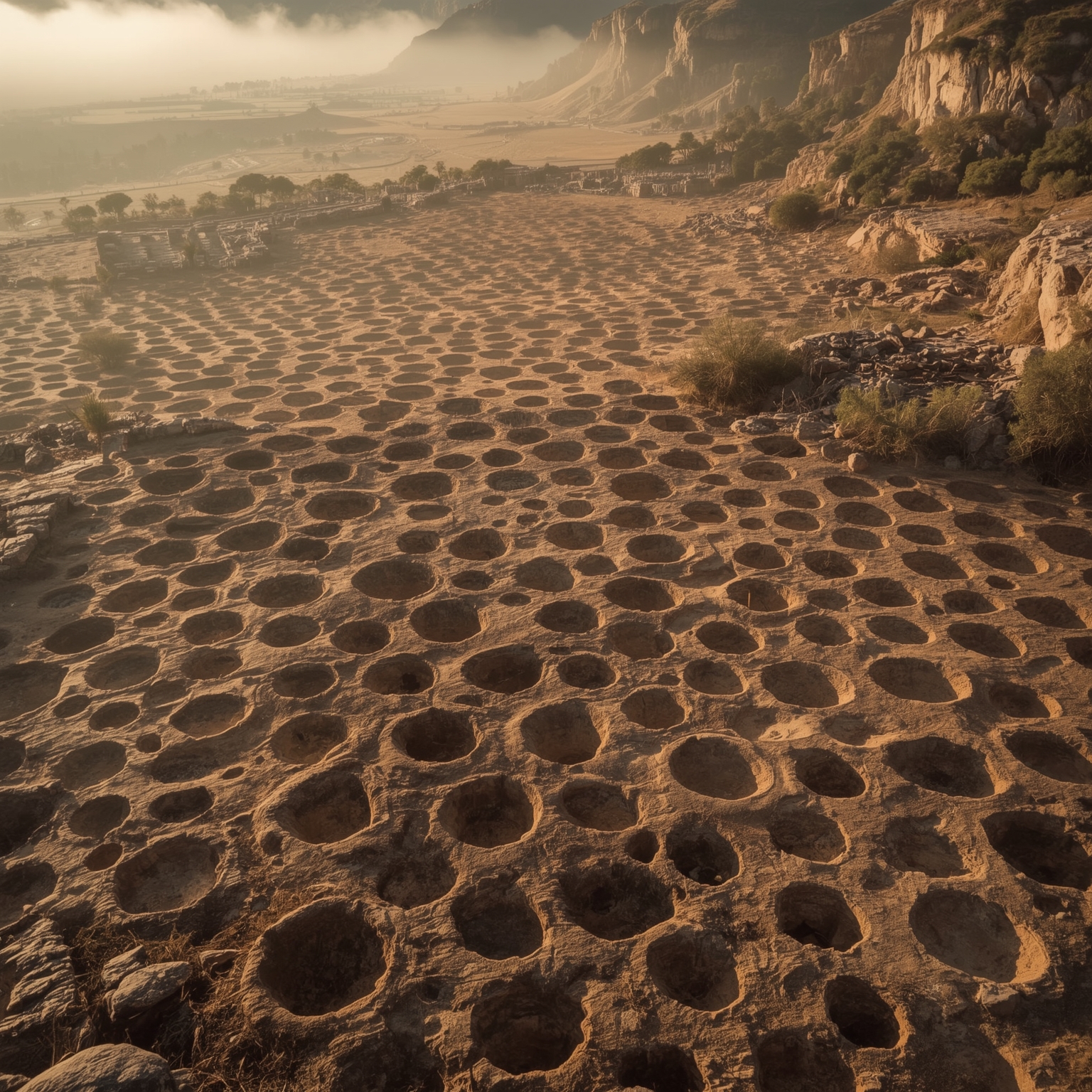
Across the rugged landscape of South America, deep within the southern reaches of the Peruvian Andes, lies one of the continent’s most enigmatic archaeological marvels—a sprawling monument that extends nearly a mile, or approximately 1.5 kilometers, through barren highland terrain. Known as Monte Sierpe, which translates to “serpent mountain,” this immense formation has long captivated the curiosity of researchers and travelers alike. Consisting of carefully organized rows containing around 5,200 uniformly shaped cavities, the site forms a pattern so deliberate and extensive that it appears almost as if carved by some immense, ancient design. Scholars have puzzled for decades over its original function, and now, an ambitious interdisciplinary team of scientists has unveiled a new and potentially transformative theory regarding its purpose.
In a groundbreaking paper published in the prestigious archaeological journal *Antiquity*, an international collaboration of experts presented the findings of their latest investigation. The research combined cutting-edge technological methods, including sediment sampling and drone-based aerial photography, to explore Monte Sierpe in exquisite detail. The study revealed new evidence suggesting that this extraordinary monument—also referred to by the evocative name “Band of Holes”—may once have served a sophisticated role in the economic and administrative life of pre-Hispanic societies. According to the team, the pattern of holes likely functioned as a system for accounting and trade among local Indigenous populations, linking landscape modification to ancient systems of organization and exchange.
As lead author Jacob Bongers, an archaeologist from the University of Sydney, explained in his statement to *Antiquity*, the academic community has long debated a wide range of possible explanations for Monte Sierpe’s purpose. Hypotheses have included defensive fortifications, food or resource storage, numerical recording systems, water-collection facilities, fog-capture technologies, and even specialized agricultural plots for garden cultivation. Yet, despite the persistence of these various interpretations, Bongers notes that the function of the site remains elusive. What the new study offers is a more unified framework, integrating both physical evidence and spatial patterning to reconstruct the ways in which ancient Andean communities may have interacted with this monumental feature.
Physically, Monte Sierpe’s surface is divided into distinct segments of holes, each cavity varying between roughly one and two meters in diameter (equivalent to about 3.3 to 6.6 feet) and descending to depths of approximately half a meter to one meter (1.6 to 3.3 feet). Through meticulous microbotanical analysis—an examination of minute pollen and plant residues preserved within the sediments—the researchers uncovered traces of maize kernels along with plant species traditionally valued for basket weaving. This microscopic evidence, coupled with the monument’s scale and organization, provides tangible support for the interpretation that ancient peoples periodically lined these depressions with plant fibers or woven materials before depositing goods, perhaps agricultural produce or trade items, into the holes for short-term storage or ceremonial cataloging.
From an aerial vantage point, high-resolution drone imagery further revealed that the thousands of holes were not randomly placed but instead arranged according to discernible numerical and geometric patterns. This organization echoes the structure of the khipu, a renowned Andean accounting system that utilized cords and knots to register quantities, obligations, and exchanges across the Inca Empire. Drawing on this comparison, the scholars proposed that Monte Sierpe may have functioned as a monumental, landscape-scale analog of such a system—a physical ‘ledger’ built directly into the terrain, possibly serving as a place where administrators or traders recorded transactions, deliveries, or tributes owed to the state.
The contextual geography of Monte Sierpe strengthens this interpretation. The monument lies strategically between two significant administrative centers of the Inca period and near an intersection of pre-Hispanic road networks that once connected the Andean highlands to the coastal plains. This liminal setting, bridging mountains and coast, would have facilitated encounters between groups specializing in distinct ecological zones. Highland communities likely brought goods such as textiles or potatoes, while coastal traders might have exchanged fish, shells, or salt. In such a nexus of cultural and economic activity, a facility devoted to measuring, recording, and organizing trade would have been exceptionally practical.
According to the researchers, this monumental site may have initially originated under the influence of the pre-Inca Chincha Kingdom, one of the most prominent regional powers along Peru’s southern coast. The Chincha appear to have developed sophisticated systems of controlled trade, and Monte Sierpe could have served as an early instrument of regulation and record keeping. Later, as Inca dominion expanded, the empire may have repurposed or incorporated the site into its own vast accounting and tribute-collection systems. In this sense, the Band of Holes embodies a tangible dialogue between successive civilizations, illustrating how monumental architecture could adapt to new forms of social and administrative organization over time.
Bongers and his colleagues emphasize that these discoveries do more than just clarify a single archaeological mystery—they illuminate broader themes in Andean history. By demonstrating how ancient communities transformed their environments to enable collaboration, negotiation, and interaction, the research offers valuable insights into the intricate social fabrics that underpinned pre-Columbian societies. Ultimately, the study expands modern understanding of barter-based marketplaces, Indigenous accounting innovations, and the diverse methods through which ancient peoples structured economic and political life across the Andes and beyond.
Sourse: https://gizmodo.com/there-are-thousands-of-aligned-holes-in-peru-researchers-think-they-finally-know-why-2000680970


