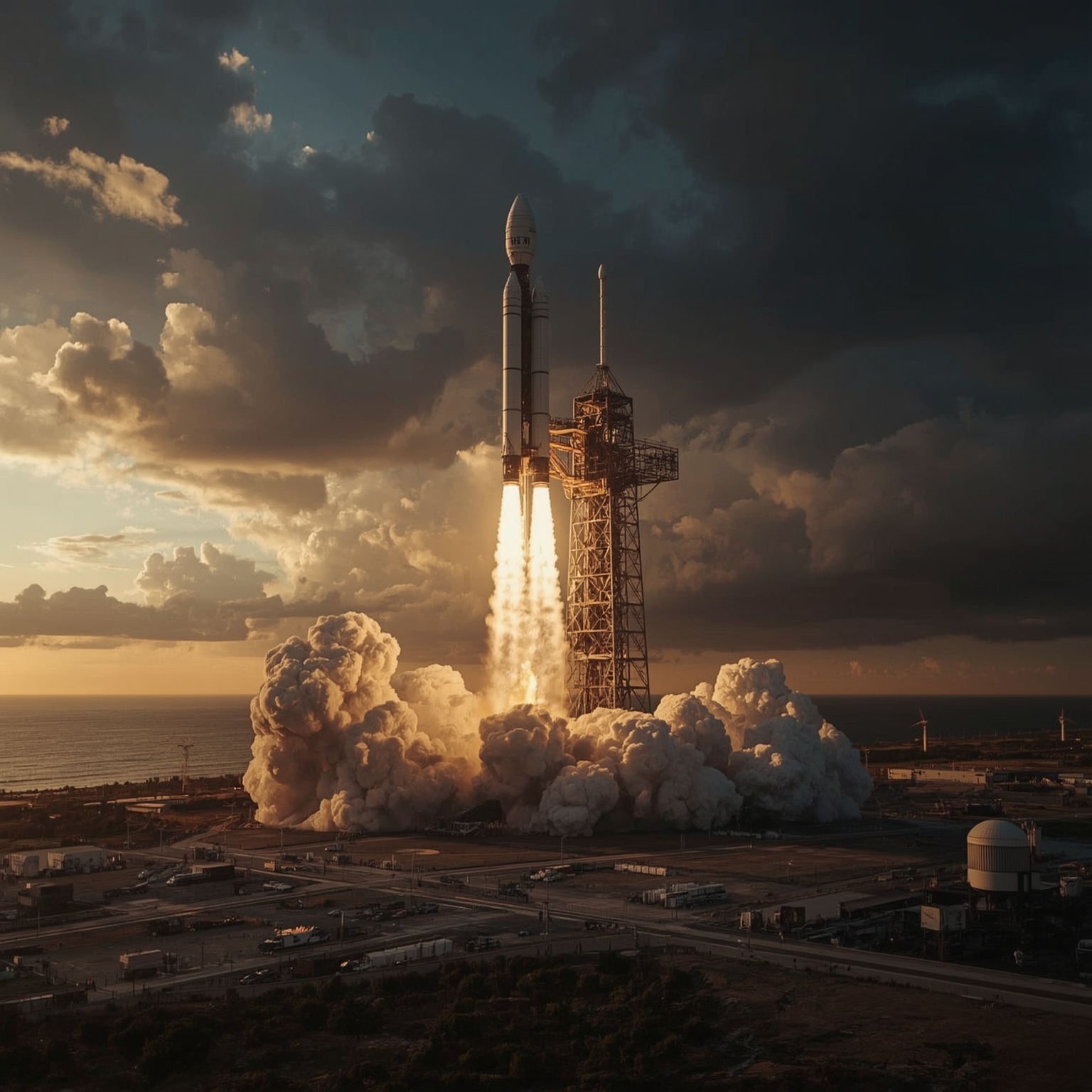
Blue Origin’s second scheduled flight of its ambitious and partially reusable New Glenn rocket was called off on Sunday after unfavorable atmospheric conditions rendered launch operations unsafe, forcing mission controllers to postpone NASA’s most recent Mars-focused project. The decision, taken in accordance with strict aerospace safety protocols, underscores how even the most sophisticated space technologies remain at the mercy of environmental forces beyond human control. According to Blue Origin—the private aerospace firm founded by Jeff Bezos—the next opportunity to attempt liftoff from Cape Canaveral Space Force Station in Florida will not occur before Wednesday, November 12th, during a designated launch window extending from 2:50 p.m. to 4:17 p.m. Eastern Time.
This upcoming launch carries substantial scientific and strategic importance for the 320-foot-tall megarocket, representing a pivotal step in both NASA’s and Blue Origin’s exploration agendas. The vehicle’s mission is to propel NASA’s twin ESCAPADE probes—formally known as the Escape and Plasma Acceleration and Dynamics Explorers—into their deep-space trajectory toward Mars. These dual spacecraft are part of the first Mars-directed mission since NASA successfully launched its Perseverance rover and Ingenuity helicopter in 2020, both of which continue to study the Martian surface and atmosphere. Once they reach their intended orbit around Mars, projected for 2027, the ESCAPADE satellites will conduct intricate measurements of the planet’s magnetosphere and atmospheric interactions, helping scientists gain a more refined understanding of how solar wind shapes Martian space weather.
Beyond its scientific payload, the launch will serve as a critical technical demonstration for Blue Origin’s engineering capabilities. It will include a renewed attempt to recover the rocket’s reusable first-stage booster, a maneuver designed to land the massive stage vertically on a floating ocean platform. This process mirrors the method pioneered by SpaceX’s Falcon series rockets, wherein boosters are recovered and refurbished for future flights—an approach that drastically reduces the overall cost of space travel and increases mission frequency. While Blue Origin celebrated its inaugural New Glenn launch earlier in January after numerous schedule adjustments, that milestone flight ended with the booster being lost during descent, highlighting the inherent difficulty of perfecting vertical landing technology. A successful repetition this time would mark an inflection point in Blue Origin’s efforts to position itself as a credible competitor in the field of heavy-lift and deep-space launch operations, placing it in more direct rivalry with established industry leaders such as SpaceX and United Launch Alliance.
The company also disclosed that it has collaborated closely with the Federal Aviation Administration (FAA) to finalize the updated launch window. In doing so, Blue Origin appears to have secured a limited exemption from the FAA’s newly implemented flight restrictions, which temporarily bar commercial rocket launches between 6 a.m. and 10 p.m. This regulatory measure, enacted on November 10th as an emergency response to mounting air traffic congestion caused by the ongoing government shutdown, had the potential to complicate scheduling for all private aerospace operators. The fact that Blue Origin was granted an operational exception illustrates both the mission’s high priority and the company’s strong coordination with federal regulators.
If no new meteorological or technical obstacles arise, the company plans to provide a live-streamed webcast of New Glenn’s second flight, beginning approximately twenty minutes prior to the launch window on Wednesday. Viewers around the world will once again have the opportunity to witness whether Blue Origin’s vision of partial reusability—and NASA’s continued quest to understand Mars—can finally align under favorable skies.
Sourse: https://www.theverge.com/news/817466/blue-origin-new-glenn-second-launch-scrubbed


