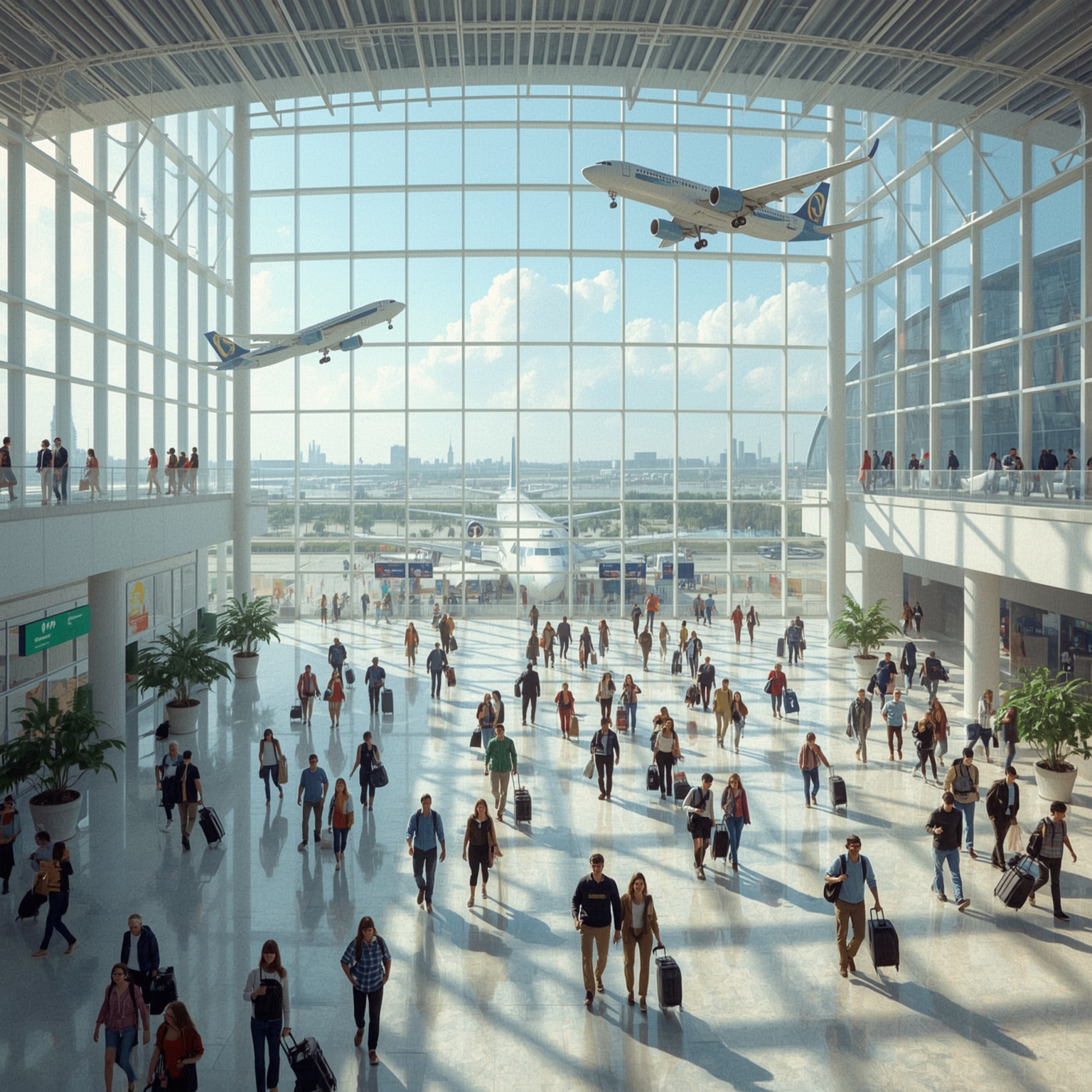
The Federal Aviation Administration (FAA) announced that the widespread flight reductions imposed during the recent government shutdown would officially conclude at 6 a.m. on Monday. This long-awaited move effectively marks the end of a period of constrained flight schedules and heralds a gradual return to normal operations at airports across the United States. The decision arrives at a critical juncture, as the nation enters the busy travel period leading up to Thanksgiving—a holiday that traditionally sees one of the highest volumes of airline passengers in the year. With these restrictions lifted, airports are expected to ramp up their activity, facilitating increased passenger flow and restoring vital air travel capacity that had been limited during the shutdown.
According to a detailed press release issued by the agency on Sunday evening, the FAA based its decision on a careful evaluation of current safety conditions and operational data. The agency emphasized that before rescinding the emergency order that mandated flight reductions, it had performed a comprehensive review of ongoing safety trends and staffing adequacy. This analysis revealed a significant improvement in controller availability: the number of so-called “staffing triggers”—a metric used to indicate when the number of on-duty air traffic controllers falls below the minimum safe staffing levels—had declined dramatically. On Sunday, just a single staffing trigger was recorded, compared to an unprecedented peak of eighty-one on November 8, illustrating a substantial recovery in personnel levels and operational stability.
Transportation Secretary Sean Duffy expressed his appreciation for the agency’s workforce and for the public’s understanding throughout this unprecedented interruption. In the statement, Duffy commended the FAA’s safety professionals for their unwavering commitment to maintaining security and flight integrity during what he described as the nation’s longest government shutdown. He also extended gratitude to travelers and citizens for their patience, noting that prioritizing safety above expedience remained the government’s foremost concern even under difficult circumstances.
Among the federal employees most directly affected by the stopgap in government funding were air traffic controllers, whose specialized work is fundamental to the safety and efficiency of the U.S. aviation system. Thousands of these professionals, together with other essential federal workers, endured weeks without pay. As financial strain deepened—particularly after October 28, when many controllers missed their first full paycheck—reports began to surface of increasing absenteeism, with several employees calling in sick. These absences compounded the already fragile staffing situation, ultimately causing systemic challenges and prompting the FAA to mandate a nationwide reduction of roughly ten percent in flights across forty major airport hubs.
Data from the aviation analytics company Cirium provides a snapshot of how airports operated under these restricted conditions just before the new announcement. On Sunday, 17,404 flights had been originally scheduled at the forty affected airports. Despite this high level of activity, the overall cancellation rate was an impressively low 0.25 percent—below the standard industry average—and on-time departures reached a remarkable 91 percent, surpassing normal performance expectations. These figures suggest that, even under considerable pressure, airline and airport personnel managed operations with notable efficiency and discipline.
Nonetheless, the operational disruptions earlier in November left a visible mark on the national travel network. Between November 7 and November 10, more than 7,000 flights across the United States were canceled, generating widespread congestion and frustration. Many travelers found themselves stranded at airports for extended periods, while pilots and other airline workers voiced their exasperation, particularly over the tarmac delays and the wider uncertainty surrounding the shutdown’s duration.
Political commentary soon followed. President Donald Trump stated that air traffic controllers who chose to call in sick during the shutdown could face disciplinary consequences, while those who demonstrated loyalty by continuing to report for duty despite missed paychecks should receive a $10,000 bonus. Homeland Security Secretary Kristi Noem echoed this sentiment, indicating that a similar reward might be extended to select Transportation Security Administration (TSA) agents who had exhibited exceptional dedication and professionalism during the period of financial hardship.
After forty-three tense and tumultuous days, the shutdown finally came to an end on Wednesday, concluding the longest federal government suspension in American history. The cessation of the shutdown restores stability to the nation’s crucial transportation networks, symbolizing not only a technical and administrative recovery but also a moment of renewed public confidence as travelers prepare to take to the skies for the holiday season.
Sourse: https://www.businessinsider.com/faa-lifts-government-shutdown-flight-cuts-at-major-airports-2025-11


