More than three decades ago, when I was still a toddler barely old enough to form complete sentences, my mother embarked on what would become one of the defining endeavors of her life — the founding of her own business. Those early days remain etched vividly in my memory, not because of grand milestones, but due to the countless small moments that formed the rhythm of our lives. I can still recall curling up between two office chairs that I had pushed together to create a makeshift bed, drifting to sleep to the mechanical whir of dot-matrix printers and the rhythmic tapping of calculator buttons. Those sounds became the lullaby of my childhood, underscoring my mother’s tireless pursuit of stability and success. She poured her days and nights into her work, propelled by an unwavering determination and a singular goal — to create better educational opportunities for her children than she herself had received.
That dream became the compass of my own academic journey. I carried her hope forward, striving to make real the effort she had invested, until the day I proudly earned my bachelor’s degree, a testament to her sacrifices and resilience. Yet, what I never anticipated was that our shared devotion to education would later become the very thing that would test the limits of our understanding of one another. When, years later, I became a mother and chose to homeschool my own daughter, my mother’s immediate reaction was far from supportive. Her skepticism was rooted not in a lack of faith in me, but rather in the unfamiliarity of an educational approach so different from the traditional system she had trusted all her life.
Becoming a parent awakened in me a deep curiosity to explore new educational possibilities, and homeschooling stood out for the freedom, adaptability, and creativity it promised. I was drawn to the idea of tailoring lessons to my daughter’s natural interests and strengths — allowing her learning to unfold organically through lived experiences rather than being confined to rigid curricula or standardized expectations. When the time came to prepare for kindergarten, I chose not to force a fixed agenda upon her. Instead, I allowed space for curiosity to ignite naturally, encouraging her to explore, question, and learn at her own rhythm.
To my mother, however, this decision seemed counterintuitive. Having built her worldview around the structure and predictability of the public school system, she viewed my unstructured approach with concern. Her hesitation was understandable; when I was growing up in the 1990s, homeschooling carried an unavoidable stigma. Children educated outside traditional schools were often labeled as socially awkward, reclusive, or unprepared for the real world. My mother feared this same isolation for her lively, sociable granddaughter — the very traits she treasured and wanted to protect.
Despite her doubts, I pressed forward, determined to show rather than tell her what homeschooling could be. Throughout that first summer, while she bustled around the kitchen, she would glance over as I introduced early reading, counting, and science concepts during day-to-day activities. Over time, her initial skepticism began to soften into quiet curiosity. The more she observed, the less foreign the idea seemed. She began to see that learning at home did not mean learning in isolation; it could be vibrant, dynamic, and deeply personal.
I experimented with a combination of educational methods — some days my daughter worked through interactive online courses at her own pace, while on others, I transformed everyday tasks like cooking dinner or organizing the pantry into spontaneous lessons in math, science, and problem-solving. Slowly, my mother’s distance shortened; one afternoon, I noticed her pulling up a chair at the dining table, leaning in to watch more closely. A few weeks later, she volunteered to lead short reading and spelling sessions, and before long she had embraced her new role as my daughter’s second teacher.
The transformation culminated on a day that remains dear to me. I walked into the kitchen to find my mother had meticulously arranged teaching materials on the dining table — phonics cards fanned out beside neat rows of pencils, a small whiteboard bearing carefully written words, and a container of animal cookies serving as playful rewards. In that moment, I stood still, overwhelmed by a sense of continuity. Watching her guide my daughter reminded me of the long afternoons she had once spent teaching me to read, patiently introducing me to stories that awakened my imagination. Those cherished moments of shared reading — especially the times we curled up with picture books until I could proudly read them aloud myself — had planted the seeds of the lifelong curiosity that defines me still.
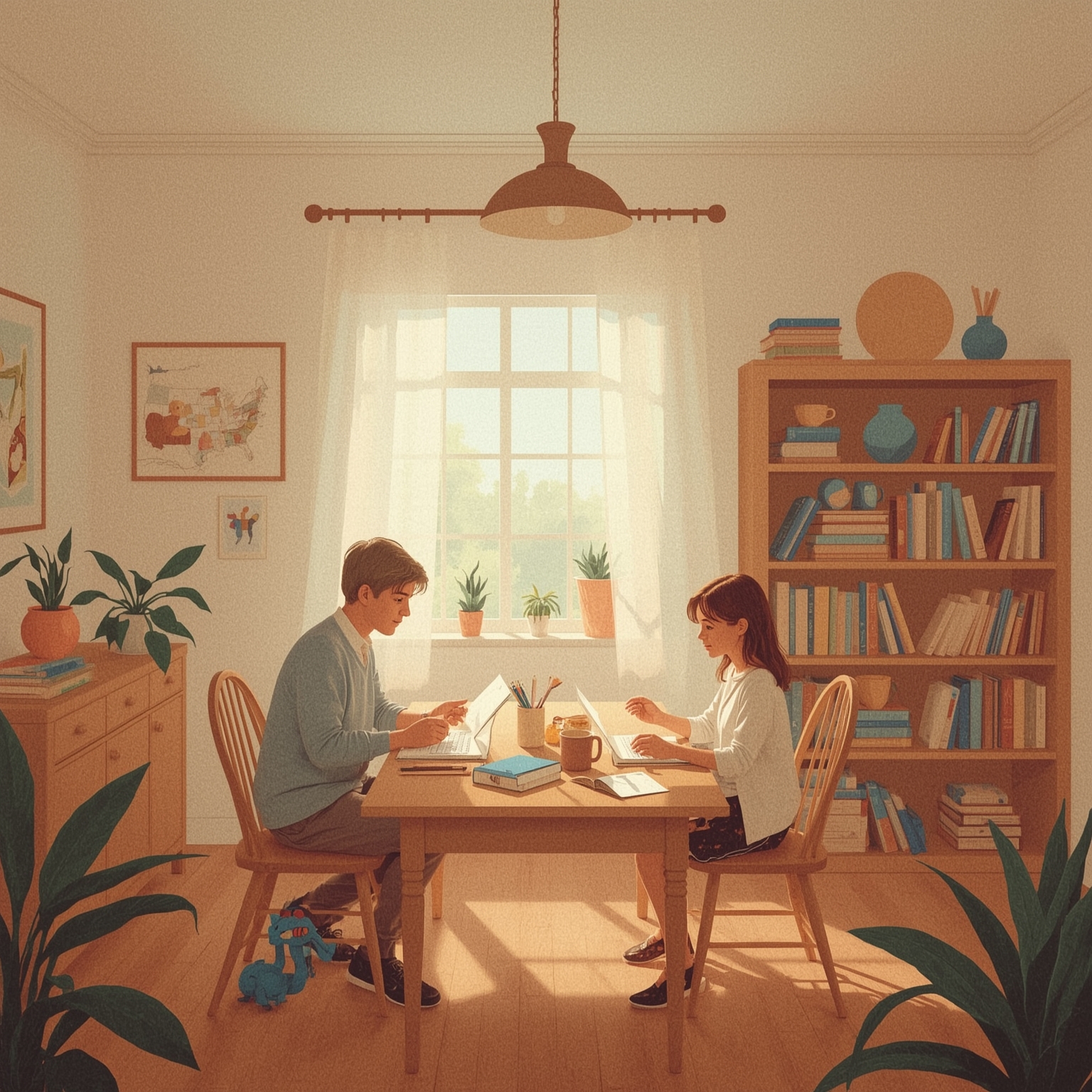
Now, decades later, our family finds itself gathered around that same table, three generations intertwined in one evolving story. My mother, seated on one side, seems to rediscover a lighter, joyful version of herself — a side she had set aside during the years of relentless work and responsibility. My daughter, on the other side, radiates enthusiasm, clapping along as we break words into syllables, sounding out letters and dancing with delight at each new sentence she conquers. I sit between them, struck by the quiet beauty of the moment — the awareness that what began as a point of division has become a shared source of purpose and renewal. Together, we are not only revisiting precious memories but also weaving new ones, learning and laughing in the same rhythm.
Through this experience, homeschooling evolved beyond an educational choice; it became the living thread that binds three generations together. Our days are colored by my mother’s vivid recollections of her own childhood in 1950s South Texas, when classrooms were simpler but teachers held an almost mythic influence on their students’ lives. As she recounts those stories — of chalkboards, recess games, and the mentors who shaped her youth — my daughter listens wide-eyed, absorbing family history through the lens of learning. Laughter fills the room as nostalgia meets discovery, and for a moment time seems to fold in on itself.
Having my mother as a partner in this journey has proven to be one of the most unexpected and rewarding blessings of my adult life. On days when my professional commitments demand attention, she steps in seamlessly, ensuring the continuity of learning. My daughter benefits from two distinct teaching styles — my methodical, exploratory approach complemented by my mother’s time-tested patience and experience. The collaboration between us bridges not only generations but philosophies: the sturdy discipline and work ethic of the past meeting the creativity and flexibility of today’s educational landscape.
What began as a clash of ideals has matured into a profound family alliance and a celebration of shared purpose. My mother’s love of learning, once confined to her own students and workplace, now flows freely toward her granddaughter. I, in turn, witness the legacy of her perseverance coming full circle — embodied in the laughter, curiosity, and progress that fill our homeschool days. Each phonics lesson, every solved equation, and even every animal cookie shared at the table stands as a small testament to how understanding and openness can turn doubt into connection and transform a generational divide into an enduring bond.
Sourse: https://www.businessinsider.com/grandma-against-homeschooling-helping-mom-teach-2025-11


