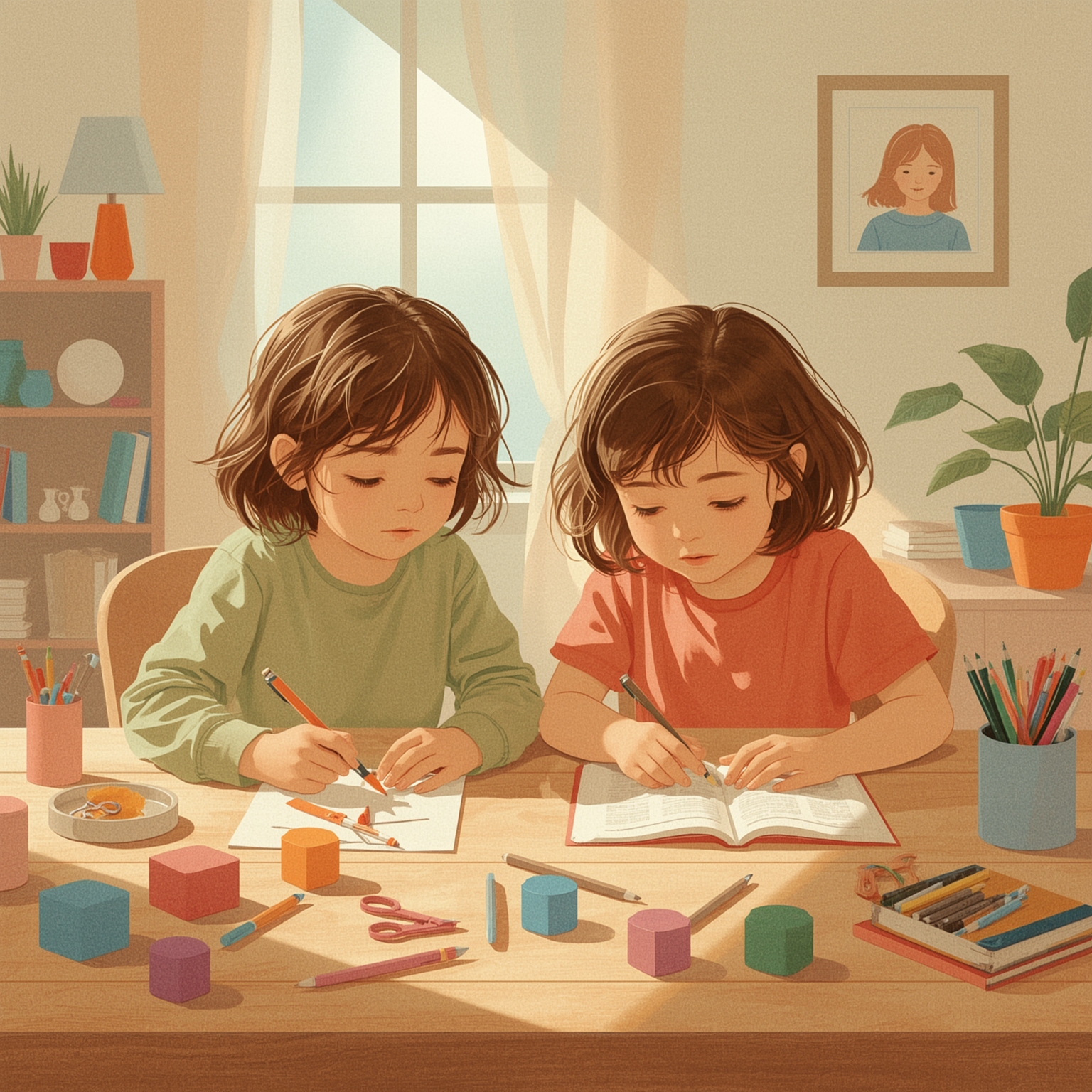
From the time I was a child, I found myself deeply intrigued by the phenomenon of twins. Their mysterious connection, their mirrored existence, and the quiet synchrony that seemed to unite them always fascinated me, even though no twins existed within my immediate or extended family. So, when fate blessed me with twin boys of my own—an occurrence unprecedented in our entire family lineage—it felt as though life had woven a thread of magic into our story. I had often heard about the singular, almost ethereal bond shared by twins, how they seem to understand one another through glances and gestures more eloquent than speech. The prospect of witnessing that bond firsthand filled me with wonder; it was as if I were about to observe a living narrative unfolding before my eyes, one composed of instinctive understanding and silent communication.
Now, my sons are thirteen, but from the very beginning, their closeness has been unmistakable. From infancy, each milestone—whether a first smile, a hesitant step, or a babbled word—emerged almost in tandem, separated only by days. Their lives seemed to move in rhythmic harmony. They have always shared a cadence that transcends mere companionship, one woven into the subtleties of their daily existence: a mutual rhythm of reactions, the same bursts of laughter, inside jokes that required no clarification. Their understanding of one another often rendered explanation unnecessary, as if they conversed in a language known only to them. As they grew, their common interests became another expression of this unity. They gravitated toward the same toys, delighted in identical games, and even carried the same expressions across their faces. I vividly recall a moment from their childhood: they were about five, sitting at their small table, dressed in matching T-shirts, eating their dinner in synchronized motions. When my cousin walked in and paused, she remarked with astonishment, “It looks like he’s eating in front of a mirror.” Her words captured exactly what I felt. Their resemblance went beyond appearance—it was as though their entire way of existing in the world was intertwined, reflecting a shared essence rather than just shared looks.
This extraordinary bond between them has always been something I’ve held close to my heart, a source of awe and gratitude. Yet, as they grow older, my awareness deepens: part of growing up means learning to step into one’s own identity. While their connection remains something sacred, I understood that they would need to embrace their individuality if they were to fully flourish as their own people. In retrospect, I realized that my husband and I, with the best of intentions, had unintentionally nurtured their sameness. When they were little, I often leaned into what I now call the twin aesthetic—matching clothes, identical shoes, and coordinated accessories. At the time, the choice was both practical and emotionally comforting. Dressing them alike avoided the complications of comparison and decision-making. It was easy and charming and symbolized their precious connection, a visible manifestation of the bond we cherished watching evolve.
The same mindset extended into other areas of their lives. Whenever one chose an activity—say, swimming lessons or taekwondo—the other instinctively joined in. It simplified scheduling, and to us, their happiness together seemed to validate that decision. But time has a way of reshaping perspective. As they matured, small yet telling moments began to make me reconsider whether this perpetual togetherness was serving them equally well. I recall a specific instance: one of the boys fell ill on the morning of a birthday party both had been excited to attend. His brother, who had eagerly anticipated the celebration all week—choosing his outfit and carefully wrapping the gift—did not hesitate even for a moment before declaring, “Then I won’t go either.” And that was that—no persuasion, no questioning, just an unspoken loyalty that overrode his own desire.
A similar pattern echoed later when their teachers mentioned academic planning for the years ahead. Each time a new subject or elective arose, their first instinct was not to explore personal interest, but rather to check which option the other had selected. It became clear to me that their choices were no longer purely about preference or curiosity; they were about maintaining closeness, about ensuring that togetherness remained unshaken. That realization was both tender and troubling. Their bond was indeed beautiful and rare, but it was also shaping their sense of identity—perhaps too strongly, blurring the boundaries that separate companionship from individuality.
I recognized then that as parents, our task was not to dismantle their closeness, but to gently create space within it—a broadened framework that allowed for independence without sowing distance. We began making deliberate yet delicate shifts. Instead of purchasing perfectly identical outfits, I started selecting the same style in two different colors, encouraging them to decide who preferred which. It was a small gesture, yet it introduced a quiet differentiation that felt natural. There were no arguments, no envy, merely easy acceptance: one would take blue, the other green, as though acknowledging an unspoken agreement that difference could coexist with harmony.
In our conversations, too, subtle changes emerged. We began to talk, in casual and encouraging tones, about the idea that having different preferences or pursuing different interests was not a sign of separation but an expression of individuality that could, in fact, strengthen their bond. Liking distinct subjects, choosing different clubs, or exploring separate skills did not mean drifting apart—it meant growing in parallel, enriching both of their worlds. This newfound philosophy extended to extracurricular activities. When the next round of sports trials came at school, we encouraged each of them to follow genuine enthusiasm rather than habitually mirroring the other. The outcome delighted all of us: one earned a spot on the football team, while the other excelled in basketball. The change added layers of complexity to our routine—different practice times, dual sets of gear, and logistical juggling—but these minor inconveniences were small prices to pay for the invaluable lesson we were all learning: nurturing individuality is a process that challenges not only the child but the parent as well.
Through all of this evolution, what remains unwavering is the extraordinary connection my sons share. It is a bond I treasure every day, one that defines their history together. I would never wish to undo or diminish it; indeed, I doubt such a thing could be done even if I tried. My hope, instead, is that as they continue to grow and step into more complex worlds—new schools, friendships, and experiences—they carry forward the awareness that love does not require replication. One can hold another person dearly and still stand firmly as oneself. True closeness does not demand sameness; it flourishes through respect for individuality. I want them to understand that they are not faced with a choice between unity and independence because the beauty of their relationship lies in having both. They can remain each other’s constant while simultaneously becoming the fullest versions of themselves. And to me, that balance—between deep connection and selfhood—is the most magical thing of all.
Sourse: https://www.businessinsider.com/multiples-twins-inseparable-encouraging-them-to-be-individuals-2025-11