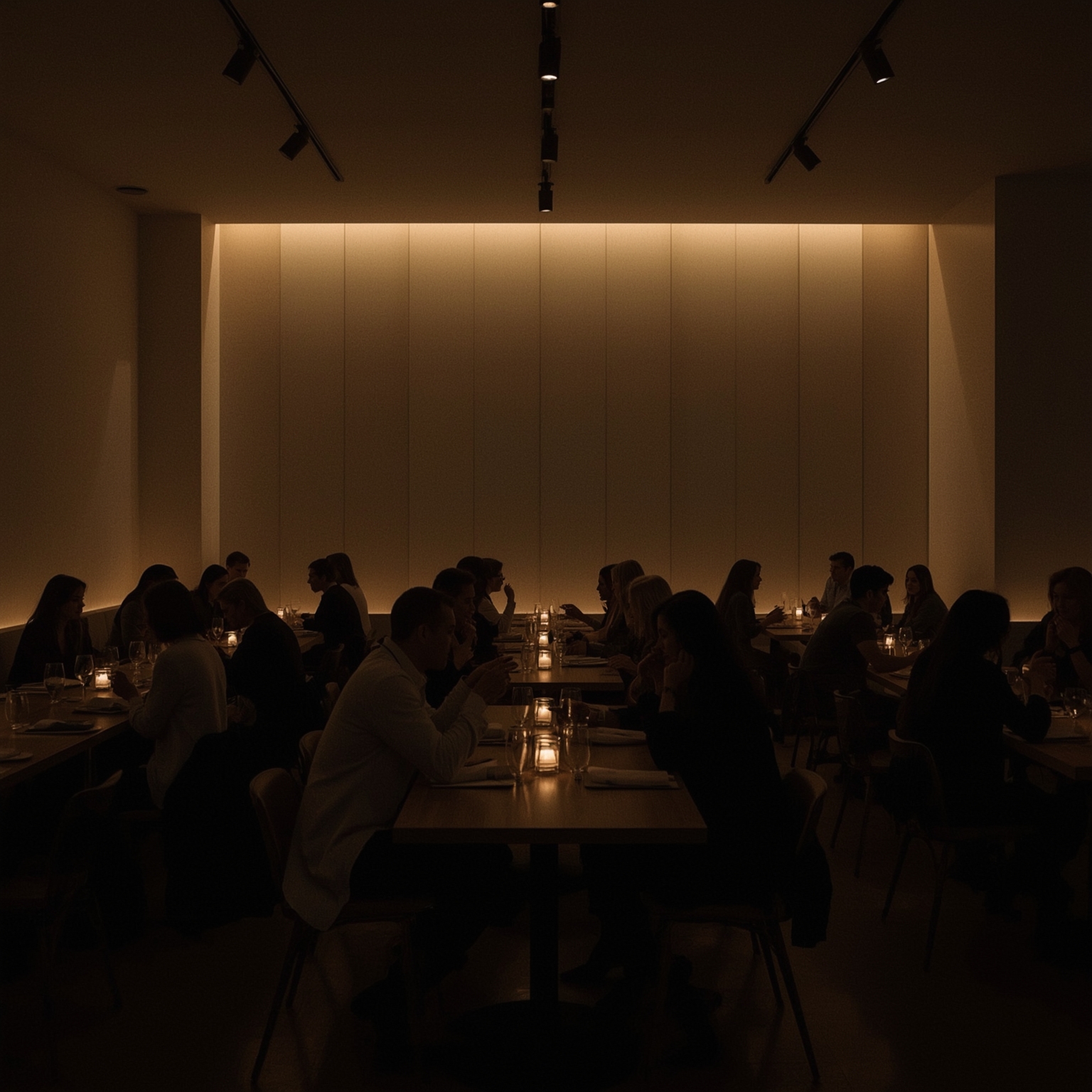
In earlier decades, many diners instinctively recoiled at the concept of dining mere inches from strangers, viewing the practice as an intrusion upon their personal space or a breach of mealtime intimacy. Yet, the cultural tide appears to be shifting. Members of Generation Z — a cohort known for its complex relationship with digital connectivity — are now, quite literally, pulling their chairs closer to one another. The latest data released by Resy, a leading online restaurant reservation platform, reveals a striking generational divide: while only 60% of baby boomers express enthusiasm for communal tables, an impressive 90% of Gen Z diners say they actually enjoy the shared-table experience. This statistic underscores a remarkable revival of one of the restaurant industry’s most polarizing traditions — the practice of seating multiple, unrelated parties together at expansive banquet-style tables.
For a generation raised amid the glow of screens yet yearning for tangible, face-to-face human contact, the act of sharing a table with strangers transcends the practical question of proximity. It has evolved into an appealing opportunity for curated social interaction — a middle ground between solitude and oversharing, offering just enough room for serendipitous connection. Such arrangements hold the prospect of starting an engaging conversation with a stranger, forming an unexpected friendship, or even sparking the beginning of a romantic relationship. Pablo Rivero, CEO of Resy and Tock, and Senior Vice President of Global Dining at American Express, notes that the culture of sharing dishes has become the new norm, especially among younger eaters. Communal tables, he says, provide the ideal setting for this trend, effortlessly transforming dinner into an event rather than a mere meal. “You never know who you’ll be seated beside,” Rivero explains with enthusiasm. “That unpredictability is precisely what makes it exciting.”
Supporting these insights, Resy’s report shows that 63% of respondents believe communal seating is a wonderful avenue for meeting new people, with half reporting they have engaged in meaningful or intriguing discussions that otherwise would not have occurred in a traditional dining setup. One-third say they have formed new friendships through this format, while one in seven even credit a communal table encounter with leading to a date. It appears that what was once derided as awkward enforced intimacy has, for a new generation, become a source of intentional and pleasurable human connection.
The concept itself is hardly new, yet it has long divided opinion. In popular culture, communal dining has been portrayed with humor and discomfort alike, appearing in television comedies such as FX’s *You’re the Worst* and IFC’s *Portlandia*, where characters contended with unwanted closeness and stilted small talk. For diners predisposed toward privacy or self-consciousness, the notion of sitting shoulder to shoulder with strangers might resemble an endurance test in social anxiety rather than a rustic form of sociability. Yet perspectives differ, and for some, these shared spaces are uniquely comforting.
Michael Della Penna, Chief Strategy Officer at the digital research firm InMarket and a parent to two Gen Z children, offers a revealing explanation. He observes that for a generation widely labeled as anxious, the communal dining format can actually serve as a gentle facilitator of engagement. Because conversation at a large table tends to develop organically among multiple participants, no single individual bears the burden of initiating or sustaining dialogue. In Della Penna’s words, group conversations “provide a safer environment,” particularly for those who may doubt their own social fluency after years of digital communication. For such individuals, speaking up within a collective is less daunting, offering a comforting halfway point between online and offline worlds. It is, he suggests, a socially moderated bridge — a means of reconnecting without exposure to the pressure of performing one-on-one.
Beyond the psychological reassurance it provides, communal dining also offers practical advantages. Shared plates typically make a meal more affordable, distributing cost while allowing diners to sample a wider range of flavors without committing to an entire entrée. The experiential value, too, is greater: the sensory immediacy of shared meals far surpasses that of takeout containers or drive-thru dining. Moreover, in an age where even food presentation doubles as social media content, a long wooden table elegantly lined with shared dishes furnishes the perfect backdrop for Instagram-worthy moments.
Historically, communal dining carries deep cultural and emotional resonance. Donnie Madia, acclaimed Chicago restaurateur and partner of the twelve-time James Beard Award–winning One Off Hospitality group, reflects on how societal upheavals have repeatedly rekindled the desire for shared dining experiences. Following the tragic events of 2001, Americans yearned for closeness and intimacy. Restaurants became places of solace — intimate spaces where proximity offered comfort. A similar wave of togetherness followed the 2008 financial crisis, when diners sought festive, convivial atmospheres as an antidote to economic anxiety. Madia observes that these cycles demonstrate a timeless truth: in moments of collective uncertainty, people instinctively reach for communal rituals, and eating together serves as one of humanity’s most fundamental expressions of solidarity.
Madia further contends that the recent resurgence of communal dining represents not merely a stylistic trend but a profound realignment toward human connection, a need amplified in today’s post-pandemic world. As society accelerates toward ever more immersive digital and artificial experiences — from AI chatbots to virtual realities — many feel a corresponding hunger for the tangible, the unfiltered, the palpably real. Gen Z, in particular, appears to be leading this recalibration. Their gradual rejection of hyper-digitized living manifests not only in their cautious attitude toward artificial intelligence but also in cultural choices such as the surprising revival of flip phones — simple, tactile devices favored for their offline authenticity. Within this context, dining communally becomes a symbolic act: it is a deliberate embrace of shared physical presence, a conscious return to touch, taste, and human conversation that cannot be downloaded or mediated through a screen.
This renewed appetite for tangible connection extends beyond restaurants to home-based social gatherings. Across cities and campuses alike, Gen Z is reigniting the tradition of dinner parties and intimate supper clubs, opting for evenings marked by cozy authenticity instead of faceless nightlife. These gatherings combine affordability with emotional richness, providing a sense of belonging that both counters digital isolation and fulfills a craving for personalized experiences.
Ashley Mitchell, Vice President of Marketing for East Coast Wings + Grill and Sammy’s Sliders, aptly summarizes this generational shift: “Gen Z is driving a movement back toward dining that is as much about shared experience as it is about eating.” She emphasizes that although this generation matured in an online world, its members are now actively seeking genuine connection in physical spaces — and the restaurant, once again, has become a social hub rather than a mere service venue. For them, she says, the act of sharing a table is no longer a logistical compromise; it is an intentional choice that transforms the meal into a communal narrative. In essence, Gen Z is redefining the meaning of dining out — not as consumption, but as connection.
Sourse: https://www.businessinsider.com/gen-z-dining-trends-communal-table-restaurants-2025-11