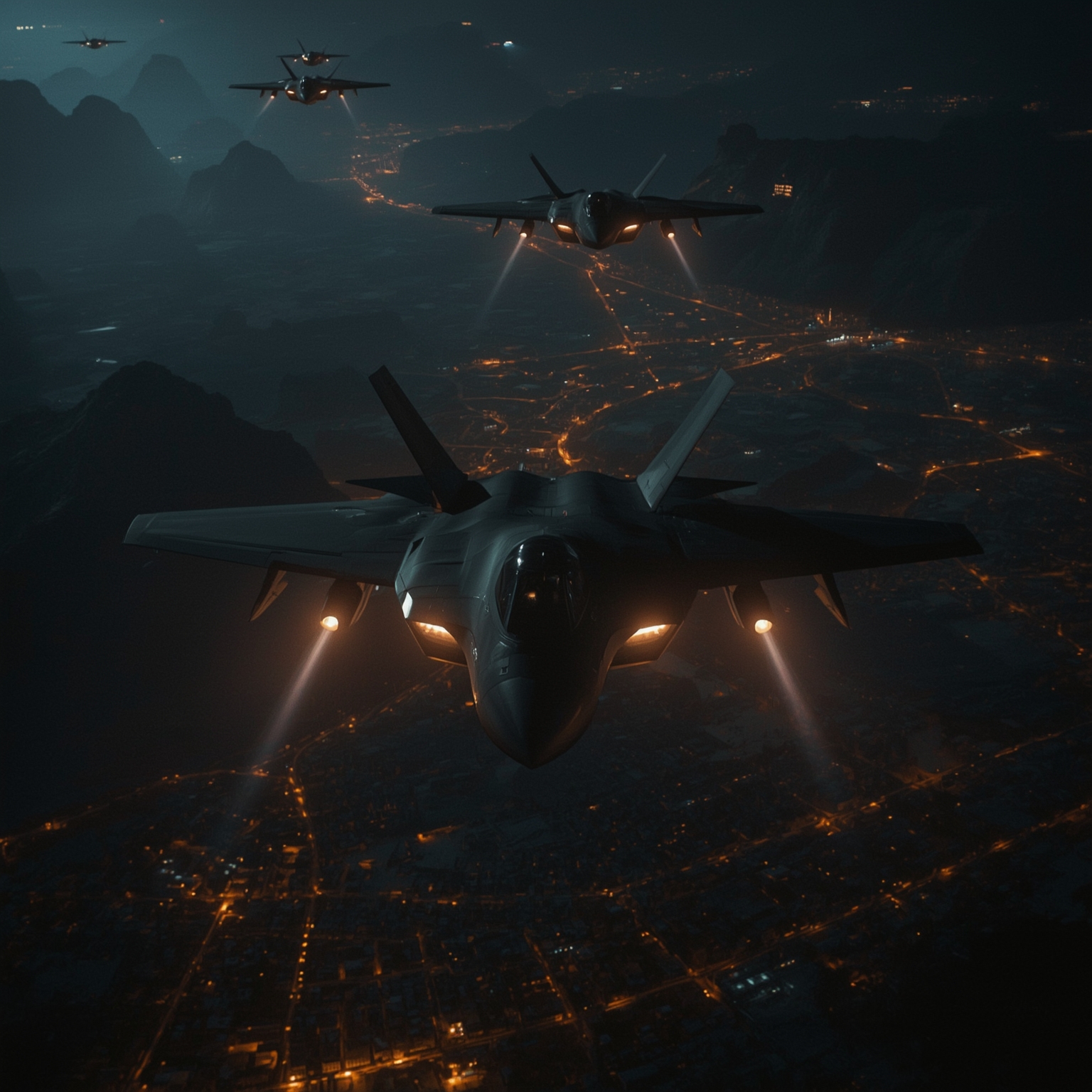
American F-35 stealth fighters played a crucial and daring role in Operation Midnight Hammer, a series of precision strikes aimed at Iran’s most fortified nuclear facilities. According to recent disclosures by U.S. military commanders, these fifth-generation aircraft penetrated hundreds of miles into Iranian airspace—demonstrating both the range and strategic confidence of the mission—and were the final combat assets to exit the country’s skies after the operation concluded. The involvement of the F-35A Lightning II, attached to the renowned 388th Fighter Wing stationed in Utah, was particularly significant, as these aircraft were charged with escorting the B-2 Spirit stealth bombers responsible for delivering more than a dozen heavy bunker-buster munitions against deeply buried Iranian targets in late June.
The F-35s not only provided protection for the B-2s but also spearheaded the suppression of Iran’s integrated air defense network, meticulously neutralizing radar and surface-to-air missile sites that could have threatened the strike force. This complex nighttime endeavor required precise timing and seamless coordination among multiple airframes operating in a highly contested environment. Lieutenant Colonel Aaron Osborne, commander of the 34th Fighter Squadron, emphasized the depth of their mission, noting that his pilots escorted the B-2s through the entirety of Iranian airspace and used precision-guided weapons to destroy multiple enemy missile batteries with remarkable accuracy.
Following the successful release of fourteen GBU-57 Massive Ordnance Penetrators—each weighing roughly 30,000 pounds and designed to annihilate hardened underground facilities—the F-35s once again demonstrated their multifaceted combat value. They shielded the departing bombers from possible counterattacks, safeguarding the exit corridor until every allied aircraft had cleared the zone. On Monday, the 388th Fighter Wing confirmed that the F-35s were the last to withdraw from the operational area, underscoring their indispensable role in guaranteeing mission completion. Surprisingly, despite the deep penetration into Iranian territory and the scale of the U.S. assault, Tehran refrained from firing upon any American aircraft during the course of Midnight Hammer, according to official reports.
The 388th Fighter Wing regularly trains for suppression of enemy air defenses—a mission set known by the acronym SEAD—at Hill Air Force Base in Utah. These exercises are essential for maintaining combat readiness in scenarios similar to the one faced during Operation Midnight Hammer. The F-35’s suite of advanced capabilities—including low radar observability, high-fidelity sensors, electronic warfare modules, and an unparalleled ability to share and synthesize data in real time—proved instrumental in countering Iran’s extensive surface-to-air missile network.
Manufactured by the U.S. defense contractor Lockheed Martin, the F-35 has accumulated two decades of flight experience since its maiden sortie and has been tested in numerous conflict zones and strategic theaters. From the Middle East to NATO airspace, the jet has confronted a wide spectrum of adversarial threats, participated in Israeli incursions into Iranian territory, and even intercepted Russian drones. It presently forms the backbone of the air forces of multiple allied nations, particularly within the NATO alliance.
While hailed as one of the world’s most capable fifth-generation fighter jets, the F-35 program is nonetheless the most expensive weapons platform ever developed, with an estimated lifetime cost nearing two trillion dollars. These enormous expenses, combined with logistical and maintenance shortfalls, have led to waves of criticism from several political figures, including former Trump administration allies. Moreover, diplomatic frictions earlier this year between Washington and certain European partners raised doubts about future export prospects for the aircraft within transatlantic defense markets.
Despite such challenges, commanders involved in Operation Midnight Hammer offered unqualified praise for the fighter’s battlefield performance. Colonel Charles Fallon, leading the 388th Fighter Wing, stated that the strike’s success verified every long-touted advantage of the F-35: its extraordinary stealth design, lethal precision, advanced sensor fusion, and its ability to magnify the effectiveness of accompanying forces. He noted that both the pilots and the aircraft surpassed expectations when subjected to one of the most demanding operational scenarios to date.
During the late-June offensive, U.S. forces targeted three major Iranian nuclear facilities—Fordow, Natanz, and Isfahan—launching a total of seventy-five precision munitions, including the formidable bunker-busters and dozens of Tomahawk cruise missiles. The strikes occurred amid escalating hostilities between Iran and Israel, adding immense geopolitical weight to an already audacious mission.
In addition to the principal F-35 and B-2 units, a wide array of other American assets participated in the surprise operation. These included F-22 Raptors, F-15 and F-16 fighter aircraft, multiple aerial refueling tankers crucial for sustaining long-range sorties, and even a U.S. Navy missile submarine supporting the effort from below the surface. Together, this diverse coalition of platforms highlighted the sophistication, coordination, and technological supremacy underpinning modern U.S. air power, as well as the pivotal role of the F-35 in shaping the future of aerial warfare.
Sourse: https://www.businessinsider.com/f-35s-flew-deep-iran-last-ones-out-midnight-hammer-2025-11