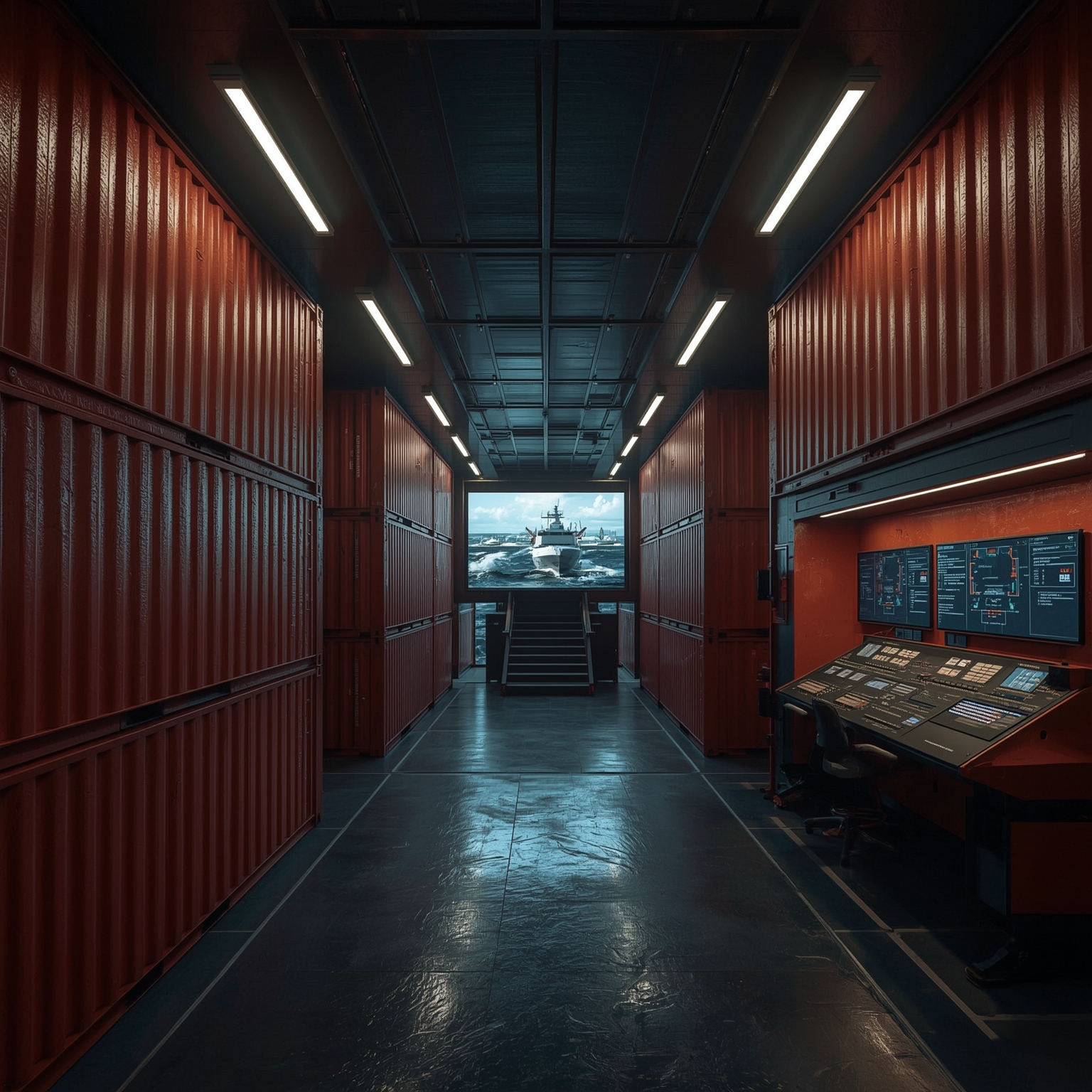
USCG TACLET SOUTH, Opa-locka, Florida — Within the confines of what the Coast Guard calls its “ship in a box,” an elite cadre of Tactical Law Enforcement Teams engages in highly choreographed rehearsals that mirror the moments of extreme tension and precision that define real-world drug interdiction operations at sea. This environment functions as a crucible where every movement, every decision, and every command must be executed with flawless coordination — the kind of mastery that can mean the difference between a successful seizure and a mission gone awry.
In recent years, the Coast Guard has been intercepting historically large quantities of narcotics on the open ocean, marking a succession of record-breaking hauls. To sustain and surpass this high level of performance, its specialized boarding teams undergo continuous, intensive preparation within the meticulously designed mock vessel. The space’s corridors, hatches, and concealed compartments simulate the unpredictable environments of actual smuggling ships, conditioning these teams to respond instantly when a routine boarding escalates into a volatile confrontation.
From an external view, the “ship in a box” might deceptively resemble a stack of ordinary cargo containers — an industrial structure one might find in a shipyard. Yet this unassuming exterior hides a complex, versatile training apparatus built to faithfully replicate the interior of a full-sized maritime vessel. Inside, the layout can be completely reconfigured; its walls, doors, and internal passageways are modular, allowing instructors to vary floor plans and recreate the unique challenges of any target vessel the team might encounter on deployment.
It is here that the Coast Guard’s celebrated Tactical Law Enforcement Teams, better known as TACLETs, refine their expertise. These are the highly trained specialists who execute the most dangerous boardings — typically against vessels suspected of transporting vast shipments of illicit substances such as cocaine or marijuana toward U.S. shores. Their training seeks to anticipate every conceivable twist of an interdiction scenario, ensuring that when they confront traffickers on the high seas, they are mentally and physically primed to prevail.
During a demonstration observed by Business Insider, one such team illustrated the intensity and precision of this program. Exercising rigorous coordination, the operators practiced boarding procedures, sweeping through compartmentalized rooms with deliberate speed and accuracy. They subdued simulated traffickers, neutralized armed adversaries, and secured vital sections of the ship. According to the instructors and participants, it is consistent exposure to this type of high-fidelity, scenario-driven training that sharpens the teams’ readiness and sustains their razor-edge proficiency.
The “ship in a box” sits squarely within TACLET South’s expansive base in Opa-locka, Florida. It features several decks and multiple points of entry, while just beside it lies a small Coast Guard vessel — the initial platform from which boarding simulations commence. The process begins in authentic fashion: operators approach, deploy a ladder from the rail, and cautiously ascend onto the mock vessel. Every team member remains vigilant, weapons trained and eyes scanning. Once aboard, they systematically move to gain control of key sections — from the propulsion areas to cargo holds — identifying and securing any substances, weapon caches, or hostile individuals that might pose immediate risks.
In one training evolution, four Coast Guardsmen quietly entered a compartment where a simulated smuggler stood unaware of their presence. Opting for discretion over confrontation, the team employed silent hand signals to compel compliance, quickly disarmed the individual, and secured him without betraying their presence to other “crew members.” In another variation, they were tasked with waking and restraining two sleeping traffickers, testing their ability to adapt to moments of calm that can suddenly devolve into chaos. Yet even these controlled successes gave way to higher-stakes situations: in one tense scenario, an armed smuggler spotted the approaching law enforcement team and attempted to raise his weapon. The operators responded instantly, neutralizing the threat before a single hostile shot could be fired. Advancing swiftly, they encountered and subdued another armed individual in a nearby cabin. The culmination of these exercises came when all threats had been contained, and the simulated vessel was declared secure.
In actual interdictions, the conclusion of such operations marks merely the beginning of a broader process. Once control is established, crews are questioned, vessel documents are verified, and evidence — particularly narcotics — is meticulously cataloged. Each operation then transitions into the lengthy chain of documentation and legal proceedings necessary to bring traffickers to justice.
According to Commander Chris Guy, the commanding officer of TACLET South, the “ship in a box” represents far more than a training prop — it embodies the rigorous preparedness required of his team. “We train extensively for what we call non-compliant boardings,” he explained, describing mission profiles where Coast Guard personnel must be ready to confront and decisively respond to active threats. “Our goal is to move confidently through constrained spaces while maintaining tactical awareness and executing close-quarters combat techniques when circumstances demand.”
At present, the Coast Guard’s interdiction efforts continue to accelerate, with operations in the Eastern Pacific and Caribbean yielding unprecedented seizures of illegal substances, especially cocaine. Just recently, one cutter achieved the largest single-vessel cocaine seizure in Coast Guard history. The growing scale of these missions underscores the necessity for adaptive, advanced training that evolves in parallel with the threats encountered at sea.
Lieutenant Matthew Lesyk, a TACLET South specialist, summed up the essence of their mission with succinct realism: “You never truly know what you’re going to face out there. We train for uncertainty so that, whatever unfolds, we can respond decisively.” His words capture the unpredictable nature of maritime enforcement — and the continuing importance of the “ship in a box” as both a symbol and a tool of readiness for those guarding America’s maritime frontiers.
Sourse: https://www.businessinsider.com/coast-guard-ship-in-a-box-train-boarding-drug-boats-2025-11