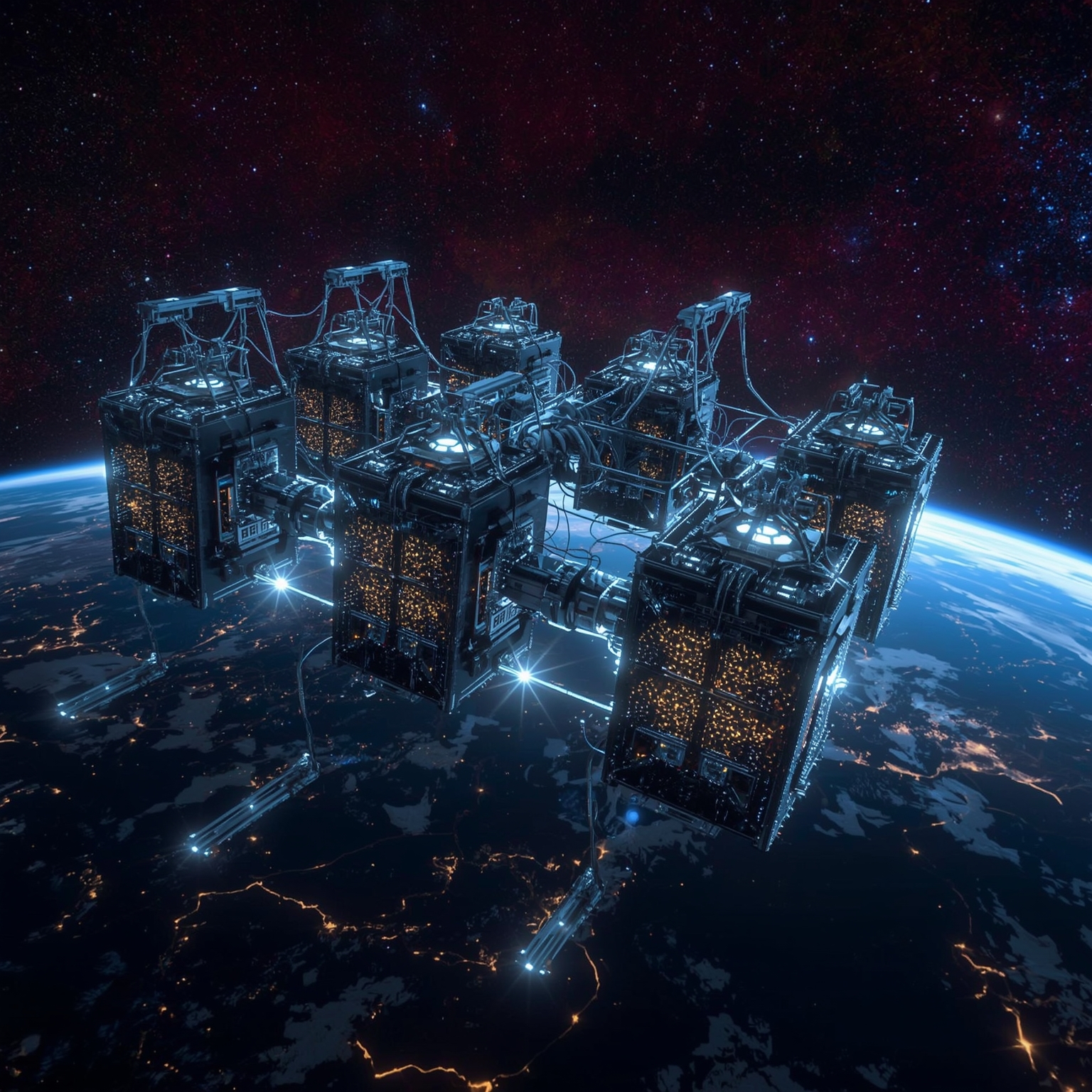
Technology’s most influential leaders appear captivated by a bold and futuristic idea: constructing massive data centers beyond Earth’s atmosphere. During a recent episode of the “Google AI: Release Notes” podcast, Sundar Pichai, the Chief Executive Officer of Google, remarked that such a prospect is, in his own words, “obviously, a moonshot.” The phrase perfectly encapsulates the audacity and experimental nature of the proposal—one that at first glance might seem implausible or even fantastical. Yet, Pichai emphasized that when we take a step back and consider the exponential surge in computational demands driven by artificial intelligence, the rationale behind the concept begins to crystallize. What initially sounds like science fiction, he argued, may ultimately be a question not of feasibility but of timing.
Pichai’s comments were made in reference to Project Suncatcher, a long-term research initiative unveiled by Google in November. This endeavor seeks to explore pathways for scaling machine learning capabilities beyond Earth’s boundaries. In essence, the project aspires to one day enable the training and deployment of AI systems in the environment of space—an effort that would dramatically expand humanity’s computational frontier. While Pichai refrained from revealing many concrete details, he did hint that by 2027, Google hopes to have one of its specialized Tensor Processing Units, or TPUs—custom chips optimized for artificial intelligence—operating in orbit. With characteristic humor, he added that perhaps it might even cross paths with a certain car floating through the cosmos: Elon Musk’s Tesla Roadster.
That lighthearted reference recalls Musk’s 2018 stunt, when he launched his personal Tesla Roadster aboard a SpaceX Falcon Heavy rocket, accompanied by a mannequin clad in a SpaceX spacesuit seated at the wheel. The vehicle has continued to drift through deep space ever since, and at one point, astronomers even mistook it for an asteroid. Yet as whimsical as that stunt may have seemed, it pales in comparison to the immense ambitions of Musk and other technological visionaries who are now seriously contemplating extraterrestrial infrastructure in the age of artificial intelligence.
Musk, for his part, recently offered a glimpse into his own grand vision via a post on X, the platform formerly known as Twitter. There, he declared that the Starship rocket could potentially transport between 300 and 500 gigawatts’ worth of solar-powered AI satellites into orbit each year. Those figures represent a staggering leap in global energy capacity. To place the comparison in perspective, the total capacity of all terrestrial data centers worldwide currently amounts to approximately 59 gigawatts, according to a recent Goldman Sachs report. Musk stressed that the critical phrase in his statement was “per year,” underscoring the transformative magnitude of the undertaking if such production were ever realized.
The context for these lofty projections lies in the escalating energy consumption fuelled by the race to expand artificial intelligence infrastructure. Global electricity demand, analysts forecast, is set to double by the middle of the century, driven in significant part by the construction of increasingly large and power-hungry data centers. In the United States, these facilities have already become one of the most significant contributors to the rising strain on the national power grid. Recognizing that the trajectory of energy demand may soon outpace what Earth-based systems can reasonably support, leaders such as Musk, Pichai, and Amazon founder Jeff Bezos are looking upward—literally. Bezos has suggested that within the next ten to twenty years, humanity could see data centers established in orbit, marking a new epoch in the technological evolution of infrastructure.
OpenAI’s CEO, Sam Altman, echoed similar sentiments during a conversation with comedian and podcaster Theo Von. Altman speculated that while much of the planet might eventually be covered with data centers, the growing computational appetite of AI could eventually force humanity to look skyward. Perhaps, he mused, the long-term solution will be to construct immense computational structures in space—he even invoked the hypothetical “Dyson sphere,” a theoretical megastructure that would harness the full energy output of the solar system, suggesting that the logic of situating such immense facilities on Earth might eventually seem nonsensical.
This line of reasoning explains the growing enthusiasm among tech magnates for relocating data centers beyond Earth. Space offers continuous solar radiation, eliminating the need for the energy storage systems, such as batteries, that ground-based operations currently rely on. Moreover, as Salesforce CEO Marc Benioff recently pointed out in a post on X, the vacuum of space provides natural conditions conducive to efficient cooling, one of the most resource-intensive aspects of data-center maintenance. Benioff summarized the argument succinctly: orbit, he wrote, could represent “the lowest-cost place for data centers.” His statement accompanied a video clip of Elon Musk at the U.S.–Saudi Investment Forum, where Musk extolled the advantages of orbital artificial intelligence systems powered directly by the sun.
Although these ideas remain, for now, at the frontier of speculation, they reveal a striking convergence among the most powerful voices in technology. Whether driven by necessity, ambition, or an enduring fascination with space exploration, these leaders appear to agree that the future of computation may one day extend far beyond the surface of our planet—into the limitless expanse of the cosmos itself.
Sourse: https://www.businessinsider.com/data-centers-in-space-google-moonshot-project-suncatcher-tesla-openai-2025-11