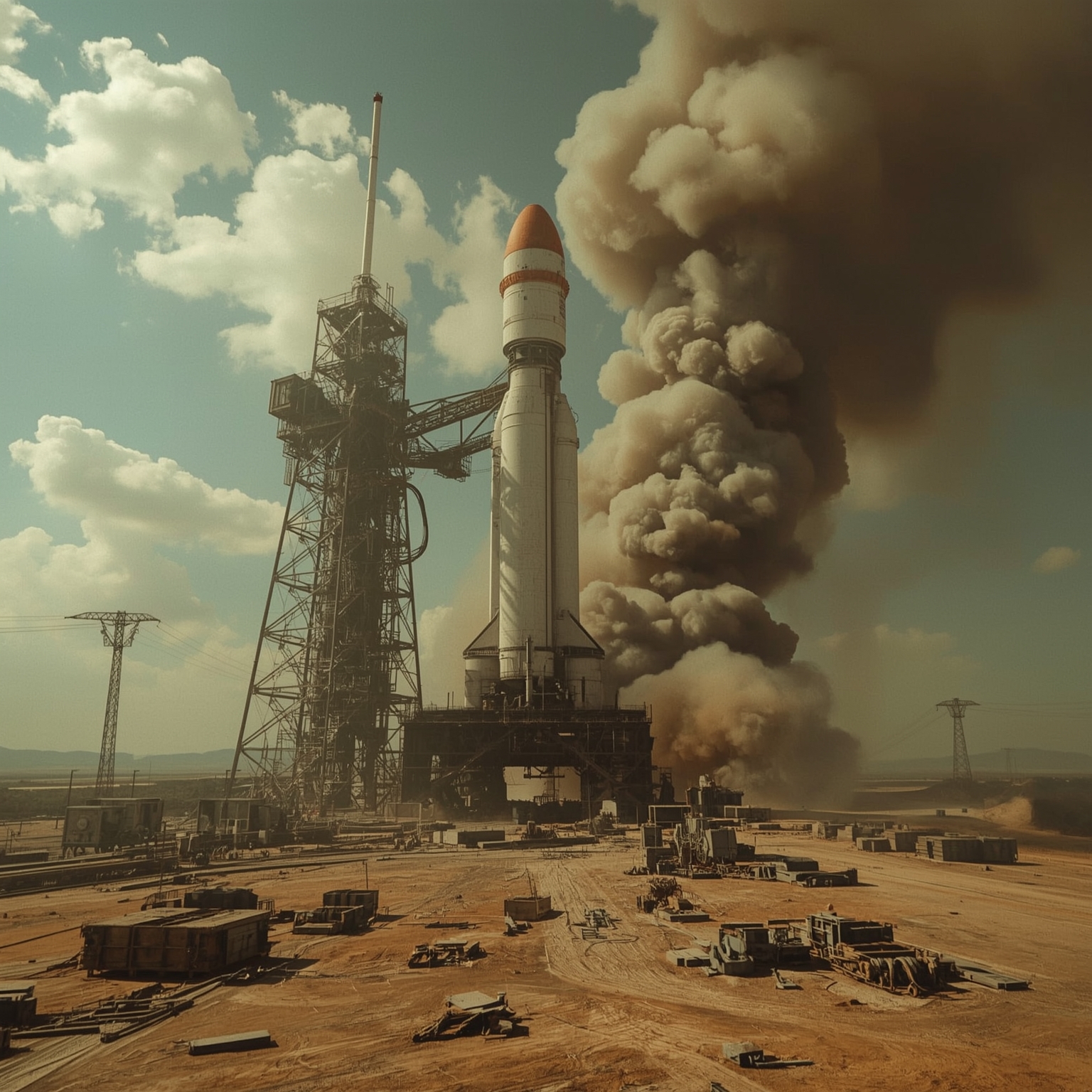
Russia’s only operational launchpad used for sending human missions beyond Earth’s atmosphere has sustained significant and potentially far-reaching structural damage following a rocket launch on Thursday. According to detailed visual records released by Roscosmos — the nation’s governmental space agency — the incident occurred in the midst of a Soyuz rocket departure, resulting in the partial collapse of one of the platform’s key support structures, which then plunged into the vast exhaust trench situated directly beneath the pad.
Official statements provided by Roscosmos to Russian state media later that day verified the occurrence of serious damage at the site, located within the Baikonur Cosmodrome in Kazakhstan. However, at the time of the announcement, the agency refrained from disclosing any definitive assessment concerning the precise scale or extent of the damage. Despite the unexpected destruction on the ground, the launch itself proceeded flawlessly: the Soyuz spacecraft succeeded in reaching orbit, transporting its crew of three astronauts safely toward the International Space Station, with no injuries reported among them.
Nevertheless, video evidence disseminated by Roscosmos suggests that the mishap originated as the Soyuz rocket ignited its powerful booster engines, which appear to have dislodged the service bay — a critical substructure situated beneath the pad — from its original position. Footage released to state media captured the dramatic moment when clouds of debris erupted upward from the trench area as the rocket’s exhaust plume illuminated the facility, possibly signifying an explosion or an abrupt mechanical failure. Moments later, an aerial view recorded by Roscosmos revealed the blackened and distorted remnants of what seemed to be a large metallic section lying amid the trench’s scorched interior. Business Insider analyzed and annotated one of these frames, identifying the wreckage as the likely remains of the dislodged service bay.
This hypothesis is supported by earlier video recordings taken just before liftoff, which clearly depicted the exhaust trench in an undisturbed and empty state moments prior to ignition. The service bay itself serves as an essential part of the launchpad’s overall framework. It forms a reinforced platform near the base of the complex that accommodates critical electrical cables, monitoring sensors, and various operational instruments necessary for the safe handling and monitoring of a rocket’s lower segment before takeoff. In addition, it functions as a workspace for engineers and maintenance personnel to access the rocket’s tail section during pre-launch preparations. Given its role, the dislodging of this bay represents a profound technical setback, as it may compromise both structural integrity and routine safety operations.
The specific mechanism behind the incident remains uncertain. It is not yet known whether the detachment was the result of heat stress, exhaust pressure, or a preexisting structural weakness. Likewise, no official timeline has been provided indicating how long repairs might take or when the facility could return to full functionality. Requests for further comment sent to Roscosmos beyond standard working hours have not yet been answered. The agency released a brief written statement noting that it is conducting a comprehensive assessment of the complex’s condition, adding that backup components required for restoration are already available and that full repairs will be carried out in the near future.
The mission’s human crew comprised two Russian cosmonauts and one NASA representative, astronaut Chris Williams. Reports confirm that all three individuals arrived safely aboard the International Space Station and are continuing their assigned tasks without incident. NASA, when contacted by Business Insider after the launch, did not provide an immediate public response.
The implications of Thursday’s event are potentially significant for Russia’s spaceflight program. The damaged site — designated Site 31/6 — constitutes the country’s sole operational launch facility currently authorized for crewed missions. This installation, constructed during the 1960s at the Baikonur spaceport, has served as a cornerstone of Russian and formerly Soviet human space exploration for decades. The Baikonur complex, which Russia leases from the Republic of Kazakhstan, also houses another historically important pad, known as Site 1 or Gagarin’s Start. That legendary platform was the origin point for Yuri Gagarin’s monumental journey in 1961, the first human spaceflight in history. Although Site 1 remained in use for more than half a century afterward, it was permanently decommissioned from active operation in 2019 due to aging infrastructure and safety concerns.
In recent years, there have been intermittent discussions and proposals aimed at reviving or modernizing Gagarin’s Start. For instance, in 2021, the United Arab Emirates expressed interest in contributing financial support toward its refurbishment, though this initiative appears to have stalled and ultimately failed to progress. By 2023, Russian officials publicly indicated that the historic pad would instead be converted into a museum commemorating the early triumphs of Soviet space achievements.
Meanwhile, Russia has been developing a new domestic launch complex, the Vostochny Cosmodrome, situated within its own territory in the Russian Far East. However, while Vostochny has hosted several uncrewed and satellite launches, the requisite infrastructure for conducting missions with human passengers has not yet been finalized or certified for operation. Consequently, Baikonur — and specifically Site 31/6 — remains the nation’s sole gateway for crewed access to orbit. The recently sustained damage therefore poses a substantial logistical and operational challenge, with the potential to delay forthcoming astronaut flights and place additional strain on Russia’s already limited spaceflight resources.
Sourse: https://www.businessinsider.com/russia-only-way-send-astronaut-space-serious-blast-damage-baikonur-2025-11