Long before the modern era of presidential air travel symbolized by Air Force One, the highest office in the United States journeyed across the nation by rail, aboard an extraordinary and heavily fortified train car known as the Ferdinand Magellan, or officially US Car No. 1. Between the years 1943 and 1954, this unique Pullman car served as both sanctuary and mobile command center for three American presidents—Franklin D. Roosevelt, Harry S. Truman, and Dwight D. Eisenhower—allowing them to carry out their duties even while traveling vast distances across the country. For more than a decade, the Ferdinand Magellan represented the convergence of security, comfort, and national symbolism, effectively functioning as a ‘White House on wheels.’
Originally constructed by the Pullman Company and rebuilt in 1942 at the explicit request of the U.S. Secret Service, the Ferdinand Magellan was transformed into an armored masterpiece during the height of World War II. At over eighty-four feet in length and ten feet in width, its reinforced nickel-steel shell, nearly half an inch thick, and its three‑inch bulletproof glass windows rendered it the heaviest passenger train car ever produced in the United States—surpassing even military tanks of its day. Every alteration, from the installation of escape hatches to the removal of identifying nameplates, was carried out with the president’s protection in mind. Special rail protocols ensured that no train could run within thirty minutes before or after it, granting the presidential entourage absolute control of the tracks.
Franklin D. Roosevelt first received the car on December 18, 1942, and used it primarily for journeys between Washington, D.C., and his family estate in Hyde Park, New York. Because of his physical condition and preference for a slower pace, he restricted the train’s maximum speed to thirty‑five miles per hour. Despite this modest velocity, Roosevelt traveled more than 50,000 miles aboard the Magellan, a figure that highlights both the necessity and the intimacy of train travel for wartime leadership. The president’s final voyage in the car occurred in March 1945, on his way to his retreat in Warm Springs, Georgia—a poignant journey that would precede his death only weeks later.
It was, however, President Harry S. Truman who made the most memorable use of the Ferdinand Magellan. In 1948, during his electrifying thirty‑five‑day ‘whistle‑stop’ campaign tour, Truman delivered more than 350 speeches from the train’s rear observation platform, addressing crowds gathered at small Midwestern depots and bustling city stations alike. In stark contrast to Roosevelt’s cautious travels, Truman often permitted speeds of up to eighty miles per hour, turning the Magellan into a fast‑moving stage from which he rallied public support and ultimately secured reelection. Truman’s successor, Dwight D. Eisenhower, presided over the dawn of the jet age, and by 1954, presidential rail travel gave way to air transport, formally ending the Ferdinand Magellan’s official service.
Although technology advanced, the prestige and nostalgia surrounding this train endured. Decades later, in 1984, President Ronald Reagan temporarily restored the Magellan to operation for a one‑day commemorative whistle‑stop campaign through Ohio, retracing the drama of Truman’s bygone tours. The car once again hosted presidential speeches, demonstrating that this historic artifact still resonated with the spirit of democratic outreach.
Today, US Car No. 1 resides at the Gold Coast Railroad Museum in Miami, Florida, where it has been preserved since 1959 following its donation from the Smithsonian Institution. Declared a National Historic Landmark—the only passenger railcar ever to receive that designation—the Ferdinand Magellan remains open to the public as a tangible relic of twentieth‑century presidential life. Visitors can explore the meticulously restored compartments that once served as both living quarters and professional offices for the nation’s leaders.
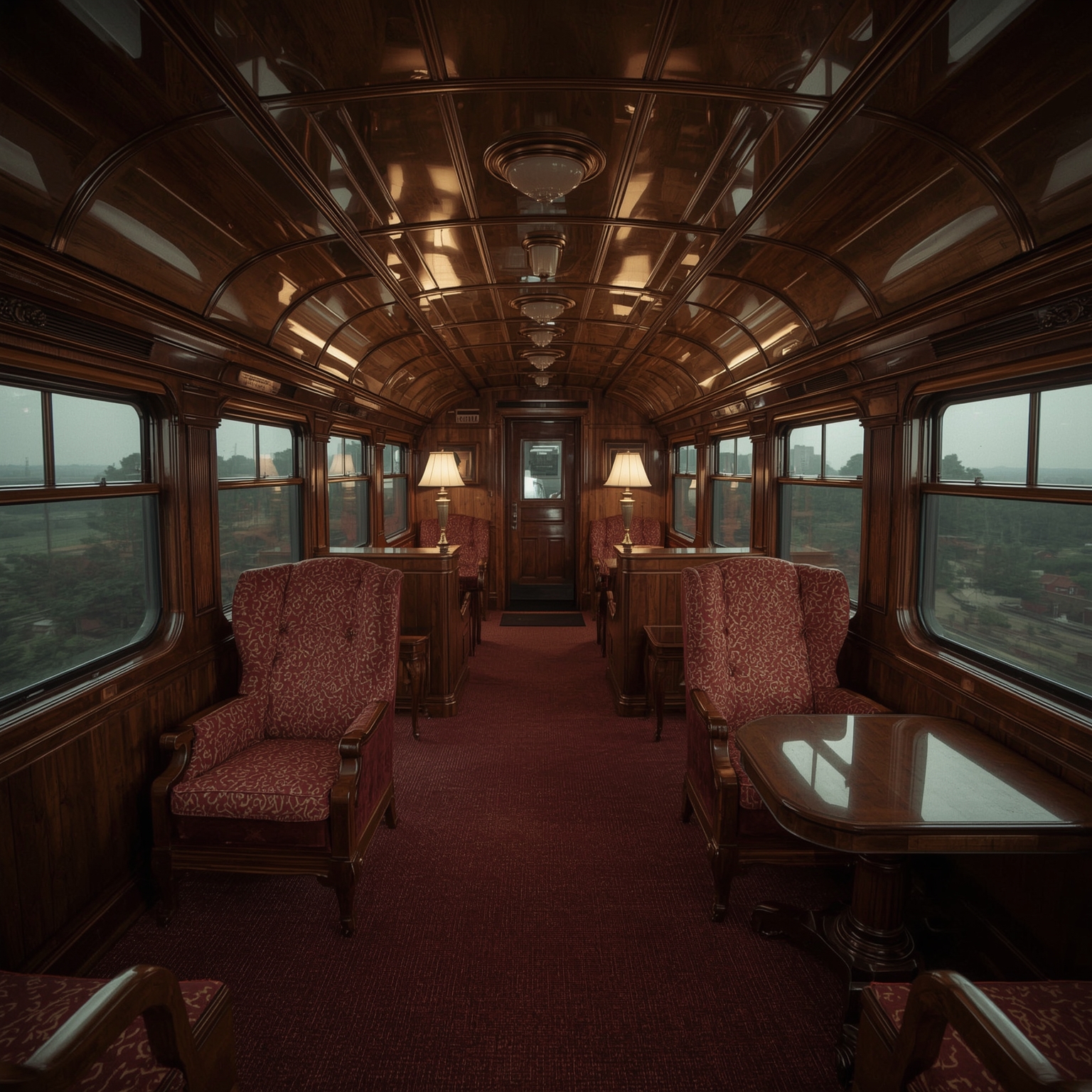
Stepping aboard, one enters through the forward compartment housing a compact yet fully equipped kitchen, where a chef prepared meals using refrigerators, ovens, and ample pantry space. Living adjacent to this culinary nook were two staff members—a chef and a porter—each assigned small berths stacked one atop the other. Proceeding deeper into the car reveals the main dining and conference room, where a polished six‑foot mahogany table served as the centerpiece for formal dinners and policy meetings alike. The room’s shelves display presidential fine china adorned with gold rims and the official seal of the president, underscoring the formality and ceremonial dignity that accompanied even mobile state functions.
Behind the dining chamber lay a private corridor leading to the staterooms. The presidential suite, ingeniously adapted for Roosevelt’s wheelchair access, occupied two connected rooms joined by a bathroom outfitted with a bathtub, sink, and secure escape hatch. The first lady’s adjoining quarters mirrored these comforts, albeit without a private bath. Additional guest staterooms provided sleeping arrangements and could convert into sitting or breakfast spaces, their foldable berths demonstrating efficient design. One such room once accommodated British Prime Minister Winston Churchill during his postwar visit in 1946, linking the car to broader diplomatic history.
At the car’s rear extended the observation lounge, enlarged during refurbishment to accommodate social gatherings and press appearances. It was from this platform that Truman famously addressed cheering crowds, the brass‑railed podium becoming an indelible symbol of mid‑century American politics. Security features subtly integrated here included submarine‑style escape hatches—reminders that even moments of public connection unfolded under guarded vigilance. In later decades, the car sustained minor damage during Hurricane Andrew in 1992, including a cracked window that, preserved today, attests to both the structure’s durability and the passage of time.
Throughout its operational years, the Ferdinand Magellan rarely traveled alone. Typically, it was coupled with companion cars assigned to Secret Service personnel, communications specialists, and members of the traveling press corps. These additional cars ensured that the president remained constantly reachable through radio and telegraph lines, transforming the entire train into a mobile executive network long before instant communication became commonplace.
Though seven decades have passed since the Ferdinand Magellan last served as the president’s principal vehicle, it still rests on live track and remains, at least in theory, capable of movement should a future leader wish to revive tradition. In this way, the car stands not only as a museum piece but also as a living artifact—an enduring bridge between a bygone era of steel rails and today’s jet‑propelled presidency. Its polished wood panels, gleaming fixtures, and fortified windows evoke the essence of a time when diplomacy, governance, and travel converged upon the parallel tracks of history and progress.
Sourse: https://www.businessinsider.com/us-car-number-one-presidential-train-tour