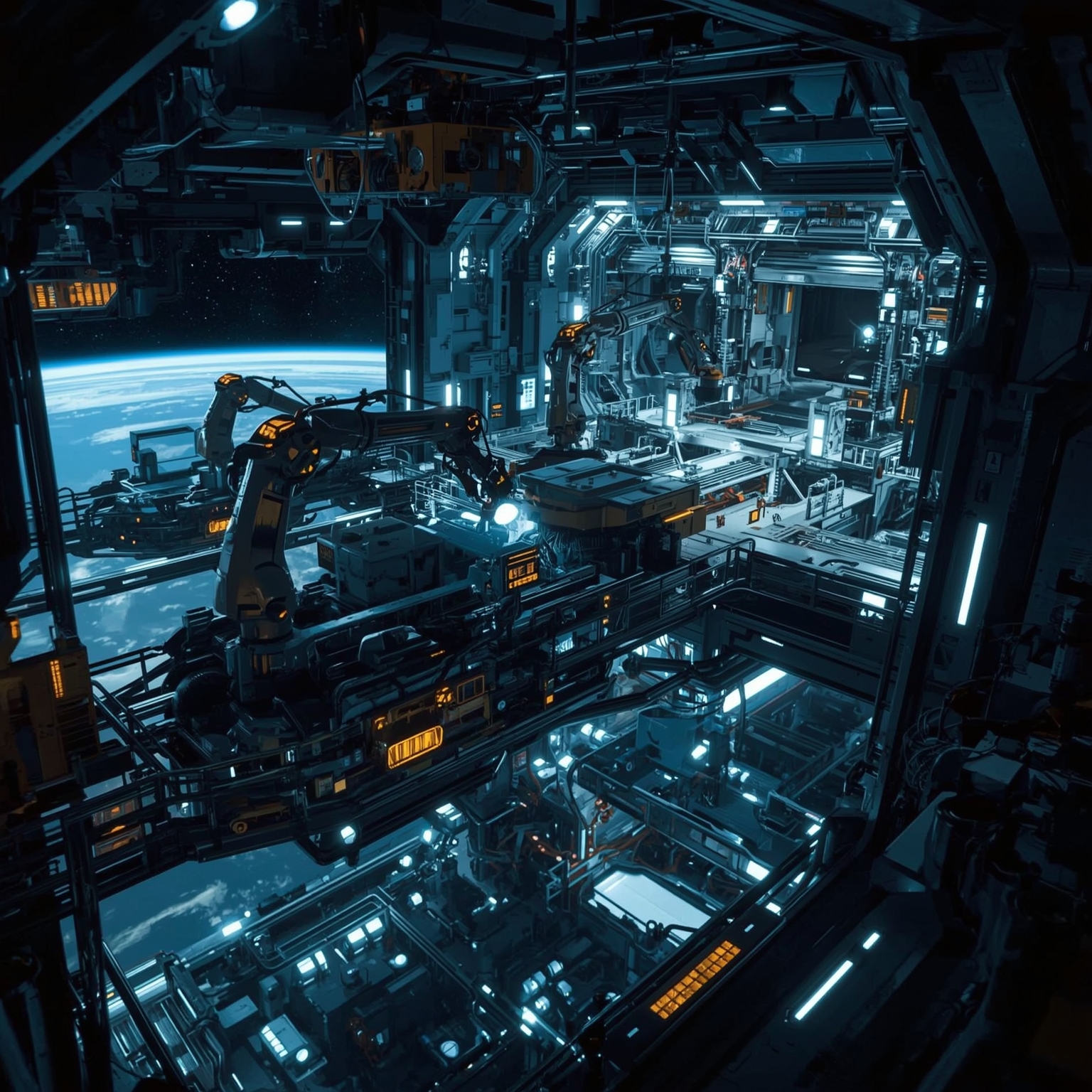
When Will Bruey discusses the trajectory of humanity’s future in orbit, his sense of time feels strikingly compressed compared to conventional expectations. The CEO of Varda Space Industries envisions a period within the coming decade when observers might stand on Earth’s surface at a designated landing site and routinely witness an extraordinary sight—multiple specialized spacecraft streaking through the night sky like a meteor shower, each descending capsule transporting delicate batches of pharmaceuticals that were not merely designed but actually manufactured in the weightlessness of space. He goes further, projecting that in approximately fifteen to twenty years, the cost of sending an average, working-class individual to spend a month in orbit—actively conducting hands-on work—could become cheaper than sustaining that same person for the same duration here on Earth.
Bruey’s confidence in these bold forecasts does not derive from naïve optimism but rather from direct professional experience in environments where highly ambitious goals materialized into reality. As an engineer at SpaceX in its formative years, he personally witnessed improbable targets being met with relentless iteration and innovation. He recalled, during his appearance at TechCrunch’s Disrupt event, that the very first rocket he helped develop was the third flight of the now-legendary Falcon 9. At that time, the concept of reusable rockets conducting launches with the regularity of daily air traffic departures from Los Angeles International Airport would have seemed like speculative fantasy, something achievable, at best, decades later. Yet SpaceX’s partially reusable, two-stage Falcon 9 has since accumulated nearly six hundred successful missions, transforming that science-fiction notion into a mundane reality. Bruey perceives Varda’s present ambitions in an equally transformative light.
That transformation has already begun to crystallize—literally. In February 2024, after navigating a prolonged and complex series of regulatory approvals, Varda became only the third private company in history to return tangible materials from orbit, recovering precisely engineered crystals of ritonavir, an antiretroviral medication used to treat HIV. The accomplishment placed Varda alongside titans like SpaceX and Boeing, signaling its entry into one of the most exclusive technological arenas. Since then, the company has executed several additional orbital missions, further refining its methods.
The spacecraft responsible for returning these microgravity-manufactured pharmaceuticals is the W-1 capsule: a compact, conical reentry vehicle no larger than a household trash bin, measuring roughly ninety centimeters across and seventy-four centimeters high while weighing under ninety kilograms. These capsules are deployed aboard SpaceX rideshare launches and are integrated with Rocket Lab’s spacecraft bus, which supplies essential onboard systems such as power, communications, propulsion, and flight control during the mission.
The rationale for producing pharmaceuticals in orbit stems from the physics of crystallization itself. On Earth, gravity influences molecular organization, often introducing sedimentation, convection currents, and other disturbances that disrupt uniform crystal growth. In the microgravity environment of space, those forces weaken or vanish entirely, allowing for meticulously controlled crystallization processes. This enables researchers to form crystals of uniform size or even generate entirely new polymorphs—alternative structural arrangements of the same chemical molecules—that cannot be produced on Earth. These differences can confer meaningful pharmaceutical advantages: greater chemical purity, enhanced stability, improved efficacy, and longer shelf life.
Such manufacturing, however, is anything but instantaneous. The production of high-grade pharmaceuticals in orbit can span several weeks or even months. When the process concludes, the capsule separates from the spacecraft bus and undertakes a breathtaking return journey—plummeting toward Earth at velocities exceeding 30,000 kilometers per hour, equivalent to more than twenty-five times the speed of sound. A heat shield constructed from advanced NASA-developed carbon-ablation material protects the valuable cargo through the fiery descent, and a parachute deploys to ensure a controlled landing.
Despite the apparent complexity, Bruey emphasizes that Varda’s business model is less about the novelty of space travel and more about industrial pragmatism. “We’re not in the space industry; we’re in-space industry,” he has said, underscoring that orbital space is, in essence, a new geographic domain for supply chain logistics. He likens the company’s technology to a laboratory apparatus—an oven or bioreactor with adjustable parameters such as temperature, pressure, or stir rate—except that Varda’s equipment adds an entirely new dial: gravity itself. In this vision, space becomes merely another location into which goods are shipped, manufactured, and returned, rather than an extraordinary or unreachable frontier.
Importantly, Varda is not engaged in the discovery of new drugs or the synthesis of novel compounds. Its mission is more focused and commercially strategic: to enhance and reimagine what can be achieved with existing, already-approved medications. The company’s work is built upon decades of academic and industrial research, including experiments conducted aboard the International Space Station by major pharmaceutical firms like Bristol Myers Squibb and Merck. These experiments proved that microgravity-based crystallization can yield superior results; Varda’s innovation lies in transforming those one-off scientific demonstrations into scalable, repeatable, and economically viable production infrastructure.
Two primary enablers make this timing possible. First, launch logistics have become significantly more reliable and predictable. What once required complex, one-off negotiations—the orbital equivalent of hitchhiking—can now be booked years in advance with precise scheduling. Second, off-the-shelf spacecraft buses developed by companies such as Rocket Lab have dramatically reduced the need for costly custom fabrication. By purchasing standardized Photon buses and integrating them with Varda’s pharmaceutical modules, the company unlocked a streamlined, modular path to regular space operations.
Still, the economics are unforgiving: only high-value products such as specialty pharmaceuticals currently justify orbital manufacturing costs. Thus, Varda’s focus on drugs that command thousands of dollars per dose is not incidental but necessary for initial viability.
Bruey’s “seven domino theory,” which he frequently shares with legislators and investors, lays out his progression of industrial milestones. The first domino—reusable rockets—has already fallen. The second involves manufacturing drugs in space and successfully returning them. The third, an especially profound step, will be the moment when an orbital-manufactured drug enters clinical trials, marking the transition from experimental novelty to an ongoing commercial cycle of perpetual launches and returns. Unlike traditional satellite companies that invest once to place durable hardware in orbit, Varda’s business model depends on continuous production cycles: each new manufacturing run necessitates a new launch. Consequently, growing demand for pharmaceuticals drives proportional expansion in launch frequency, fundamentally reshaping space-launch economics.
In this scenario, launch providers benefit from a reliable, scaling customer base rather than a one-time fleet deployment, thereby distributing fixed infrastructure costs across increasing demand. As Varda grows, falling costs enable additional classes of orbital products—other pharmaceuticals, semiconductors, even advanced materials—to become economically feasible, creating a reinforcing loop of growth and affordability. Bruey’s idealized end state envisions launch costs plummeting to the point where it becomes cheaper to place human technicians in orbit to perform certain tasks than to design complex terrestrial automation to handle equivalent work.
He imagines a near future in which a worker—he calls her “Jane”—spends a month operating in an orbital drug factory, much like a technician stationed on a remote oil rig, and produces economic value exceeding the cost of her trip. That, Bruey asserts, will be the moment when “the invisible hand of the free market economy lifts us off our home planet.”
Varda’s journey toward that future nearly ended prematurely. In June 2023, the company launched its W-1 capsule on a SpaceX Falcon 9 mission, successfully completing the onboard pharmaceutical experiments that produced Form III ritonavir—an extremely difficult crystalline structure to synthesize under Earth’s gravity. Yet after the manufacturing concluded, the capsule remained stranded in orbit for six months, not because of technical malfunction but due to regulatory gridlock. The planned return site, Utah’s Test and Training Range—a military facility intended primarily for weapons testing—did not have established protocols for commercial space landings. Each time priority military operations took place, Varda’s landing window was postponed, invalidating its Federal Aviation Administration reentry license and forcing the company to restart the application process.
Bruey recalls those months as unbearably tense: eighty employees, two and a half years of work, and millions of dollars invested—all waiting for permission to bring their creation home. Public observers speculated that Varda had launched recklessly without proper clearance, but internally, the company had acted under FAA guidance that allowed it to proceed in order to advance the broader commercial reentry sector. The challenge was bureaucratic novelty, not negligence; the W-1 mission represented the first attempt ever at a commercial land reentry on U.S. soil, and both military range managers and FAA regulators were unsure how to distribute liability.
Alternative landing options were briefly examined—overseas sites, even ocean splashdowns—but none fit Varda’s long-term needs. The company held firm: if its future required regular, land-based reentries, then it would face and resolve the regulatory hurdles head-on rather than compromise. That decision eventually bore fruit. In February 2024, eight months after its launch, W-1 finally returned safely to its original target in Utah, marking the first commercial spacecraft landing on a U.S. military test range and the first under the FAA’s modern Part 450 licensing framework introduced to streamline commercial space operations.
Today, Varda possesses landing rights in both the United States and Australia and holds the first reusable U.S. reentry license authorizing multiple missions without resubmitting complete safety documentation each time. Out of the operational challenges of W-1 emerged an unexpected secondary business: hypersonic testing. Since few objects reenter Earth’s atmosphere at Mach 25, aerospace and defense organizations require real-flight data to validate materials and instruments for extreme conditions that no earthly wind tunnel can fully reproduce. Varda’s reentry capsules, already reaching such velocities, now serve as affordable test beds. The company collaborates with agencies like the Air Force Research Laboratory, embedding sensors and experimental materials into its returning capsules to measure temperature profiles, plasma emissions, and structural stresses in situ.
Such dual-purpose operations—scientific, commercial, and defense-oriented—have caught the attention of investors. As of its Series C funding round in mid-2024, Varda has raised approximately $329 million, primarily directed toward expanding its El Segundo laboratory facilities and recruiting scientists specialized in structural biology, crystallography, and complex molecule analysis. The company ultimately aims to tackle biologics, including monoclonal antibodies—a pharmaceutical sector valued at over $200 billion annually.
The challenges ahead remain formidable, but if Bruey’s compressed timeline of innovation continues to hold true, the moment when space manufacturing transforms from a frontier experiment into a standard branch of industry may arrive far sooner than most people can currently imagine.
Sourse: https://techcrunch.com/2025/11/30/varda-says-it-has-proven-space-manufacturing-works-now-it-wants-to-make-it-boring/