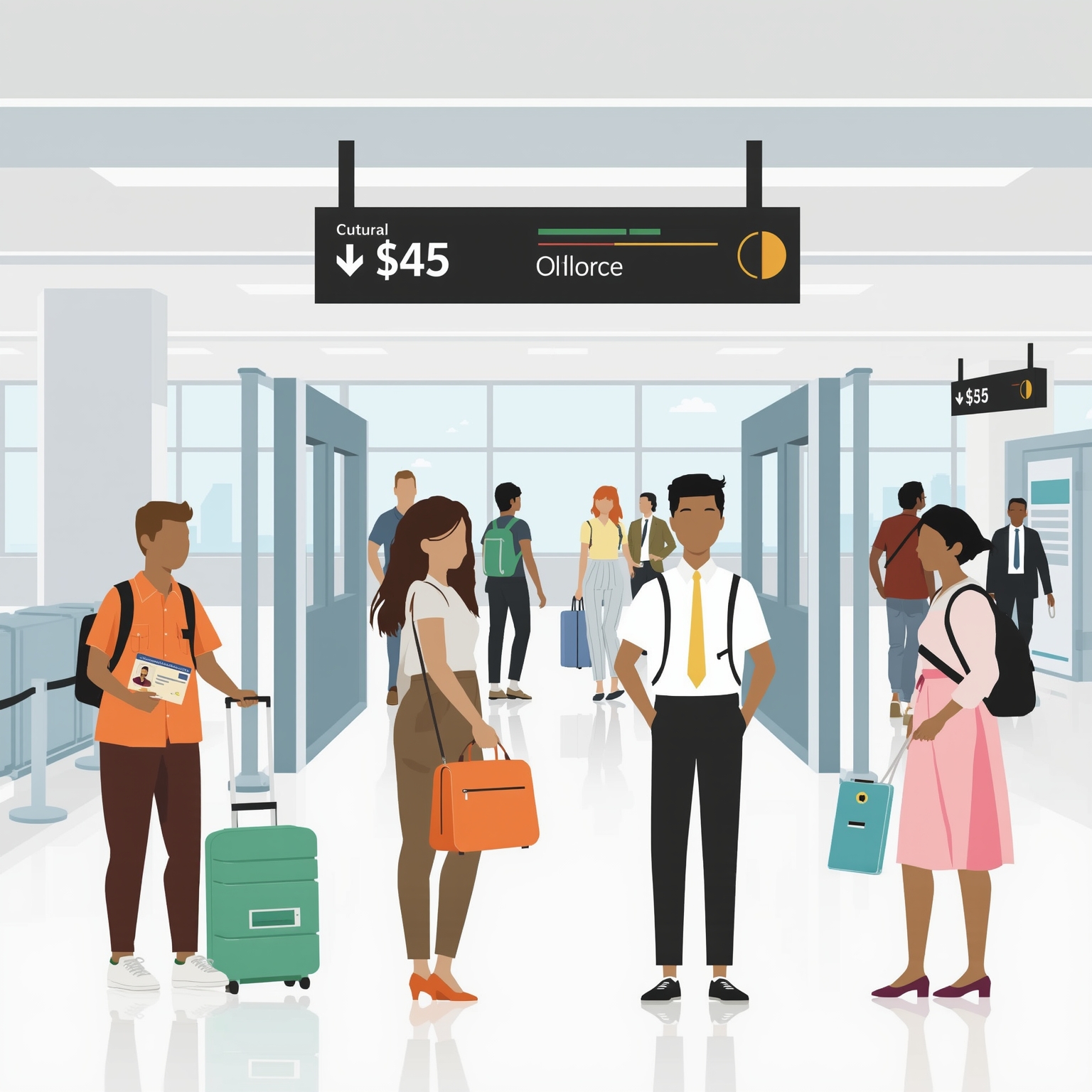
If you are an American citizen preparing to travel within the United States by air but have yet to obtain a Real ID–compliant form of identification, you may soon find yourself facing an unexpected expense. The Transportation Security Administration (TSA) has announced that beginning February 1, 2026, all domestic travelers who cannot present a Real ID–approved form of identification at airport security checkpoints will be required to pay a $45 fee. This payment grants access to a newly developed and more technologically advanced identity verification system known as TSA Confirm.ID.
According to the TSA’s statement released earlier this week, this alternative verification pathway is intended to accommodate passengers who either have not yet updated their identification or have lost their Real ID just before traveling. However, the agency emphasized that procedures may differ slightly from one airport to another, depending on local infrastructure and available partnerships. To streamline the process and help minimize delays at security checkpoints, the TSA is collaborating with selected private industry partners to create systems that will enable travelers to make the required payment online before arriving at the airport.
In its public announcement, the TSA shared statistical data revealing that the vast majority—approximately ninety-four percent—of current travelers already possess Real ID–compliant identification, most commonly in the form of upgraded state-issued driver’s licenses. Still, the agency reminds the public that several other forms of identification also meet federal security standards. Acceptable documents include U.S. passports, permanent resident (green) cards, and identification issued by the Department of Defense, among others. Despite the variety of valid options, TSA continues to strongly recommend that any individuals who have yet to secure a Real ID visit their local Department of Motor Vehicles (DMV) to begin the application process as soon as possible.
Travelers who fail to do so but instead elect to rely on noncompliant identification will not only have to pay the $45 fee but also face potential delays since the verification process will take additional time. Even those who misplace their Real ID before their scheduled flight will be required to go through the TSA Confirm.ID procedure to confirm their identity, an inconvenience that could prolong their check-in and screening experience.
The Real ID Act itself has a long and complex history. Originally passed by Congress in 2005 as a post–September 11 security measure, its full enforcement was postponed for nearly two decades due to logistical challenges and varying state-level readiness. Only in May 2024 did the TSA announce its final phase of implementation, affirming that compliance would become mandatory for domestic air travel beginning in early 2026. Interestingly, while the Real ID program is federal in scope, the exact documentation required to apply for one can differ slightly from state to state, though most applicants must present key records such as a certified birth certificate, a Social Security card, and proof of residence.
In the agency’s press release, Adam Stahl, the TSA’s Senior Official Performing the Duties of Deputy Administrator, underscored the crucial role of identity verification in ensuring public safety. Stahl stated that robust identification procedures are essential in preventing terrorists, criminals, and unauthorized individuals from exploiting weaknesses in the transportation network—whether in aviation or domestic rail travel. While he acknowledged that the overwhelming majority of passengers already provide proper credentials such as Real IDs or passports, Stahl emphasized the government’s responsibility to authenticate every traveler’s identity without exception. Beginning on February 1, 2026, those who arrive at TSA checkpoints without acceptable identification will still be allowed to fly—provided they pay the $45 fee and complete the Confirm.ID process to establish their identity beyond any doubt.
The agency has framed this new fee as a fairness measure, asserting that it ensures taxpayers will not be burdened with the expense of verifying travelers who fail to carry compliant identification. In presentations and media statements, TSA officials characterized the fee as a mechanism designed both to recover administrative costs and to encourage travelers to update their information before the deadline. Stahl reiterated this rationale, explaining that the policy’s purpose is to allocate verification expenses to the individuals directly involved rather than to the general public. He further urged travelers to preempt potential travel disruptions by obtaining a Real ID well before their next domestic departure, noting that delays, missed flights, and unnecessary stress could otherwise result.
While the Real ID Act has bipartisan legislative origins, its impending enforcement has sparked new political and ideological debates. When former President Donald Trump’s administration took concrete steps to operationalize the program, some of his staunchest supporters expressed outrage, alleging that he had been deceived into advancing what they described as a surveillance or control scheme. Conspiracy theorist Alex Jones, one of the most vocal critics, diverted responsibility away from Trump, instead claiming that mysterious foreign and corporate forces—such as figures like Bill Gates or even the Chinese government—were secretly behind the initiative and that it was designed to monitor or constrain U.S. citizens. Yet, paradoxically, Jones later argued that President Joe Biden refrained from fully enforcing Real ID not because of any privacy concerns but supposedly because doing so might have hindered what he described as an ongoing influx of undocumented immigrants. The contradictory and illogical nature of such claims highlights a broader tendency among conspiracy theorists to ignore factual consistency in favor of sensationalism.
Ultimately, the TSA’s new rule represents a major milestone in the federal government’s long-delayed implementation of the Real ID Act. It also serves as a clear signal to travelers: compliance will soon be mandatory, and those who remain unprepared may face both financial and logistical consequences. For the millions of Americans who already possess Real IDs or equivalent credentials, the change will make little difference. For those who do not, however, it stands as a compelling reason to act now, ensuring that domestic air travel remains as smooth, secure, and efficient as possible in the years ahead.
Sourse: https://gizmodo.com/tsa-will-start-charging-45-to-travelers-without-real-id-2000694213