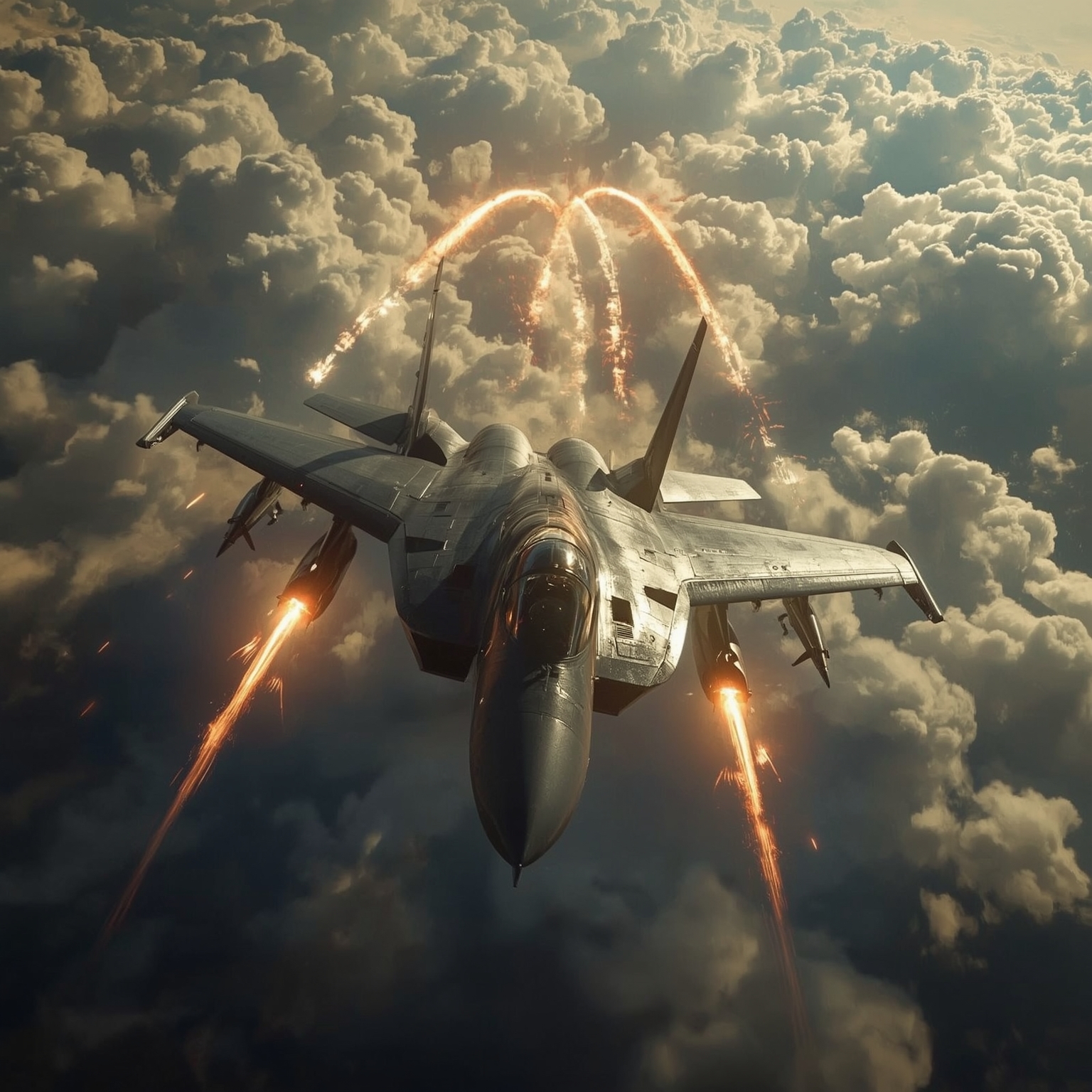
Earlier this year, during an exceptionally dangerous operation in the Middle East, a United States Air Force pilot managed to survive fifteen harrowing minutes of continuous enemy missile fire. Throughout this intense engagement, the pilot executed a series of extreme, high-gravity maneuvers to evade a barrage of incoming projectiles that detonated mere feet from his aircraft. Each turn and climb demanded immense physical endurance and split-second precision, as the pilot pushed the F-16 Fighting Falcon to its structural and physiological limits in an effort to survive where error meant certain destruction.
Lieutenant Colonel William Parks’s extraordinary performance under fire earned him the Silver Star Medal—the third-highest U.S. military award bestowed for acts of valor in combat. The decoration was presented at the Pentagon during a formal ceremony last week, following a statement by the Air Force and a citation shared with Business Insider. The Air Force confirmed that Parks’s actions took place on March 27 within the operational area overseen by U.S. Central Command, which encompasses the wider Middle East. Although the official release withheld the exact location for security reasons, the mission corresponds closely with Operation Rough Rider, a prolonged aerial campaign targeting Houthi rebel positions in Yemen.
In this mission, Parks held the dual responsibility of serving as mission commander for the entire formation of twenty-one attack aircraft and as the tactical lead for four F-16s participating in a suppression of enemy air defenses (SEAD) operation. Such missions are critical precursors to wider air campaigns, as they involve neutralizing radar installations and missile sites to allow allied aircraft to operate with reduced risk. U.S. forces had been systematically pursuing these kinds of targets throughout the Red Sea conflict, where maintaining air superiority proved essential for both naval and aerial assets.
The official award citation notes that Parks deliberately flew within the lethal envelope of the adversary’s air defense systems protecting the enemy’s capital. His calculated decision placed him in extreme personal danger but created an opportunity for friendly forces to obliterate ballistic missile production facilities—a key component of the enemy’s long-range strike capability. According to the Air Force’s account, while under relentless attack from multiple surface-to-air missiles and concentrations of anti-aircraft artillery, Parks continuously maneuvered through violent, high-G turns and deployed countermeasures in rapid succession as explosions tore through the air around him.
Engineering specifications indicate that the F-16 can withstand up to nine times the force of Earth’s gravity when fully loaded, but the human body is far more limited. Most people lose consciousness at sustained forces exceeding four or five Gs, though rigorously trained fighter pilots can endure short bursts of higher levels before reaching physiological limits. The report does not specify the exact number of Gs Parks endured that day, but given the length and intensity of the engagement, his physical resilience and mental focus were crucial to survival.
The perils of the mission extended even beyond the initial missile encounters. With his jet’s fuel levels dropping below the operational minimum while still deep in hostile airspace, Parks swiftly coordinated an emergency midair rendezvous with two aerial refueling tankers. His leadership and quick thinking ensured that both his jet and his wingman’s aircraft regained the fuel necessary to escape, preventing the likely loss of two fighters due to fuel exhaustion. The citation credited his composure under pressure with directly saving two lives—his own and that of his fellow pilot. Parks, previously the commander of the 480th Expeditionary Fighter Squadron, had already established a reputation for decisive leadership; this incident reinforced that legacy in dramatic fashion.
According to the Air Force, Parks’s fighter unit accomplished an unparalleled feat over the course of its eight-month deployment, destroying a record 108 enemy drones and land-attack cruise missiles that threatened U.S. and allied forces. Their operations supported multiple U.S. military missions throughout the region, including sustained efforts to combat terrorist organizations such as the Islamic State. Demonstrating an innovative approach to air combat, Parks used inexpensive laser-guided rockets and even decades-old AIM-9M infrared missiles to intercept enemy weapons. This ingenuity not only maintained tactical effectiveness but also generated significant cost savings for the U.S. military—estimated at more than 25 million dollars in avoided munitions expenditures.
The campaign against the Houthi rebels, including extensive bombing across the Red Sea theater, marked a period of intense engagement for U.S. forces. One particularly noteworthy outcome of Parks’s actions was the revival of the AIM-9M Sidewinder missile’s legacy. Originally developed in the 1950s and used successfully for decades, this supersonic missile had not seen combat success in thirty years until Parks reestablished its relevance through precise, skillful employment.
During the award presentation, Air Force Chief of Staff General Ken Wilsbach emphasized how rare such recognition is: fewer than one hundred Silver Star Medals have been awarded during the modern Air Force era. He praised Parks, declaring that his acts of bravery and composure under pressure embody the meaning of honor and service. “Recognizing valor in combat is vital to who we are,” Wilsbach stated, adding that it was a privilege to serve beside airmen of such extraordinary character.
The Air Force also credited Parks with intercepting six weapons that posed imminent threats to the aircraft carrier USS Harry S. Truman, a central asset in counter-Houthi operations, along with successfully defeating five separate surface-to-air missiles directed at his own F-16. Speaking after receiving his medal, Parks expressed deep gratitude and humility, calling the award “incredible” and acknowledging the influence of his aviator family in shaping his career. He reflected on how a lineage steeped in aviation instilled in him both passion and resilience—qualities that proved indispensable when the skies erupted with enemy fire and every maneuver meant the difference between life and death.
Sourse: https://www.businessinsider.com/us-pilot-dodged-missiles-extreme-turns-during-middle-east-mission-2025-12