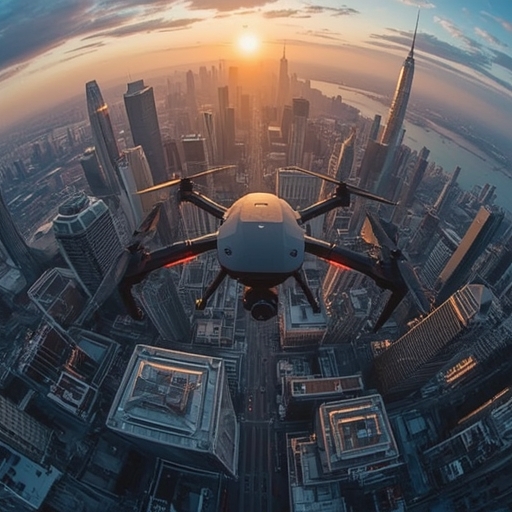
As DJI, the undisputed titan of the drone industry, faces the looming possibility of an import prohibition in the United States and its well‑known flagship models begin to vanish quietly from retail shelves, the emergence of the Antigravity A1 could not have been timed more strategically. In this shifting landscape, the A1 did not need to revolutionize aerial technology to capture journalists’ and consumers’ attention—it merely needed to function as a capable, dependable, and readily accessible alternative that enthusiasts could actually purchase on American soil. Back in August, the Chinese manufacturer hesitated to make any definite assurances that such availability would materialize. However, that uncertainty has now lifted. As of this week, the Antigravity A1 officially arrived on sale through Best Buy stores across the United States—both physically on display and available for immediate shipping. Indeed, it appears the retailer even jumped ahead of schedule, quietly placing the drones on shelves before the planned public unveiling on December 4th. One can, in fact, find a unit sitting right now at a local branch.
The more encouraging discovery is that the A1 represents far more than a stopgap DJI substitute. Priced at $1,599, the package—including both the drone and its distinctive headset—delivers an aerial experience unlike anything I have encountered in years of testing similar devices. As noted in my initial impressions from August and highlighted in the accompanying demonstration video, the Antigravity A1 redefines what it means to interact with a drone. It moves away from the traditional notion of remote piloting or manual cinematography. Instead of forcing the operator to concentrate on the mechanics of flight or frame composition, it removes that mental burden entirely, transforming the process into something remarkably intuitive and immersive.
At the heart of this system lies an ingenious combination of a 360‑degree camera array and responsive motion‑sensing goggles. The technology enables the user’s head movements to directly control the viewing direction; simply turning your head lets you look anywhere around the drone’s environment in real time. Within the goggles’ visual interface, a guiding line appears, shifting fluidly as you move your arm and hand to indicate a desired path or focal point. By pulling the trigger, you command the drone to travel instantly toward that direction, all while you continue freely exploring the surroundings from above with your gaze. Because it simultaneously records footage in every direction, there is no need to worry about missing an angle: the recorded file allows you to rotate, reframe, and zoom during post‑production, thus giving immense creative flexibility once you land.
When considering pricing, the Antigravity A1 occupies an interesting space in the consumer spectrum. Its base configuration costs $1,599, but those seeking a more complete setup can opt for $1,899, which includes three standard batteries, a multi‑charger, and a carrying case. According to Best Buy’s listing, an expanded $1,999 bundle provides three high‑capacity batteries for extended flight time. Although these price points place the A1 above certain drones that deliver sharper traditional rectangular images, the tradeoff lies in its panoramic capability and deeply intuitive interface—both of which elevate the experience beyond standard aerial photography.
During my preliminary hands‑on session, I found that the Antigravity A1 behaves in flight and handling similarly to DJI’s lightweight Mini series rather than its more robust Mavic or Air lines. It folds neatly, maintains a manageable weight, and hovers with precision, though its price edges closer to where those advanced DJI models once sat before their market availability began to diminish in the U.S. None of those established prosumer models, however, offered an integrated 360‑degree capture system or a pair of goggles designed to simplify every aspect of flying and filming. In this particular area, Antigravity’s headset solution stands out as not only more sophisticated but also genuinely user‑centric.
Still, the competitive landscape continues to evolve. Just last week, DJI secured FCC clearance for its own upcoming 360‑degree drone, the Avata 360—a potential rival that could, if timing permits, reach the American market before regulatory doors close on future DJI imports. While it is impossible to know for certain whether the Avata 360 will match or surpass Antigravity’s approach, the differences in philosophy between the two products are already apparent. The Antigravity A1 has been engineered as a lightweight, approachable system in the spirit of the DJI Mini—a compact and beginner‑friendly device that practically flies itself and, thanks to its limited weight, will likely remain exempt from registration requirements. Conversely, DJI’s Avata series has historically embraced a far more aggressive design ethos, favoring heavy, cinewhoop‑style FPV drones optimized for rapid, high‑speed swoops, exhilarating turns, and dynamic acrobatics. Thus, while both companies are exploring immersive flight, their visions cater to distinct user experiences: one pursuing effortless accessibility and the other chasing extreme performance. Together, they illustrate the fascinating divergence now taking shape as DJI’s market dominance faces its first true challenge in years.
Sourse: https://www.theverge.com/news/837922/antigravity-360-us-release-price-best-buy