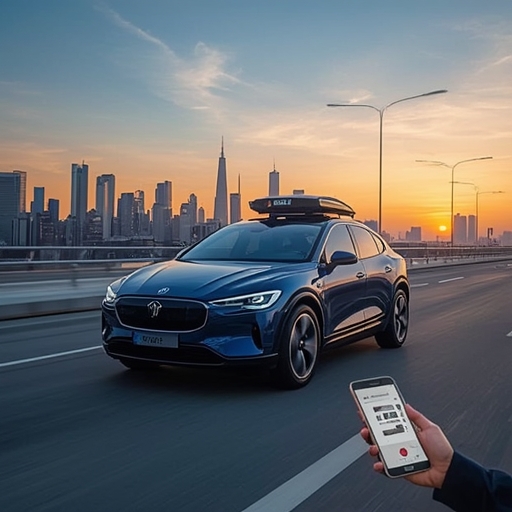
Elon Musk has recently reaffirmed his assertion that Tesla’s Full Self-Driving (FSD) software is advancing to the point where, under certain carefully defined circumstances, drivers might be able to briefly glance at or interact with their phones while the system is engaged. On Thursday, responding to a query posted by a user on X—who asked whether it would be permissible to text while using FSD version 14.2—Musk suggested that limited phone use could be acceptable, but only when the car’s autonomous features determine that the surrounding traffic conditions are safe enough. In practice, however, this bold proposition runs directly into a major obstacle: existing traffic laws still unequivocally prohibit texting or other handheld phone use when operating a vehicle.
Throughout the United States, there remains no state-level jurisdiction that grants exceptions for mobile-phone use, even when a driver-assistance system such as Tesla’s FSD is active. Legislators and regulators across numerous states are still struggling to modernize traffic codes that were written long before partially automated vehicles entered mainstream use. Importantly, according to the standards defined by the Society of Automotive Engineers, FSD does not yet qualify as a fully autonomous driving system. Tesla itself underscores this fact by appending the label “Supervised” to the product name, a linguistic reminder that the driver’s concentration and readiness to intervene remain absolutely essential at all times.
Representatives from state law enforcement agencies in Arizona, New York, and Illinois confirmed to Business Insider that there are no legal provisions excusing drivers who use advanced driver-assistance systems (ADAS) from existing laws banning texting while driving. These three states—each ranked among the ten with the highest number of registered electric vehicles, based on Department of Energy data—make it clear that the legal framework does not bend for technological convenience. Law enforcement officials emphasized that the only limited exception for cellphone use behind the wheel applies strictly to genuine emergencies, such as placing a call to 911. Beyond such circumstances, any form of handheld interaction, including texting, dialing, or operating other portable communication devices, remains against the law. A spokesperson for the Arizona Department of Public Safety reiterated this position in writing, emphasizing that holding a phone or engaging in any other non-emergency use of wireless devices while driving continues to constitute a legal violation.
Tesla declined to comment publicly on the matter, leaving interpretations of Musk’s remarks to circulate largely among users and analysts. Meanwhile, the company recently rolled out the newest version of its FSD Supervised software. Musk had previously teased in July that this iteration would represent a substantial leap forward—a “step change improvement”—building upon advancements originally developed for Tesla’s experimental Robotaxi program in Austin, Texas. The Robotaxi initiative currently operates with a safety monitor seated in the front passenger seat, serving as a precautionary human overseer while the company tests large-scale urban deployment of its autonomous vehicles.
Integral to FSD Supervised is Tesla’s in-car attention monitoring system, which continually tracks the driver’s gaze and issues audible or visual alerts when it detects lapses in attentiveness. If the system determines that the driver repeatedly fails to remain engaged, FSD access can be temporarily suspended to maintain safety. Despite these countermeasures, numerous Tesla users have expressed frustration online, describing the alerts as distracting or overly sensitive. In August, Musk addressed such criticism by announcing that FSD version 14 would “nag” drivers less frequently once confidence in its safety performance reached a satisfactory threshold.
Nonetheless, Tesla’s driver-assistance programs continue to attract regulatory scrutiny. In October, the National Highway Traffic Safety Administration (NHTSA) initiated an extensive probe into approximately 2.9 million Tesla vehicles equipped with FSD after receiving reports that the system had, in some instances, disobeyed traffic controls—allegedly proceeding through red lights or even driving in the wrong direction on public roads. These findings highlight the complex intersection between cutting-edge automation and long-established road safety protocols.
Despite official warnings, some Tesla owners remain remarkably trusting of the FSD system, occasionally allowing their faith in technology to supersede legal and safety considerations. Ring CEO Jamie Siminoff told Business Insider that during his regular commute in his Tesla Model Y, he sometimes composes emails from his phone and has found a particular spot to position the device so that it avoids detection by the car’s driver-monitoring sensors. However, he admitted that the trick is imperfect—every few months, he receives a citation for phone use while driving. On occasion, Siminoff claimed, he managed to talk his way out of such penalties, though law enforcement officers often react with skepticism when he insists that he wasn’t truly the one operating the vehicle. “You get a dirty look,” he observed, acknowledging the tension between personal convenience and police enforcement of road laws.
To test the implications of Musk’s claims firsthand, Business Insider journalist Alistair Barr conducted an informal trial using the latest FSD software. Although his vehicle issued two attention warnings while in motion, it ultimately continued to drive autonomously, providing a real-world glimpse into both the capabilities and the inherent ambiguities of Tesla’s semi-autonomous driving technology. As public fascination with automation continues to grow, such moments underscore the unresolved tension between innovation, regulation, and individual responsibility on modern roads.
Sourse: https://www.businessinsider.com/tesla-fsd-full-self-driving-text-drive-iillegal-elon-musk-2025-12