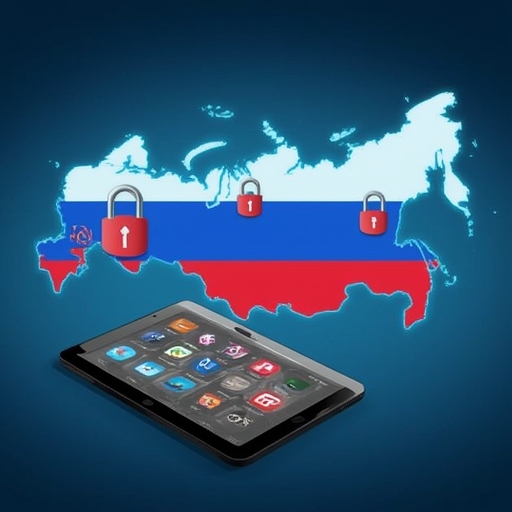
Russia’s principal authority overseeing internet communications and media, the federal regulator known as Roskomnadzor, announced this week that it has taken decisive action to block access to both Snapchat and Roblox within the country. According to the agency’s official statement, the decision was made on the grounds that these widely used digital platforms have allegedly facilitated activities described as ‘extremist and terrorist’ in nature. This move reflects an intensifying pattern of state intervention in Russia’s online ecosystem, where expressions of dissent or unsanctioned communication are increasingly framed under national security concerns.
Roskomnadzor formally declared its decision to restrict Snapchat on Thursday but clarified that the app had already been rendered inaccessible to users across Russia earlier in the month, specifically beginning on October 10. In an official press release cited by state-controlled media, the agency conveyed that the action stemmed from reports provided by Russian law enforcement bodies. These agencies purportedly concluded that Snapchat had been exploited by certain users as a digital tool for the organization and coordination of terrorist acts within Russian territory, for recruiting potential perpetrators, as well as for engaging in fraudulent schemes and other forms of criminal misconduct targeting Russian citizens. The language of the statement emphasized the government’s framing of online spaces as channels that could be weaponized for subversive or violent purposes.
Only a day prior, on Wednesday, the same federal regulator revealed that it had similarly blacklisted the online gaming platform Roblox. In its announcement, Roskomnadzor accused Roblox of providing virtual environments that allowed the circulation of materials promoting extremist and terrorist ideologies. The agency further asserted that some users had utilized the game to disseminate ‘LGBT information,’ which, under the country’s controversial legal framework, is categorized as extremist content. This claim situates the decision within Russia’s broader sociopolitical campaign to suppress LGBTQ+ representation and discussion in public and digital life, a stance that has been internationally criticized for its discriminatory implications.
Expanding its measures beyond gaming and social media, Roskomnadzor also disclosed on Thursday that it would impose additional ‘restrictive measures’ targeting Apple’s FaceTime video calling service. The state-run news agency TASS reported that Russian officials justified this action by alleging that FaceTime, like the other platforms, was being utilized to coordinate terrorist activity, facilitate extremist recruitment efforts, and engage in fraud and other crimes against citizens. This official rationale aligns closely with the broader narrative employed by Russian authorities, in which national security is invoked to validate escalating layers of digital surveillance and platform control.
In response to the mounting restrictions, a spokesperson for Roblox provided a statement to Business Insider emphasizing the company’s firm and ongoing commitment to user safety. The representative noted that Roblox implements proactive detection systems and moderation protocols intended to identify, report, and eliminate harmful or illicit content before it can spread widely. The company reaffirmed its respect for the legal frameworks of the nations where it operates while maintaining that Roblox’s core purpose is to foster an inclusive, creative, and educational environment where users can connect meaningfully and safely.
Dave Baszucki, the company’s chief executive officer, had previously stated in September 2022 that Russia accounted for an estimated two million active daily Roblox users at that time—a figure that, while significant, was modest compared to the roughly eleven million daily users engaging with the platform in the United States. Apple and Snap Inc., the parent company of Snapchat, were both approached by Business Insider for comment regarding the Russian regulator’s decisions; however, neither firm responded to inquiries sent outside normal business hours.
The latest series of restrictions form part of a much broader trajectory in Russia’s approach to internet regulation, which has become markedly more stringent since the country launched its full-scale invasion of Ukraine. In recent years, authorities have introduced various bans, throttling measures, and monitoring systems targeting major international platforms, including encrypted messaging and social media services such as Signal, Meta’s WhatsApp, and Instagram. These policies have been justified by references to national security and cultural sovereignty, though critics argue they serve primarily to stifle dissent and isolate Russian users from global information networks.
Telegram, the widely used messaging app created by Russian-born entrepreneur Pavel Durov, has also been subjected to partial restrictions, with voice and video call features severely limited within the country. Furthermore, reports suggest that Russian internet providers may be artificially slowing YouTube traffic, effectively curbing accessibility without imposing an outright ban. Such tactics illustrate a strategic shift from overt censorship to more technologically sophisticated methods of control and deterrence.
The Kremlin has historically defended these intrusive measures by invoking the need to combat terrorism and extremism, framing internet restrictions as defensive actions intended to protect national stability. However, since the onset of the Ukraine conflict, these justifications have increasingly been applied to cyber activity and narratives associated with Ukrainian or anti-Kremlin partisans, including attacks or incursions on Russian soil. Nonetheless, analysts remain uncertain whether the most recent wave of digital blockages is directly linked to such incidents. The Ukrainian Ministry of Defense did not provide commentary in response to media requests sent after normal working hours, leaving the connection between these events ambiguous.
It is also important to note that Russia has faced violent domestic attacks that appear largely unrelated to Ukraine. A particularly deadly example occurred in March 2024, when coordinated assaults at a concert venue in Moscow resulted in the deaths of at least 149 individuals and injuries to more than 600 others. Responsibility for that massacre was later claimed by an Afghanistan-based branch of ISIS. This tragic event not only intensified the Kremlin’s rhetoric around domestic security but may also have contributed to the heightened scrutiny now directed at digital communications platforms.
Taken together, these developments illustrate a continuing escalation in the Russian government’s effort to consolidate control over online information flows. By framing global social media and communication services as potential conduits for extremist threats, authorities are extending the boundaries of internet censorship under the guise of public safety. The consequences of these actions reverberate beyond Russia’s borders, raising pressing questions about digital freedom, cross-border regulation, and the balance between state security and human rights in the modern technological era.
Sourse: https://www.businessinsider.com/russia-block-snapchat-roblox-facetime-extremism-internet-regulation-2025-12