In 1990—just one year after the historic fall of the Berlin Wall, when Europe was in the midst of extraordinary political and cultural transformation—my parents made a bold and unconventional decision. Leaving behind the stability and familiarity of Western Germany, they chose to move eastward, to what had only recently ceased to be the German Democratic Republic, in order to take advantage of a rare business opportunity: becoming a Tupperware franchise partner. For them, this choice was nothing short of a golden prospect, a chance to participate in the wave of renewal and economic optimism that swept across the former East. After decades of scarcity and restricted access to consumer goods, people there were eager—almost ravenous—to experience the material comforts and small luxuries that had long been unavailable to them. They desired to explore not only products but also the wider world they had been shielded from for nearly thirty years, and my parents were well positioned to help meet that curiosity.
At that time, I was only eight years old—a child just beginning to grasp the contours of life beyond my immediate family and neighborhood. I still remember vividly the day my parents gathered my younger siblings and me around the kitchen table to tell us about our impending move. While they were filled with enthusiasm and excitement for the new chapter ahead, my young heart sank. I had only just begun primary school, a place where I had started building friendships and routines that felt integral to my growing sense of identity. The idea of leaving all that behind—to start over in a new region, with new classmates and unfamiliar surroundings—filled me with dread and sadness. Yet, what affected me most profoundly was knowing that I had to leave my beloved grandfather behind. He was my anchor, a calm and loving presence whose warmth I had always known. Although we managed to visit him several times a year, the physical separation weighed heavily on me throughout my childhood.
Years later, I unknowingly recreated a parallel situation for my own children. In 2017, after falling deeply in love with an extraordinary man—and also with the Netherlands itself, with its open-minded culture, its kind people, and its melodic language—I made the decision to relocate there permanently. My husband and I have since built a beautiful life together, raising our daughter and son in an environment enriched by three languages and multiple cultural influences. I cherish our home and the opportunities that have come with it, yet one lingering ache persists: the distance from my parents, who still live roughly four hundred miles away. I regret that my children cannot simply drop by their grandparents’ home, share spontaneous moments, or enjoy everyday interactions as I once dreamed they would.
Although for our children, this arrangement is normal—they have never known anything different—I can never forget my own childhood longing for my grandfather’s presence. That empathy drives my husband and me to do whatever we can to maintain a strong, ongoing connection between our children and their grandparents. It matters deeply to both of us that all four of them develop meaningful bonds, truly get to know one another, and ultimately build a reservoir of joyful memories that will endure well beyond the limits of geography.
Our children are now six and four years old, and since their births we have continually adapted and refined how we stay in touch with my parents. One of the most important commitments we made early on was to visit them as frequently as possible. Because I am an entrepreneur whose work can be managed remotely and my husband also has a flexible, home-based schedule, travel was easy in the early years. Once our daughter entered school, coordinating visits became more complex, yet we always make it a priority. Sometimes that means departing in the afternoon, driving for hours, and arriving late at night—simply so we can spend the weekend together. These trips, though tiring, are invaluable windows of family closeness.
At least once a year, my parents return the gesture by traveling with their dog to stay with us in the Netherlands for one or two weeks. They arrive in their motorhome, which they park on our driveway, and during that time they become a vibrant part of our household. They accompany the children to and from school, share in their daily routines, and fill our evenings with delicious meals, laughter, and shared stories. Summers bring another cherished tradition: a two-week holiday together that all of us look forward to throughout the year. For the children, it is the highlight of their annual calendar; for me, it is a chance to slow down, put work aside, and simply relish being with my parents again. Those trips also give my husband and me the rare gift of quiet moments together, while our children and their grandparents build ever more lasting memories of their own.
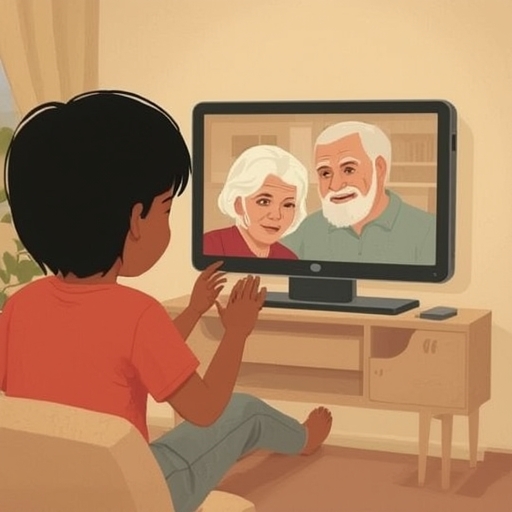
Between visits, the bond remains alive and strong through digital connection. We organize weekly video calls where everyone updates one another on daily life—small triumphs, funny incidents, new discoveries. Sometimes our children are more interested in saying hello to my parents’ dog than in sustained conversation, yet even those seemingly trivial moments spark laughter and affection and keep emotional intimacy intact despite the miles that separate us.
In addition to these active ways of staying connected, we consciously weave reminders of my parents into our family’s everyday environment. Our daughter, who has recently learned to write, often sends short messages or emojis through WhatsApp, while we regularly share photos and videos highlighting small milestones—such as her mastering a new breakdance move or our son bravely starting his first swimming class. We also dedicate time to crafting small gifts and drawings, which the children make especially for their grandparents. In our living room hangs a photo calendar displaying snapshots from shared vacations and celebrations, serving as a constant visual reminder of our family bonds.
We strive to celebrate major holidays together whenever possible—Halloween, Christmas, birthdays—and through these shared occasions, even when they happen only a few times a year, the sense of continuity and closeness grows stronger. There are certainly moments when the absence of my parents in our daily lives feels painful. Yet I have discovered that physical separation need not equate to emotional distance. With creativity, consistency, and genuine effort, children can grow up deeply connected to their grandparents, learning to treasure those relationships even when oceans or borders lie between them. In the end, love and intention, not geography, are what keep families together.
Sourse: https://www.businessinsider.com/help-kids-bond-with-grandparents-who-live-far-away-2025-11