In recent years, a recurring motif has come to dominate the landscape of contemporary horror: the notion that the true source of monstrosity lies not in demons, ghosts, or creatures of the night, but in the unhealed wounds of human trauma. This concept — that “the real monster is trauma” — has become so widespread that it now borders on cliché, appearing in numerous critically acclaimed works that seek to merge psychological depth with supernatural terror. Films such as *Hereditary* and *The Babadook* serve as exemplary expressions of this theme, while *Smile* attempts a similar exploration with less precision or emotional resonance. Yet, among all these efforts, few achieve the balance of empathy, dread, and artistry found in the 2020 film *His House*, which stands as one of the most sophisticated and affecting treatments of this overused but potent idea.
At its heart, *His House* tells the story of Bol and Rial, two refugees who have fled the horrors of the civil war in South Sudan in search of safety and renewal in England. Their journey, portrayed through the understated yet emotionally charged performances of Sope Dirisu and Wunmi Mosaku, becomes a harrowing meditation on displacement, guilt, and the fragile notion of belonging. Both actors bring extraordinary depth to roles that in a lesser film might have been reduced to archetypes. Dirisu’s Bol radiates a quiet desperation, his stoicism barely concealing the turmoil within, while Mosaku’s Rial embodies a resilience that is both maternal and ferocious. Her portrayal, filled with psychological nuance and rare screen presence, reveals layers of pain, intelligence, and strength that distinguish her performance as one truly worthy of greater recognition. Their work significantly elevates the film beyond the typical “haunted by trauma” template that has come to define modern genre cinema.
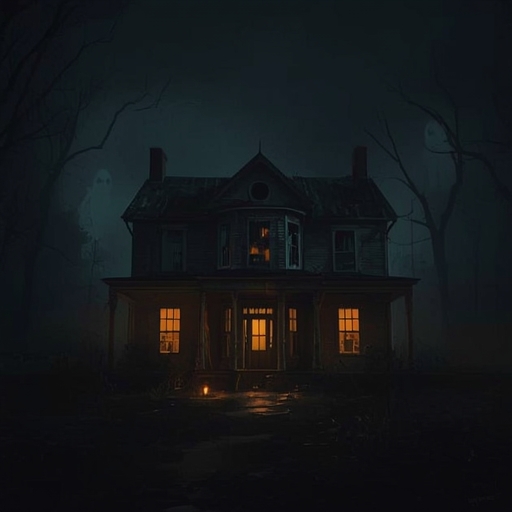
Still, audiences do not approach horror films solely for their emotional or dramatic complexity — they come seeking fear, tension, and the thrill of the unknown. In this regard, *His House* excels with remarkable control and artistry. The couple is allocated a deteriorating government-provided house on the fraying outskirts of London, a structure that feels oppressively decayed from the moment they step inside. Cracks split the walls, the wallpaper curls away like dead skin, and the electricity sputters unreliably in the gloom. For all its ruin, however, the house represents to them a fragile sanctuary: a physical space that offers a pause from the unimaginable violence they narrowly escaped. Yet this sense of refuge proves fleeting, as director and writer Remi Weekes refuses to allow comfort or calm to last for more than a moment.
Weekes masterfully escalates unease, weaving together traditional horror techniques with subtler psychological distress. While there are a few well-placed jump scares, the film’s most disturbing power lies in its suffocating atmosphere — a claustrophobic dread that seems to seep from every surface. The horror emanates not only from whatever lurks inside the walls but also from the wider environment that surrounds Bol and Rial. The streets outside their home carry an air of estrangement and hostility; the people they encounter regard them with cold suspicion rather than compassion. Even the officials charged with supporting their resettlement, such as the dismissive caseworker Mark, played with calculated restraint by Matt Smith, treat them less as human beings and more as bureaucratic inconveniences. The pervasive sense of alienation becomes another ghost of sorts, haunting every interaction and reinforcing that their new world offers little more comfort than the one they fled.
As Bol struggles to shed his past and assimilate into British society, he finds himself overwhelmed by conflicting forces — the external pressures of cultural adaptation and the internal burdens of survivor’s guilt. The memories of those lost during his escape, the decisions he made to secure safety, and the moral compromises demanded by survival gradually manifest into tangible terrors. Weekes unveils these truths through carefully interwoven flashbacks that peel away the façade of normalcy Bol and Rial attempt to maintain. These glimpses into their past reveal both the scale of their suffering and the origin of the specters that now pursue them.
Ultimately, *His House* distinguishes itself as one of the rare horror films capable of merging the supernatural with the painfully human, transforming real-world agony into something viscerally cinematic. It is a film that operates simultaneously as a ghost story, a social critique, and a tragic psychological study, achieving all these ends without prioritizing one dimension over the others. For viewers who crave horror that does not rely solely on jolts or gore but instead intertwines fear with genuine emotional gravity, *His House* provides a haunting experience that lingers long after the credits roll. To witness its artistry and emotional force firsthand, audiences can currently stream *His House* on Netflix, where its blend of terror and tenderness awaits the patient and the brave alike.
Sourse: https://www.theverge.com/entertainment/839753/watch-modern-horror-masterpiece-his-house