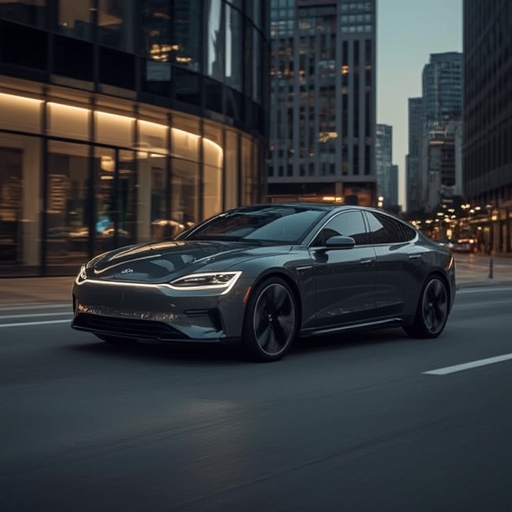
Chinese electric vehicles continue to attract significant global attention, particularly in the United States, even though American consumers currently cannot purchase them. These models are increasingly recognized as symbols of technological progress, design sophistication, and value-driven innovation. Recently, one of the most respected technology reviewers in the digital sphere offered high praise that may shape broader public perception. Marques Brownlee — widely known by his online moniker MKBHD — spent two weeks behind the wheel of the Xiaomi SU7 Max, providing a comprehensive assessment that resonated widely within the EV community.
The Xiaomi SU7 Max, positioned at the upper end of the brand’s lineup, retails for approximately 299,000 Chinese yuan, or about $42,000, setting it well below the price of a comparable Tesla Model 3 Performance, which comes in just under $55,000. This discrepancy makes Xiaomi’s achievement particularly noteworthy: despite its more accessible price point, Brownlee concluded that the SU7 Max delivers a level of quality, performance, and design typically expected of far more expensive automobiles. His verdict, stated with unmistakable enthusiasm, was that the experience behind the wheel felt nothing like what one would anticipate from a $42,000 car. In short, he described it simply but emphatically as “a nice car” — an understated phrase that, coming from such a critical voice, signals genuine admiration.
As he examined the vehicle from the outside, MKBHD drew comparisons with several famous marques. The silhouette of the SU7 Max, he observed, bore a resemblance to high-end European designs, recalling elements of the Porsche Taycan, with its athletic curves and low-slung profile, as well as influences from the Polestar and Mercedes design language. Even the steering wheel evoked the feel of a Porsche, reinforcing the impression that Xiaomi’s designers had carefully studied premium automotive aesthetics.
Moving into the cabin, Brownlee emphasized the sophistication of Xiaomi’s in-car software environment. Calling it “so good,” he elaborated that its fluid interface and intuitive layout represented what Apple might have achieved if it ever ventured into the automotive industry. The minimalist aesthetic, clean graphics, and seamless responsiveness of the infotainment system suggested an emphasis on usability and style unusual for this price bracket.
Xiaomi currently offers the SU7 in four variants — Standard, Pro, Max, and Ultra — enabling prospective buyers to select a model that best matches their preferences in performance and technology features. Among the many aspects that struck MKBHD, the interior’s distinctive modularity stood out. The car includes multiple accessory mounting points designed to support a range of user-customizable add-ons, such as external speedometers, magnetic phone mounts, chargers, microphones, and even walkie-talkies. With genuine surprise, Brownlee questioned rhetorically what other manufacturer had ever offered such extensive opportunities for hardware personalization inside a production vehicle. In his view, this ability to control “how much or how little hardware” exists in the interior layout reflects Xiaomi’s targeted focus on functional flexibility and modern consumer expectations.
His driving impressions further reinforced the car’s stellar reputation. Describing the SU7 Max as a “really capable car,” Brownlee compared its performance directly to established benchmarks like the Tesla Model 3 and BMW i4 — both of which are considered leaders in their respective segments. Remarkably, he concluded that the Xiaomi SU7 delivers the sensation of piloting a $75,000 car, even though it costs close to half that amount. This sense of value-per-dollar appears to be a defining characteristic of Xiaomi’s foray into the automotive space.
As with most Chinese electric vehicles, however, the Xiaomi Speed Ultra 7 is not currently available for purchase in the United States, a fact that has not prevented determined enthusiasts and industry leaders from securing access to it. Notably, Ford’s CEO, Jim Farley, disclosed in a podcast interview that he had gone so far as to import one. His admiration was unapologetically enthusiastic: after mentioning that Ford had flown a demo model from Shanghai to Chicago, Farley admitted to having driven it for six months and confessed that he does not want to give it up. Such high-profile admiration underscores the EV’s international appeal and the growing recognition of Chinese automakers as genuine competitors on the world stage.
Beyond its automotive ambitions, Xiaomi remains a vast technology conglomerate with ventures that extend deeply into other consumer product categories — from smartphones and wearable devices to smart-home appliances, including robot vacuums and connected ecosystems. Recently, its electric-vehicle division achieved its first recorded profit, a significant milestone in an industry where many early entrants continue to report losses. This success not only validates the company’s strategic diversification but also hints at its ability to merge hardware expertise and software integration in a way few rivals can match.
In contemplating the hypothetical scenario of Chinese EVs becoming widely available in the American market, Brownlee posed a stark question: “Are we cooked?” — a reference to how formidable the competition could become for incumbent U.S. manufacturers. He quickly reassured that the domestic market remains safe for now, primarily because political barriers, including tariffs and strict import duties, make such cross-border entry improbable in the near future. “We may never get a car like this available in the U.S. for $42,000,” he noted, acknowledging the complex interplay of economics and international policy that constrains consumers’ access to these advanced vehicles.
Meanwhile, Xiaomi is looking beyond its home market. The company recently confirmed plans to bring its EV lineup to Europe in 2027, setting the stage for a major expansion into one of the most competitive and environmentally progressive automotive regions in the world. Europe could serve as a critical proving ground: as Xiaomi establishes its presence, U.S. manufacturers such as Tesla are encountering mounting challenges there. According to data from the European Automobile Manufacturers’ Association, Tesla’s European sales dropped by roughly 48.5% year over year as of October, reflecting intensified competition and shifting market conditions across the continent.
Reflecting on the broader implications of Xiaomi’s achievement, MKBHD concluded that the introduction of cars like the SU7 raises expectations across the entire automotive industry. When a $42,000 EV can convincingly emulate the refinement, technological depth, and driving dynamics of vehicles nearly twice its price, the benchmark for quality and innovation is irrevocably elevated. In his words, “It raises the ceiling for all cars to get better, more impressive, and more complete” — a sentiment that captures how new entrants, particularly from China, are reshaping the definition of modern mobility.
Sourse: https://www.businessinsider.com/youtuber-mkbhd-xiaomi-su7-review-chinese-ev-2025-12