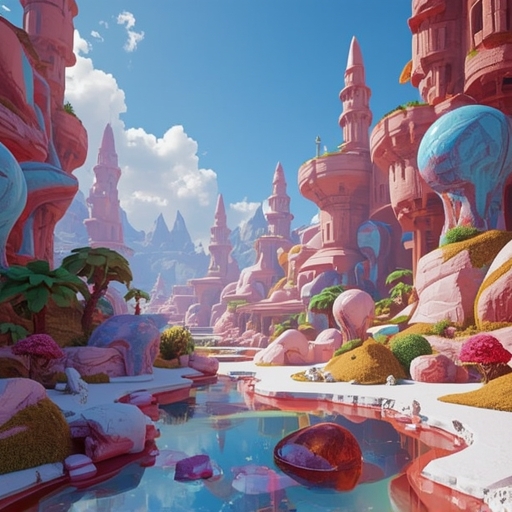
At the peak of their ambition and expense, today’s large-scale video games often converge into a visually indistinguishable mass. Their surface diversity belies an underlying sameness, as market pressures and escalating production costs compel developers and publishers to adopt familiar formulas over untested artistry. The economics of this cycle are brutally simple: the more lavish the budget, the more financial risk involved, and thus the greater the urge to mitigate that danger through predictability. Publishers, fearing failure, retreat into the safety of proven aesthetics—grim, semi-realistic landscapes filled with muted browns and grays; worlds that look like heavy metal album covers populated by an endless parade of grizzled survivors, gunslingers, or vaguely dystopian antiheroes. Similarly, multiplayer titles cling to the glossy cartoon realism of animated hero shooters, where the musculature of every character seems meticulously crafted for both cinematic trailers and fan art. The industry’s creative conservatism, born from finance, manifests as visual monotony.
And yet, amidst those towering spectacles of sameness, a few remarkable works break away, forging new aesthetic territory. One such defiant example is *Octopath Traveler 0*, the third installment in Square Enix’s much-acclaimed *Octopath* series. This project is not merely a prequel tailored to attract newcomers, nor just an elaborate adaptation of an earlier mobile game polished for consoles. It represents a broader artistic culmination—the capstone of a years-long celebration of “HD-2D,” a stylistic experiment that Square Enix launched in 2018 and has since elevated into an enduring creative doctrine. HD-2D transforms nostalgia into deliberate craftsmanship: it is both a reverent homage to the pixelated splendor of classic role-playing games and an assertion that old forms can thrive under the illumination of new technology.
Producer Masaaki Hayasaka, who oversaw *Dragon Quest I & II HD-2D Remake*, explained that the entire philosophy began with a simple yet profound question—what might happen if games from the Super Famicom era, the golden age of pixel art, could be reimagined using modern rendering tools? The first realization of this vision, 2018’s *Octopath Traveler*, blended the aesthetic texture of beloved 16-bit masterpieces such as *Final Fantasy VI* with the cinematic depth achievable through contemporary engines. Utilizing Unreal Engine, Square Enix and co-developer Acquire cleverly combined hand-crafted pixel figures with fully three-dimensional environments illuminated like modern titles. The result is a world that looks simultaneously timeless and current—like a diorama of memory refracted through present-day technology. At its debut, *Octopath Traveler* sought to appeal not only to players nostalgic for the SNES epoch but also to a new audience seeking sophistication on the Nintendo Switch. Its gamble succeeded brilliantly.
The commercial and critical triumph of *Octopath Traveler* convinced Square Enix to formally trademark the term “HD-2D,” signaling both pride and strategic intent. Subsequent titles—*Triangle Strategy* and the remake of the cult classic *Live a Live*—extended the technique, proving that HD-2D was not a fleeting experiment but the foundation of a new identity for the company’s retro-inspired catalog. Each release explored distinct narrative structures and artistic moods: *Triangle Strategy* translated the grandeur of tactical warfare into watercolor-like tableaux, while *Live a Live* resurrected a once-lost masterpiece, finally making it accessible to a global audience. Together they defined two complementary branches of HD-2D design—original compositions that reinterpret the essence of classic RPGs and faithful restorations that lovingly rebuild forgotten treasures.
As producer Hirohito Suzuki remarked in reference to *Octopath Traveler 0*, pixel art offers a singular space for imagination—its simplicity invites the eye to fill in what is unseen, stimulating creative interpretation rather than overwhelming it with photographic fidelity. This understanding lies at the heart of HD-2D’s allure. The style recognizes that limitation can be liberating, that imperfection can generate emotional truth. It taps into what made older games resonate so deeply: their suggestion, their abstraction, and their inherent invitation to the player’s imagination.
Yet, paradoxically, the HD-2D aesthetic is not exclusively tied to the 16-bit lineage that inspired it. As the developers themselves conceded in a 2019 Unreal Engine showcase, the visual language also owes conceptual debt to early 3D-era works like *Xenogears* and *Grandia*. Those PlayStation-era hybrids, which fused two-dimensional sprites with polygonal spaces, serve as spiritual ancestors. Thus, HD-2D is better understood as a synthesis—a deliberate stylistic unification that pays tribute to multiple generations of visual evolution. Hayasaka explained that, at its most fundamental, HD-2D simply means placing pixel-art characters against three-dimensional backdrops. However, the real artistry emerges in calibration—the color palette, the lighting effects, the placement of shadows, and especially the intangible “atmosphere” that ensures the illusion convinces both heart and eye. According to him, this craft depends on an art director with an intuitive grasp of nostalgia’s delicate balance—someone capable of distinguishing sentiment from stagnation.
Interestingly, despite surface similarities, no two HD-2D titles are identical in tone or visual composition. The earlier entries—*Octopath Traveler* and *Triangle Strategy*—embrace restrained palettes and stylized, paper-diorama landscapes, deliberately evoking handcrafted miniatures. Their subtle hues risk dullness if overused, yet their restraint allows for breathtaking moments when light floods across mountains, town squares, or cathedrals, elevating simple pixels into poetry. The remakes, by contrast, push the technique toward opulence. The *Dragon Quest* titles shimmer with vibrancy and exuberance, drawing on Akira Toriyama’s unmistakable art to animate a more exuberant visual field. By leaning toward the “HD” aspect of the term, these remakes craft a nearly painterly richness that reaffirms how traditional artistry can thrive under high-definition scrutiny.
Critics have responded enthusiastically, often describing HD-2D productions as “gorgeous,” “elegant,” or “timeless.” Reviewers such as *Polygon*’s Oli Welsh note that this approach surpasses mere nostalgia; it reframes the familiar beauty of the 1990s for a modern context, achieving both reverence and reinvention. The aesthetic’s underlying insecurity—its creators’ fear that pure 2D might feel antiquated—has, ironically, become its source of vitality. HD-2D transforms anxiety about obsolescence into artful resilience, revealing that technical constraint and emotional resonance can coexist.
This creative tension—between progress and preservation—is emblematic of video games as a medium. Whereas traditional art forms exist largely independent of their tools, games are inseparable from the technology that births them. A painting can age gracefully, but a game can become pixel-smeared or aurally awkward when thrust into a higher resolution than it was ever meant to endure. Developers must continuously choose: should they immortalize imperfections that once defined their craft, or erase them in pursuit of modernization? HD-2D represents a poignant attempt to resolve that dilemma. It strives to create artifacts that feel archaeologically authentic but technologically enduring—a bridge that honors history without succumbing to it.
Therein lies the bittersweet beauty of the HD-2D approach: it embodies the impossible dream of timelessness. It suggests that perhaps there exists a perfect equilibrium—a version of a game untouched by the decay of trends or hardware—but in pursuing this ideal, it also acknowledges the inevitability of change. Games, like players, evolve; what dazzles one generation may puzzle the next. To chase permanence in such a fleeting medium requires both courage and humility. It is moving, even noble, to attempt transcendence knowing that obsolescence is unavoidable. And yet, that very effort—the striving against sameness, the insistence on vision amid risk—is what defines artistry in gaming.
Thus, when all major releases begin to blur together, it is these bold deviations—these unexpected, aesthetically daring works—that remind us how vibrant the medium can be. Video games may all look the same, until one refuses to, and in that refusal, the art form rediscovers its soul.
Sourse: https://www.theverge.com/entertainment/840080/square-enix-hd2d-games-octopath-dragon-quest