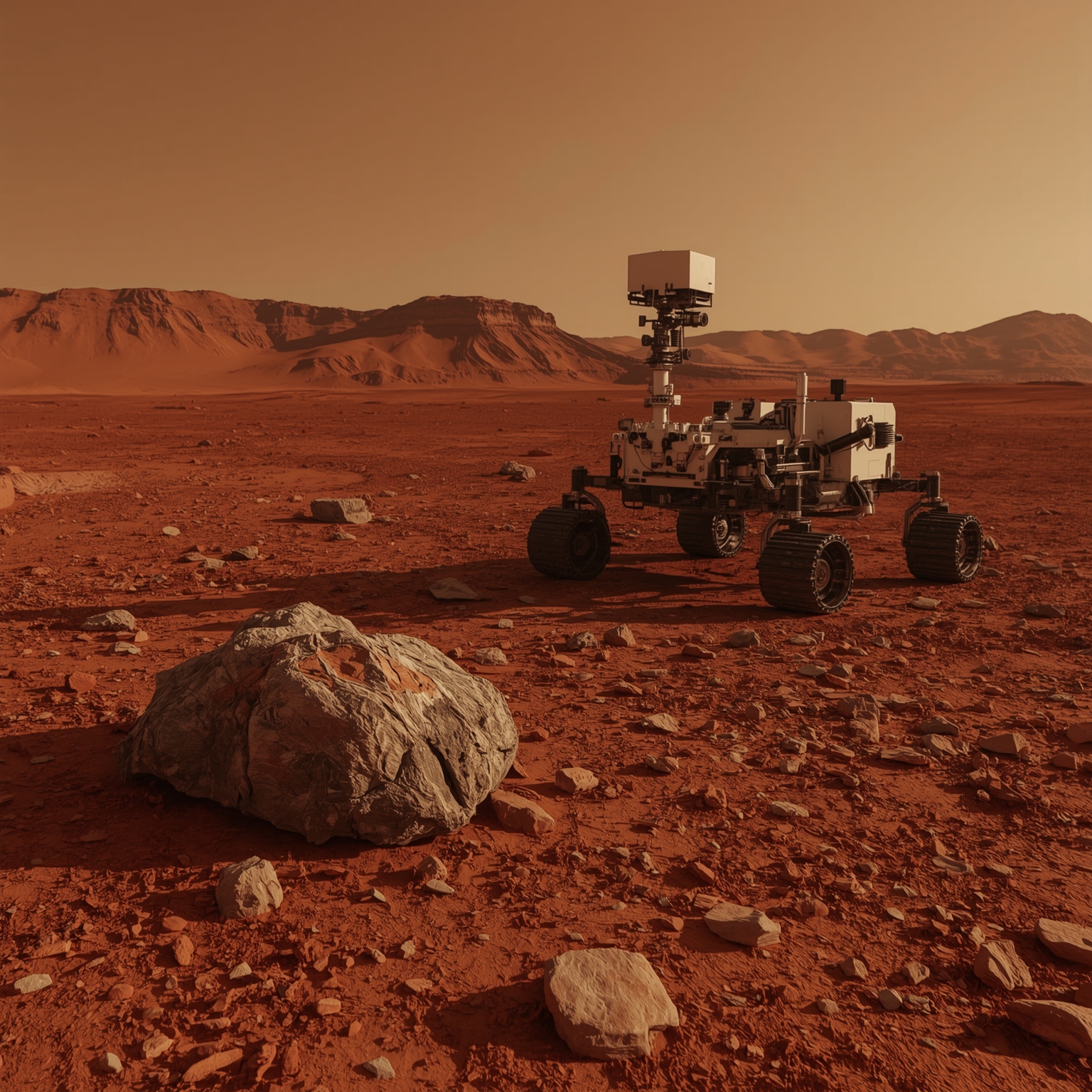
A remarkable breakthrough on Mars—one that could potentially reshape our understanding of life beyond Earth—is being clouded by mounting turmoil within NASA. At the very moment when scientists revealed compelling evidence suggestive of past microbial activity on the Red Planet, political decisions and staggering budgetary reductions threaten to unravel decades of painstaking progress and erode an invaluable legacy of exploration that has taken generations to build.
Yesterday, NASA unveiled research in the prestigious journal *Nature*, reporting on tantalizing findings from the Perseverance rover. In a rock formation estimated to be 3.5 billion years old, located within the ancient river delta of Jezero crater, the rover identified what appear to be possible biosignatures—subtle geological traces that, while not direct proof of organisms, can offer clues about whether microbial life once thrived there. Speaking at a press conference, Acting NASA Administrator and Transportation Secretary Sean Duffy emphasized the significance of the results, noting that they may represent the most persuasive hint of life yet encountered on Mars.
The research team exercised appropriate caution, underscoring that the unusual formations observed cannot yet be accepted as conclusive proof. The textures, found in rocks collected within the Neretva Vallis region, resemble patterns informally nicknamed “poppy seeds” and “leopard spots.” These descriptive labels denote dark dots and ring-shaped markings with pronounced rims—structures which, on Earth, often arise through biological processes linked to microbial communities. However, the scientists were clear that alternative geological or chemical processes might plausibly account for their appearance, reminding the public that many past claims of extraterrestrial life have later yielded to more mundane explanations. Nicky Fox, Associate Administrator for NASA’s Science Mission Directorate, articulated the cautious excitement by comparing the textures to fossils that preserve traces of life long after the living organisms themselves have vanished.
Ordinarily, such an announcement would be celebrated purely as a triumph of science. Instead, it comes at a moment of fragility for the agency. In fact, the preliminary results were first revealed in July 2024, after which they endured the demanding process of peer review. The choice to host another press conference at this juncture is unusual and has led some to speculate that NASA may be attempting to shift attention away from the severe fiscal threats facing its programs. The current U.S. administration, under President Donald Trump, has advanced proposals to slash the space science budget by nearly half. The potential cuts extend to programs critical for Mars exploration, including termination of the MAVEN and Mars Odyssey orbiters, retreat from a cooperative project with the European Space Agency focused on biosignature detection, and a substantial 25 percent reduction in funding for the Perseverance rover itself. Experts such as Casey Dreier of The Planetary Society have denounced the plans as draconian, warning that they could cripple the nation’s capacity to conduct meaningful space science just when breakthroughs are within reach.
Most alarming is the administration’s suggestion to cancel the Mars Sample Return mission entirely. This program is intended to deliver to Earth the rock cores meticulously gathered by Perseverance, samples that hold the promise of answering conclusively whether Mars once hosted life. Debate has long raged within the scientific community regarding the prioritization of sample return, yet with material now stored and awaiting retrieval, virtually all researchers argue that to abandon the mission would represent not only scientific wastefulness but also a betrayal of decades of investment and vision. As Joel Hurowitz of Stony Brook University, lead author of the new research, explained, no rover—no matter how advanced—can unambiguously identify biological origins of textures with its onboard laboratory. Only sophisticated analysis in terrestrial laboratories can decide whether the Martian features arose from microbial activity or from abiotic processes. In his words, bringing the rock back to Earth is indispensable for resolving the origin of these striking patterns.
When pressed on whether these discoveries would prompt a reconsideration of priorities, Duffy offered evasive assurances. He invoked human exploration, using the antiquated term “manned mission,” suggesting that the findings support the president’s larger vision of pursuing human expeditions beyond Earth. Although there are peripheral links—such as Perseverance’s experiments with spacesuit materials to prepare for eventual Mars landings—the scientific goal of reconstructing ancient microbial ecosystems is fundamentally distinct from efforts to put astronauts on the lunar surface. One is an endeavor aimed at profound questions of biology and planetary history; the other, in large part, is motivated by international competition and prestige.
This tension highlights a wider philosophical divide emerging within NASA itself: whether the agency should primarily pursue human spaceflight, often framed as crucial for national pride and geopolitical rivalry with countries like China, or whether its resources should emphasize robotic exploration that delivers knowledge more efficiently, with greater scientific returns for fewer risks. That division was starkly illustrated during an internal town hall meeting where Duffy reportedly advised NASA employees not to allow safety precautions to “be the enemy of progress” in the race to return humans to the moon. To veteran scientists and historians of spaceflight, this rhetoric evokes painful memories of NASA tragedies. Astronomer Phil Plait, referencing the Challenger and Columbia shuttle disasters, warned that dismissing safety concerns for the sake of speed threatens to repeat past mistakes where institutional culture stifled dissent, with catastrophic consequences.
While the administration publicly champions American leadership in space, its proposed financial policies appear to undermine that very objective. Casey Dreier encapsulated the paradox succinctly: at the very moment when NASA is on the threshold of historic discovery—discoveries that remind humanity of our unique ability to probe the cosmos—the White House is moving to dismantle the infrastructure that makes such breakthroughs possible. The contrast, he asserted, could not be more striking. To jeopardize Mars Sample Return and related programs would not merely cancel a project, but would also extinguish the chance to confirm one of the most profound findings in human history: the possibility that life once existed on another world. He urged policymakers to reflect on what would be irreparably lost should these plans proceed.
Thus, the unfolding drama around NASA is not only a battle over budgets. It is a struggle over priorities, values, and the trajectory of humanity’s search for knowledge. With Mars potentially whispering remnants of its long-lost secrets, the question is whether America will choose to listen—or turn away at the threshold of discovery.
Sourse: https://www.theverge.com/nasa/776554/nasa-mars-jezero-crater-budget-cuts