Although JPMorgan Chase may now claim the most technologically advanced and architecturally striking skyscraper on Wall Street—a gleaming, $3 billion testament to modern corporate ambition—only ten blocks farther downtown stands a quiet but profound counterpoint to that glass-and-steel marvel. There, undisturbed by passing decades, remains the 119-year-old library originally conceived by the bank’s formidable founder, John Pierpont Morgan. This venerable building, small in scale yet monumental in its historical weight, serves as an enduring emblem of the financial titan’s intellectual passions and cultural sensibilities.
Amid the attention lavished on JPMorgan’s new headquarters—the proverbial “new kid on the block”—the institution’s earlier monument offers an entirely different narrative, one rooted less in innovation and more in preservation. Motivated by this contrast, I made a point to visit the classic structure, today formally recognized as The Morgan Library & Museum. Nestled at the intersection of Madison Avenue and 36th Street in the heart of Manhattan, the site exudes an aura of refinement that still powerfully evokes the Gilded Age’s splendor and excess.
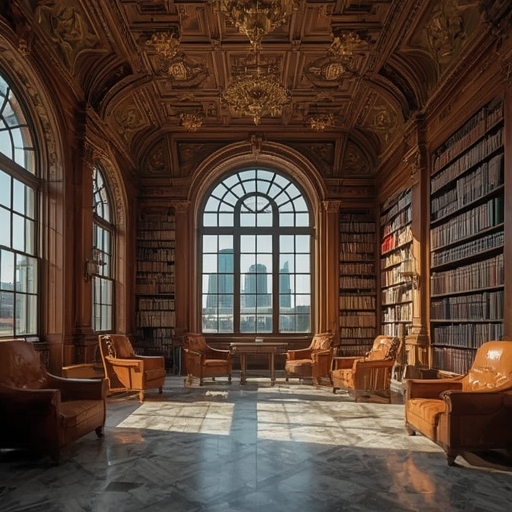
Completed in 1906, the building was commissioned by J.P. Morgan himself to house his personal study and extraordinary collection of books, documents, and art. Set adjacent to his family brownstone, the library was conceived as a private sanctuary rather than a public edifice. Yet stepping into its original architectural core transports visitors instantly back to the turn of the twentieth century, when craftsmanship, luxury, and intellectual pursuit coexisted in opulent harmony. The soaring rotunda entrance, its vaulted ceiling resplendent with elaborate paintings and frescoes, introduces guests to a realm where art and finance appear equally deliberate and disciplined undertakings. The deep crimson wallpaper that envelops Morgan’s study creates a mood of solemn dignity, while the intricate woodwork of the towering bookcases reveals an almost reverential regard for knowledge and history. Within these shelves rests Morgan’s formidable personal library—volumes that once informed the mind of one of the most influential financiers in American history.
For those hoping to encounter tales of market speculation or early Wall Street intrigue, the museum’s narrative may initially seem unrelated to the world of high finance. However, its appeal lies in the revelation of another facet of Morgan’s personality—the connoisseur, collector, and cultural patron. This duality between commerce and culture gives the space a distinctive character. As one guide aptly noted, visitors who appreciate artistic genius and historical resonance will find the museum to be an essential experience, much as its namesake regarded the aesthetic and intellectual treasures he gathered.
Over the years, as J.P. Morgan’s financial power expanded across continents and European aristocratic fortunes diminished, he used his immense resources to amass a breathtaking array of works and artifacts. Each acquisition—from ancient Mesopotamian relics to Renaissance manuscripts—reflected his insatiable curiosity and his desire to rescue beauty and knowledge from obscurity. The museum’s collection today bears witness to that passionate global pursuit, encompassing pieces that span millennia and civilizations.
One museum guide shared her personal favorites among the treasures: the miraculous Gutenberg Bible, one of the first major books ever printed with movable type, and the original manuscript of Charles Dickens’ “A Christmas Carol.” To behold these masterpieces at arm’s length is an almost transcendent experience, reminding visitors of the intimate connection between intellectual achievement and artistic craftsmanship that defined Morgan’s collecting philosophy.
In Morgan’s private study, portraits of both J.P. and his son, Jack Morgan, gaze watchfully over the chamber, their expressions seemingly fixed in contemplation. In one secluded corner lies a reinforced vault—an elegant reminder that even art and knowledge once required protection akin to gold. Beyond the study, the main library ascends through three stately stories, each wall sheathed in bookshelves that spiral upward, creating a cathedral-like ambiance dedicated not to faith but to human thought. The sheer magnitude of wealth, taste, and acquisition displayed throughout can border on overwhelming, yet the museum itself displays a gentle sense of self-awareness. A prominently featured political cartoon humorously depicts Morgan with a giant magnet, drawing valuable artifacts out of Europe—an image that subtly critiques the collector’s appetite even as it celebrates his preservation of cultural heritage.
For those enamored of history rather than solely finance, the visit proves deeply rewarding. The Morgan Library & Museum stands as an embodiment of the complex intersections between wealth, intellect, and beauty, bridging the gap between corporate achievement and artistic immortality.
Before leaving, I stopped at the museum’s gift shop, where a clerk shared that one of the institution’s most popular recent exhibits focuses not on Morgan himself but on the library’s first director, Belle da Costa Greene. Serving from 1905 to 1948, Greene was a pioneering figure whose scholarship and curatorial vision helped define the museum’s identity. According to the clerk, renewed public attention to Greene was sparked by a celebrated historical novel titled “The Personal Librarian,” which has become one of the shop’s best-selling items. This growing interest not only underscores the library’s continuing relevance but also highlights how its legacy—spanning finance, art, and literature—continues to inspire fresh perspectives on the individuals who built and preserved it.
Sourse: https://www.businessinsider.com/morgan-library-museum-jp-morgans-119-year-old-personal-study-2025-12