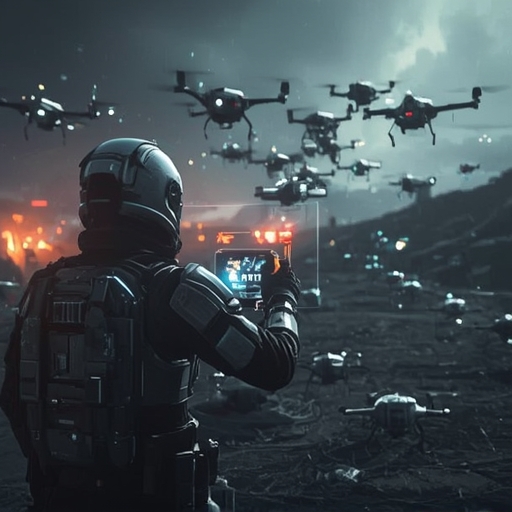
The evolving nature of warfare is on the verge of an extraordinary transformation—one that will require a single combatant to command vast, intelligent legions of autonomous drones capable of operating cooperatively with minimal human oversight. This vision, articulated by the leader of the Ukrainian defense company Ark Robotics, suggests that tomorrow’s battlefield will no longer rely on the traditional one-to-one relationship between pilot and machine. Instead, success will hinge on a model where a single, highly trained operator can coordinate hundreds or even thousands of drones functioning in synchrony, much like an orchestra responding to a single conductor.
Achi, the chief executive of Ark Robotics, explained to Business Insider that shifting from a system in which each drone depends on its own pilot to a structure where one operator can command many simultaneously is not merely an improvement—it is, in his words, a fundamental prerequisite for triumph in what he called the era of “total drone warfare.” Under the current model, scaling drone fleets can only be accomplished by proportionally increasing the number of trained pilots. But this approach presents obvious limitations. As Achi pointed out, it is far easier to ramp up production of aerial vehicles than to train an equivalent number of human controllers, and the imbalance in scalability makes the traditional structure unsustainable in the long term.
Ark Robotics has already gained extensive experience in developing autonomous robotic systems, currently utilized by more than twenty Ukrainian brigades. The company is engineering a unified command network that would allow thousands of aerial and ground-based drones—many of which were not originally produced by Ark—to interact and function collaboratively with only minimal human input. Its development trajectory is firmly directed toward the creation of a framework where one individual can assume control over a large constellation of autonomous machines.
Globally, the acceleration of drone manufacturing is unprecedented, spanning from Ukraine’s urgent wartime innovations to the large-scale industrial capacity of its Western allies and strategic adversaries such as Russia and China. Yet, as Achi emphasized, having advanced drones is meaningless if militaries cannot deploy them efficiently and in massive numbers. The lesson emerging from Ukraine’s conflict is that the scale of unmanned systems is as critical as their sophistication.
Since Russia’s full-scale invasion of Ukraine, drones have played a more prominent role than in any previous conflict in history. Rapid innovation has followed battlefield necessity, turning Ukraine into a proving ground for unmanned technology while the rest of the world—especially Western governments—closely scrutinizes the implications for their own defense strategies. For Ukraine, drones compensate for its numerical inferiority against Russia’s immense military force by providing what Achi calls “mass.” However, when each drone requires individual supervision, the advantage dissipates. Only by adopting swarm-based systems—where drones coordinate their actions autonomously—can militaries magnify combat effectiveness while reducing risk and response time. The growing interest in swarm technology, therefore, is not a matter of interest alone but an operational imperative.
To date, no country has confirmed the deployment of large-scale, fully autonomous swarms capable of independent decision-making in combat without substantial human direction. Nevertheless, experts agree that such advancements would revolutionize warfare entirely. Dr. James Patton Rogers of Cornell’s Brooks Tech Policy Institute described the potential as the opening of an entirely new realm of military tactics and strategies—concepts that human strategists have not yet even begun to conceive.
Ark’s ongoing program, known as Frontier, exemplifies how Ukraine continues to push these technological boundaries. Still in its prototype stage, Frontier demonstrates both the nation’s ambition and the infancy of this emerging field. Achi noted that Ukraine’s experience illustrates how sheer quantity can evolve into a form of quality. By developing asymmetric systems that allow soldiers to operate multiple drones concurrently, Ukrainian forces strive to offset their adversary’s larger numbers. This principle serves as an invaluable lesson not only for Ukraine but for the West as well.
Western military strategists and defense industry leaders are recognizing that traditional approaches—relying on a few sophisticated but expensive systems—are ill-suited for modern, attritional warfare dominated by abundant, expendable drones and missiles. To effectively counter Russia’s heavy bombardment tactics, they must shift toward mass-producing simpler, cost-effective weapons that can be fielded rapidly. Within this paradigm, drone swarms represent not just a technological innovation but the conceptual key to sustaining modern conflict at scale.
Yet questions remain regarding how significant a role drones might play in future Western conflicts compared to their centrality in Ukraine. Part of Ukraine’s reliance stems from necessity—its shortage of conventional weaponry and manpower. Even so, NATO and allied nations increasingly emphasize the urgent need to enhance both drone and counter-drone capacities. Swarming systems are among the most sought-after capabilities, as they promise to multiply human potential while minimizing exposure to danger.
Sweden’s Defense Minister, Pål Jonson, told Business Insider that observing the Ukrainian conflict has driven his nation to accelerate development of systems that would allow a single soldier to autonomously control as many as one hundred drones. Other NATO members are pursuing similar initiatives, though the exact timelines for operational readiness remain uncertain. Despite this momentum, there is still no comprehensive alliance-wide investment or unified strategy ensuring these systems reach the battlefield at scale. Within NATO, officials repeatedly warn that procurement is proceeding too slowly, that production cycles remain bound by outdated processes, and that opportunities to assimilate wartime lessons risk being squandered.
Achi cautioned that while public discourse often exaggerates the current level of autonomy in defense technologies, the relentless realities of the battlefield have proven that autonomy itself is indispensable and, in his view, irreversible. Across industries and governments, a recognition is emerging: autonomous systems are the only viable means to overcome manpower constraints, accelerate decision-making, and safeguard personnel.
This sentiment is echoed by Agris Kipurs, CEO of Origin Robotics in Latvia—another key supplier of drones to Ukraine and a member of NATO’s defense ecosystem. Kipurs considers autonomy a strategic necessity, particularly for smaller NATO states bordering Russia, where human resources are limited. Scalable systems, he argues, are the only sustainable path to credible deterrence. Autonomy, therefore, becomes not an optional supplement but a structural foundation for modern defense.
Looking forward, Achi advocates for Europe to heed Ukraine’s hard-earned battlefield lessons while simultaneously anticipating future challenges. Whereas Ukraine develops technology under existential pressure, Europe possesses the luxury of time—a resource that should be used wisely. He warned that increased defense spending will be wasted if it merely replicates outdated or inefficient systems. Instead, it should be channeled toward forward-thinking innovation that builds upon, rather than merely imitates, Ukraine’s pioneering achievements. For him, progress means learning from today’s lessons while already planning the next generation of solutions, ensuring that Europe’s technological evolution remains both adaptive and visionary in the age of autonomous warfare.
Sourse: https://www.businessinsider.com/future-war-needs-one-soldier-controlling-many-drones-ukraine-ceo-2025-12