As a writer who treats the craft as both vocation and discipline, I have learned to regard the instruments of my trade with a careful balance of seriousness and pragmatism. Every key I press, every click that accompanies the rhythm of my thought, serves as the interface between conception and creation. Yet, while I appreciate finely engineered tools, I do not verge on extravagance—there is no universe in which I would invest several thousand dollars in a keyboard, however exquisite. At the same time, the flat, unyielding feel of a MacBook keyboard, when used for long stretches, leaves me restless and frustrated, constantly aware of its inadequacy. It interrupts my immersion in the written word and saps from the tactile pleasure that should accompany the act of writing. This tension between functionality and focus propelled me, as winter gave way to spring, into the pursuit of what I began to think of as a truly distraction-free writing environment—a minimalist space where both mind and machine could operate with quiet precision. My research soon led me toward two essential components: a lightweight e-reader that could double as a dedicated writing platform, and, of course, a mechanical keyboard capable of delivering that satisfying, rhythmic feedback so beloved by writers and typists alike.
My first experiment in this search was the Boox Palma 2, an E Ink device whose restrained connectivity and monochrome display promised to liberate me from the digital noise of the modern internet. Its purpose was not to entertain but to facilitate deep concentration, and I quickly realized that when paired with the right keyboard, it might indeed fulfill that role admirably. After careful comparison of brands, switch types, and form factors—a process that sent me deep into the surprisingly passionate world of keyboard enthusiasts—I found myself drawn to the NuPhy Air60 V2. I selected the version equipped with the company’s heaviest tactile Moss switches, whose weight and resistance convey a subtle but gratifying firmness. To complete the ensemble, I chose the NuFolio carrying case in the cheerfully named “nostalgic tan,” a shade that in truth radiates a bold, almost golden hue, reminiscent of aged paper under warm lamplight. This detail, though aesthetic, contributed to my overall motivation; tools that please the eye often inspire the hand.
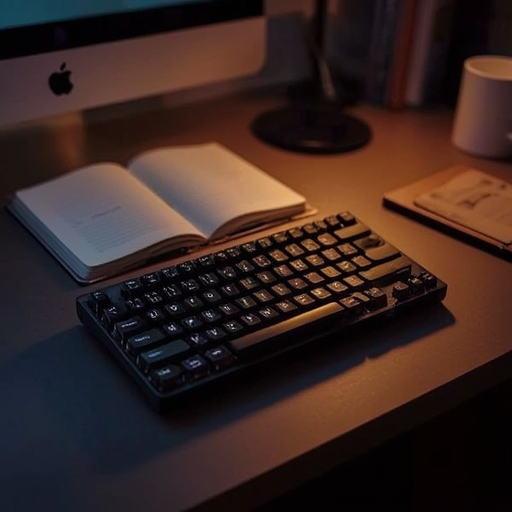
Although I would never claim to be an expert in mechanical keyboard craftsmanship, the Air60 V2 delighted me from the first sentence I composed upon it. Its low-profile keys, while not offering the cavernous travel distance of a full-sized desktop model or the near-mythical IBM Model M that gathers dust in my office, nonetheless provide a tangible upgrade over the shallow, whisper-thin scissor switches of my MacBook. The Moss switches yield a pleasing “thock”—a muted resonance that signals each keystroke without broadcasting it obnoxiously. It strikes that elusive balance between responsiveness and restraint: audible enough to be satisfying, yet subdued enough for public spaces. Admittedly, I might think twice before using it in a hushed coffee shop, but I have comfortably written at length while perched on a barstool, surrounded by low conversation and the hum of refrigeration, feeling perfectly at ease and confident in my small sonic footprint.
A further advantage, and one of no small practical significance, is the keyboard’s ability to pair with three different devices simultaneously. This flexibility allows me to shift seamlessly between my personal laptop, my work machine, and the Boox Palma without a moment’s pause. A 2.4GHz wireless dongle accompanies the setup for those who prefer a physical connection, but I have rarely found reason to employ it—the stability of the built-in Bluetooth connection has proven more than adequate for my routine.
On many quiet evenings behind the bar at Flagship Brewery, where I earn my living on Tuesdays and Thursdays, the Air60 often accompanies me, tucked neatly into my bag alongside the Palma. When business slows and the atmosphere turns tranquil, I set up my miniature workstation. If I happen to use my laptop, the Air60’s design ingeniously allows it to rest directly atop the MacBook keyboard without obstructing the trackpad, making for an elegant, ergonomic arrangement. More often, however, I rely solely on the Palma 2 for writing sessions that thrive on solitude. In those moments, the NuFolio case reveals its versatility, transforming from a protective cover into a sturdy stand, while the Palma’s folding cover drapes naturally over the top. Together, they form a compact, self-contained workspace—an intimate cocoon of productivity in which the internet’s incessant chatter becomes a distant memory.
Even in the comfort of my home, this pairing has found a well-deserved place in my creative rhythm. When I decided, after nearly two decades of neglect, to return to writing fiction, I installed Obsidian on the Palma and immediately felt a sense of liberation. The simplicity of this unconnected environment, coupled with the tactile joy of the Air60, reinvigorated my creative energy. I have always relied on timers and structured intervals to maintain focus, yet this combination seemed almost transformative—a genuine remedy for my habitual tendency toward distraction. The physical act of typing became something I anticipated with eagerness; the feel of the Moss switches beneath my fingers, the gentle tone accompanying each word, even the color palette of my chosen tools all contributed to an almost meditative sense of contentment no integrated laptop keyboard could hope to reproduce.
Of course, no tool is without its shortcomings. The Air60’s compact 64-key layout, designed for maximum portability, demands a small concession in typing accuracy. The reduced spacing sometimes leads me to strike unintended keys more often than would happen on a full-sized board. Similarly, the keyboard’s shallow incline, though visually sleek, can cause slight strain during long seated sessions. Yet these are small trade-offs. When positioned on a standing desk—or indeed, atop the bar where I often work—its ergonomics feel close to ideal. Even set casually in my lap, it provides a comfortable platform that allows my hands and posture to align naturally.
When I first purchased the NuPhy, I did so with more hesitation than certainty. At the time, my finances were precarious; a year of unemployment and dwindling freelance work had left me questioning every expenditure. I wondered if this relatively modest yet nonessential investment was an act of indulgence I would later regret. But looking back, nearly nine months on, I can say without reservation that it has proven indispensable. The Air60 has not only justified its cost but has redefined the texture and pleasure of my daily writing practice. What began as a small experiment in minimizing distraction evolved into a rediscovery of focus, a renewed appreciation for the tactile intimacy of language, and a reminder that even in lean times, the right tool can profoundly shape the art one creates.
Sourse: https://www.theverge.com/gadgets/843455/mechanical-keyboard-nyphy-favorite