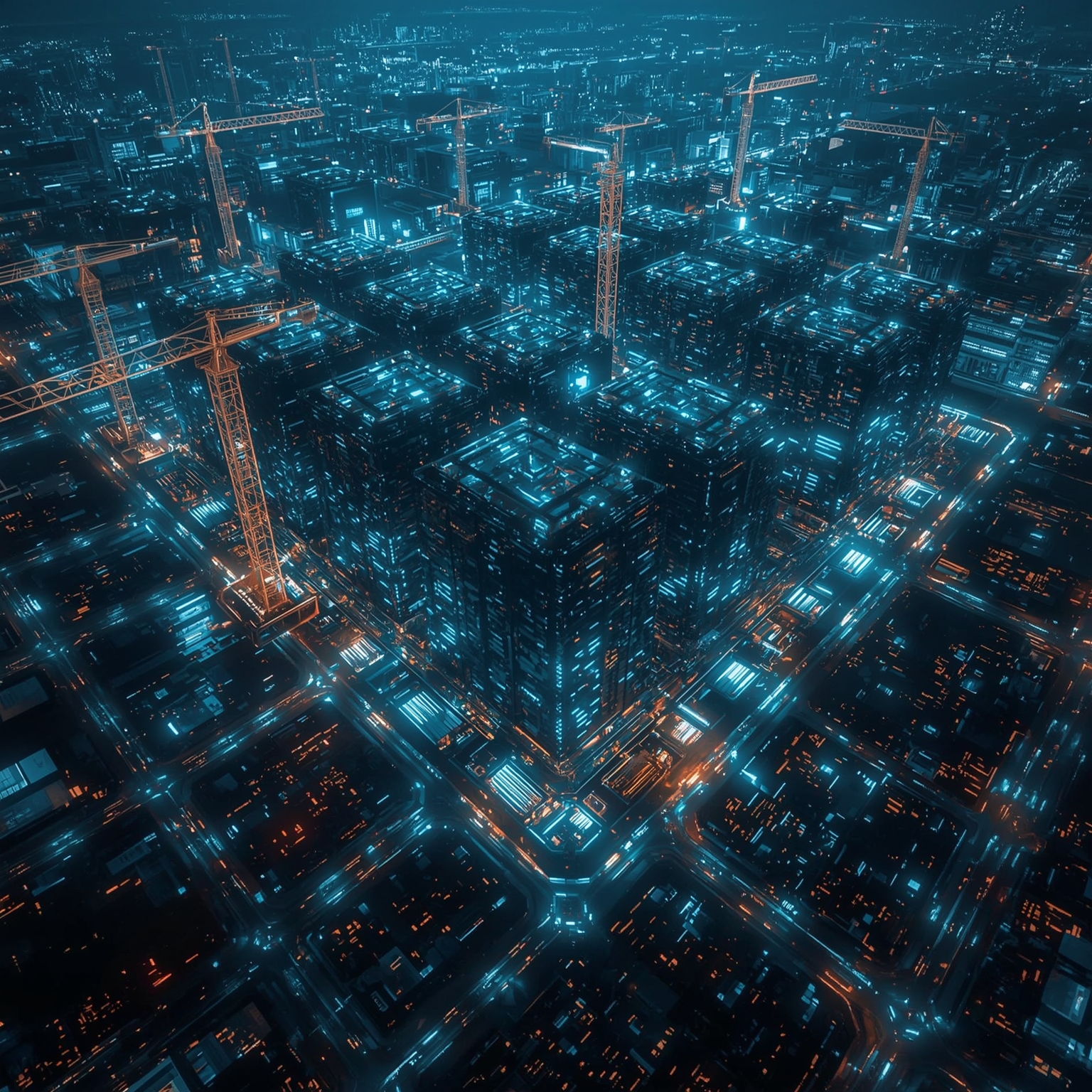
According to a newly released report from Bank of America Global Research, overall expenditures on data center construction within the United States reached an unprecedented milestone in June, climbing to approximately $40 billion annually. This figure represents the highest level of spending ever recorded in this sector. Drawing upon detailed data published by the U.S. Census Bureau, the research highlights that this level of expenditure signifies a substantial 28% increase compared with the amount spent during the previous year, thus underscoring the dramatic acceleration in infrastructure investment taking place.
The driving forces behind this rapid growth are the massive expansion strategies of the largest and most influential technology companies. Industry giants such as Amazon, Microsoft, Google, and Meta are at the forefront, pushing forward with ambitious development plans so extensive that analysts anticipate total capital expenditures potentially exceeding one trillion dollars over the coming years. Bank of America’s forecast further narrows in on the role of artificial intelligence infrastructure, estimating that between 2025 and 2028 those same companies will devote a combined $385 billion per year to the construction and scaling of facilities purpose-built to power AI workloads, cloud computing, and advanced digital services.
This intense and highly competitive race to dominate artificial intelligence has catalyzed a dramatic surge in spending across the technology sector, one that appears far from reaching its peak. During quarterly earnings presentations just last month, all four corporations—Amazon, Microsoft, Google, and Meta—jointly emphasized to their investors that capital expenditure would surpass prior projections for the year. These statements effectively confirmed that their commitments to widening digital and AI infrastructure will not abate in the foreseeable future.
Even Apple, a company that has historically taken a more cautious and comparatively modest approach with regard to data center investments, has reported a significant shift. The company disclosed that it spent $9.5 billion on data center infrastructure during the first three quarters of the current year, which represents a 50% increase relative to the same period in 2024. This departure from Apple’s traditionally restrained spending underscores the degree to which the demands of AI development and digital services are reshaping investment strategies across the entire industry.
Oracle, a company rarely mentioned in the same breath as the leading four in terms of infrastructure outlay, startled markets with an aggressive new capital expenditure forecast. On its most recent first-quarter earnings call, the company announced a projected $35 billion in capex for the fiscal year, amounting to a 65% year-over-year increase. Historically known for spending significantly less on physical infrastructure than its peers, Oracle’s dramatic shift highlights the profound realignment underway throughout the technology ecosystem. This surge has been fueled in part by the signing of $317 billion worth of new artificial intelligence–focused contracts during the preceding quarter. Oracle’s Chief Executive Officer, Safra Catz, informed shareholders of this monumental deal during the call, information that triggered a remarkable market reaction. The revelation sparked a sudden surge in the firm’s stock price, propelling Oracle cofounder, executive chairman, and chief technology officer Larry Ellison, to briefly become the wealthiest individual globally on September 10.
Analysts from TD Cowan offered additional context in a recent research note, suggesting that a significant portion of this $317 billion influx resulted from Oracle’s contract with OpenAI. Confirmation of the scope of this partnership emerged in July, when OpenAI announced that it had entered into an agreement with Oracle to develop an extraordinary 4.5 gigawatts of electrical capacity for its data center project known as Stargate. To illustrate the scale of this commitment, 4.5 gigawatts equates to over twice the electricity-generating capacity of the Hoover Dam, signaling the immense energy requirements of AI infrastructure.
The Stargate initiative has an unusual origin story. It was first unveiled publicly in January by then-President Donald J. Trump during a White House press event. Presented as a collaborative venture between Oracle, OpenAI, and SoftBank, the project was heralded as a transformative investment expected to channel approximately $500 billion into U.S. infrastructure. The announcement was made alongside prominent figures including Larry Ellison, OpenAI CEO Sam Altman, and SoftBank CEO Masayoshi Son, reinforcing the project’s symbolic significance. However, since that initial unveiling, information regarding the progress of the collaboration has remained sparse.
While Oracle and SoftBank’s roles remain less prominently referenced in subsequent communications, OpenAI has increasingly presented Stargate as a proprietary initiative focused on building its own extensive network of data centers. The company has already revealed plans to extend the project beyond U.S. borders, identifying Norway and the United Arab Emirates as key sites for expansion. Interestingly, in these announcements Oracle and SoftBank were not mentioned as central partners, fueling questions about the precise nature of the trio’s ongoing collaboration.
Nevertheless, in July, Oracle and OpenAI jointly confirmed that the Abilene, Texas, data center campus currently under development would serve as Stargate I, marking the first official facility to adopt the Stargate name. In contrast, SoftBank did not appear in this specific announcement, further emphasizing the shifting dynamics of the partnership. Together, these developments illustrate the extraordinary pace, scale, and competitive intensity of investment in AI-enabled digital infrastructure, a growth trajectory that is profoundly reshaping both corporate priorities and the broader technology landscape.
Sourse: https://www.businessinsider.com/us-data-center-construction-40-billion-spend-hits-record-high-2025-9