In our household, the annual ritual of selecting the perfect Christmas tree has long been more than just a seasonal errand—it has become a cherished family tradition, symbolizing togetherness and the continuity of our shared history. Despite the fact that our children, now fifteen and seventeen, are increasingly independent and immersed in their own busy teenage lives, we still make every effort to carve out time for this familiar tradition. This year proved no different. Between my daughter’s scheduled shift at her part-time job in a cheerful local gift store and my son’s ever-looming dental appointment, we managed to find a narrow window of opportunity to embark on our festive quest.
In years past, our family’s tree invariably came from a hearty Vermonter who transformed our church parking lot into a rustic pine forest each December. His small seasonal outpost, with its scent of fresh fir and simple hand-painted signs, had become a comforting fixture of our holiday routine. Long before parenthood, however, when my husband and I were still living amid the bustle of New York City, our tradition looked a bit different. Back then, we would weave through city sidewalks until we found a friendly vendor standing beside a truck brimming with freshly cut conifers. Choosing a tree in that urban setting possessed its own peculiar magic—the delight of lifting it onto your shoulder, carrying it through the cold air, and wrestling it into the apartment elevator, which afterward would be carpeted in fallen pine needles, was somehow part of the charm.
As a British transplant, I have always been amused by this uniquely American custom of strapping a Christmas tree to the roof of one’s vehicle. In the United Kingdom, people often haul their tree home by hand or fit it awkwardly into the backseat of their car. Watching SUVs and sedans cruising along highways with evergreens tightly secured on top never fails to make me smile—it feels both whimsical and quintessentially festive.
This year, however, our dependable Vermonter failed to appear, his familiar stand conspicuously absent from the church lot for reasons unknown. On the recommendation of a friend, we decided instead to visit a bustling nursery that promised a wide assortment of fresh trees. The place was teeming with other families seeking their own perfect specimen, yet hundreds of trees still stood there, each aligned neatly and tethered to poles, swaying slightly with the winter breeze. Because this Christmas would be my daughter’s last before she sets off to college, we were determined to make it feel especially memorable. We agreed, somewhat sentimentally, to choose a tree loftier and grander than those of previous years.
We began our search with excitement, imagining how the right tree would glow under the soft lights of our living room. My daughter took the lead, wandering through the nine- and ten-foot sections before settling, with characteristic decisiveness, on the third tree she inspected. While she and my husband examined it more closely, I drifted away to admire the garlands and wreaths artfully displayed nearby. Out of the corner of my eye, I suddenly caught sight of my husband wildly gesturing in my direction, his lips forming the urgent words, “Get back in the car!” I hurried over, puzzled and slightly alarmed, only to discover the cause of his distress: the price tag. The tree my daughter had selected came with a jaw-dropping cost of three hundred and seventy dollars—an astonishing thirty-seven dollars per foot. I let out an audible gasp. Although I am fully aware that our county is among the most expensive in New York, perhaps even in the entire country, the sheer extravagance of that number stunned me.
There was, quite simply, no way I could justify spending nearly four hundred dollars on a tree that would stand proudly in our living room for barely a month before being dragged to the curb. Even my children, who usually lobby for larger and more ornate selections, conceded that the price was excessive. Their pragmatic acceptance somehow made the decision easier but also deepened my reflection on how far removed today’s holiday consumerism feels from the simplicity of my own childhood.
That sticker shock triggered an unexpected wave of nostalgia. My thoughts drifted back across decades and miles to the northeastern corner of England in the 1970s, where I grew up in a modest home with my parents and my sister, Alison. Every December, instead of purchasing a new tree, my father would head out into the frosty garden to unearth a small four-foot fir that had become our family’s perennial Christmas companion. For some whimsical reason, we had named this scraggly little tree George. Sparse and slightly lopsided, George bore a resemblance to the forlorn tree from the Charlie Brown Christmas special, yet to us, he was perfect.
My father would carefully place George into a large pot, then carry him indoors to assume his honored position in our living room. My sister and I would enthusiastically decorate him with colorful lights, glittering tinsel, and a mismatched collection of ornaments we had accumulated over the years. Once the holiday season concluded, my father would ceremoniously return George to his original spot in the garden, where he would thrive quietly until it was time to repeat the process the following year. Looking back, I suppose our family practiced environmentally responsible traditions long before phrases like “sustainable living” had entered common vocabulary.
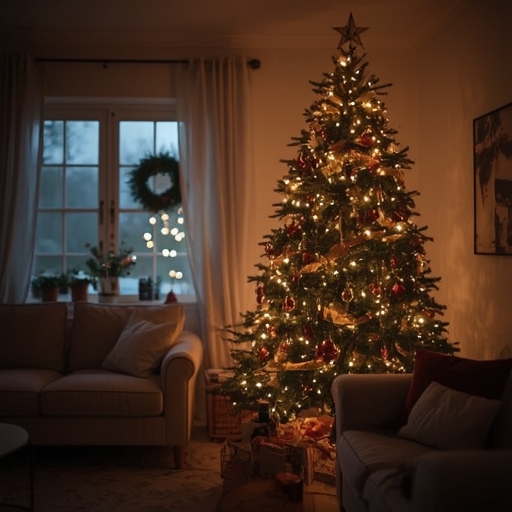
When I later mentioned our contemporary search for a reasonably priced tree to my sister, the conversation led us back to fond memories of George. We recalled his eventual demise—he had been dug up and re-potted one too many times, and at last, he failed to survive another transplanting. The day we lost him was unexpectedly sad; it marked the end of a small but meaningful ritual that had defined our childhood Decembers. After recovering from the shock of the modern tree prices, I briefly entertained the idea of finding a new sapling to plant and name George II, reviving that old family practice. Pragmatism prevailed, however, and we ultimately purchased a stately ten-foot tree from a roadside stand for just over two hundred dollars—a relative bargain compared to our earlier discovery.
A few days later, while reminiscing further with Alison, she surprised me with something truly touching: a black-and-white photograph she had unearthed from 1976. She had sent it via WhatsApp—a delightful collision of nostalgia and modern technology. In the picture, a wide-eyed eight-year-old version of myself stood proudly in our front yard beside little George, the tree that had once seemed to me the very essence of Christmas. My mother, it turned out, had safeguarded that photo for decades at the bottom of a drawer. Seeing it again reminded me that the true beauty of the holiday season lies not in lavish decorations or monumental trees, but in the enduring warmth of memory, family, and modest rituals that, even when revisited years later, still sparkle with quiet magic.
Sourse: https://www.businessinsider.com/why-christmas-tree-costs-are-so-high-family-experience-2025-12