For much of my life, I never really understood what kind of pizza I actually liked. It sounds trivial, even laughably insignificant, but that small uncertainty was quietly emblematic of a larger truth about who I was—or perhaps, who I hadn’t yet allowed myself to become. For decades, I played the role of the pragmatic adult, the mother of four sons, always making choices for the group rather than the individual. When it came to pizza, I defaulted to efficiency and consensus: an extra-large cheese to satisfy everyone, or pepperoni when I dared to feel slightly adventurous. Those selections weren’t about taste; they were utilitarian compromises, symbolic of a life defined by responsibility and practicality. For a single mother constantly racing between work, home, and errands, the notion of pausing long enough to consider what *I* wanted—on a pizza or otherwise—felt like an impossible luxury.
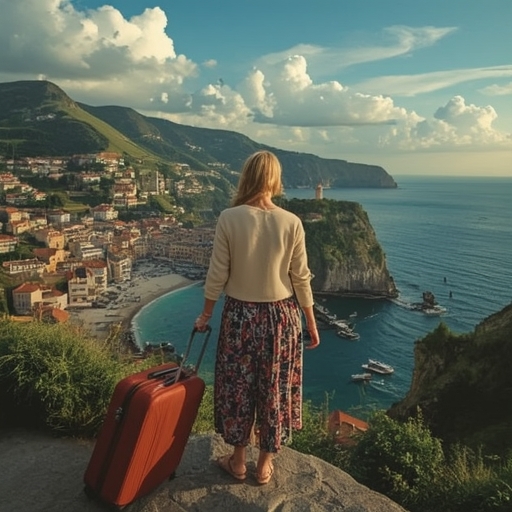
Perhaps that underlying neglect of self is one of the reasons I eventually packed a single suitcase and crossed an ocean after my youngest son left for college. On the surface, I told people I wanted to discover what I truly liked on my pizza. Beneath that simple metaphor, however, lived a much deeper hunger—one for discovery, autonomy, and self-definition after decades of parenthood. It wasn’t just about toppings; it was about parts of myself left unexplored.
For years, the idea of Europe had shimmered in the distance of my imagination, a kind of unreachable dream. During the busiest seasons of motherhood—when grocery runs felt like major expeditions and the school parking lot defined the outer edge of my world—I’d fantasize about long afternoons in Italy or quiet mornings in a French café. At that time, Europe was not merely a place on a map; it was shorthand for freedom, beauty, and reinvention. From the vantage point of our small Canadian town, even the airport seemed impossibly far, a portal to a world that other people got to experience.
This story, part of the *Adult Gap Year* series, isn’t just about travel logistics or destination checklists. It’s about personal recalibration—the courage to pause life’s relentless forward motion and take a deliberate break to rediscover purpose, identity, and joy. When the moment finally arrived, my fear of remaining stuck outweighed my fear of leaving. I realized I couldn’t keep waiting for my sons’ occasional visits to make me feel whole. The home I’d built for years had become both sanctuary and cage. And so, armed with trembling resolve and a modest tax return, I booked a one-way ticket to Rome.
Determined not to let hesitation define me, I packed my laptop to maintain remote work and afford a semblance of independence. My first stop was a minuscule studio apartment in the historical heart of Tivoli, just outside Rome—a place where ancient stones and narrow alleys whispered stories older than memory itself. From there, I spent a month in Avignon, in southern France, surrounded by lavender fields and steady sunlight. Later came Belfast, with its rugged coastline and wind-bitten charm. My itinerary wasn’t crafted for prestige or style; I chose these places mostly through friends’ suggestions and the most affordable monthly Airbnbs I could find. I knew embarrassingly little about the wider world beyond my backyard, and that ignorance was exactly why I needed to go.
For half a year, I relearned how to exist as an individual rather than merely as “Mom.” Without the familiar framework of caretaking, I had to encounter myself anew. Making friends no longer came through my children’s school networks or workplace small talk—it required reaching strangers as just myself. In Italy, I joined a local hiking group, where I met a woman who soon became one of my dearest companions. Day after day, we walked mountain trails and navigated conversations that flowed between two languages, bridging meaning with gestures, laughter, and patience. Learning Italian as a middle-aged woman was humbling. I felt clumsy and exhilarated at once—foolish in my mistakes yet unexpectedly alive in my vulnerability.
During these months, my rhythm became unhurried and contemplative. I walked everywhere instead of rushing. I learned the quiet pleasure of solitude—long train rides with scenery unspooling beyond the windows, silent museum afternoons spent among marble statues, evening glasses of wine sipped slowly in street cafés. Each morning, I would carry my coffee to the local courtyard, settling on a bench to observe the town’s choreography: children kicking soccer balls, women chatting as they filled their water jugs, elderly men engrossed in a game of bocce. Every cliché of Italian life unfolded before me, and for once, I let myself revel in it fully, unselfconsciously.
Of course, I missed my sons—deeply and often. There were nights when the ache of distance made the quiet unbearable, and I considered abandoning it all to fly home. Yet missing them from afar, within the unfamiliar hum of foreign streets, somehow felt gentler than missing them from the same kitchen I’d cooked in for 20 years. At home, absence felt like stagnation; abroad, it felt like an evolution. Leaving became a declaration that my life, too, still contained the possibility of change.
When my path led from Italy to Avignon, I sensed a new ease. I spoke enough French to engage warmly with locals, and the city’s scale—its winding lanes and open plazas—made it feel instantly welcoming. Almost everywhere I turned, I met other women in a similar life stage: empty-nest mothers forging new identities while remaining lovingly bound to their grown children. They insisted I join their lunches and afternoon promenades. In their laughter and companionship, I saw mirrors of myself—women rediscovering how to inhabit space on their own terms.
Over those six months, I realized something subtle yet profound: it was possible to construct a new life without dismantling the old one. I didn’t have to abandon motherhood to reclaim individuality; I could weave both into a single, evolving self. Growth didn’t require erasure—it required expansion.
In Belfast, the final chapter of my journey, I wrote incessantly. I hiked the green paths of Cave Hill, sometimes in companionable silence with new friends and sometimes entirely alone. I took weekend buses to the Giant’s Causeway, where I ate steaming bowls of fish chowder overlooking the sea’s gray expanse. My days unfolded in deliberate balance: familiar comforts like yoga classes or quiet afternoons reading by a pub fireplace, paired with small acts of exploration—music nights, local festivals, spontaneous laughter with strangers. For the first time in many years, I had the time, space, and peace to write a full book, born from the stillness I’d so long craved. It felt as though, at last, I was living inside a story that belonged entirely to me.
When the adventure came to its natural close, I invited my sons to join me for two weeks in Rome. We revisited the iconic sites—the Trevi Fountain, the Spanish Steps, and all the postcard-perfect corners of the city—but what felt most important wasn’t the grandeur of the monuments. I wanted them to meet the woman I had become: still their mother, but also a friend, a wanderer, a writer, and, quite pleasantly, a newly minted lover of all varieties of pizza. In the glow of that shared experience, I understood that change doesn’t erase the past—it expands it.
Sourse: https://www.businessinsider.com/single-mom-empty-nester-travel-solo-europe-next-steps-2025-12