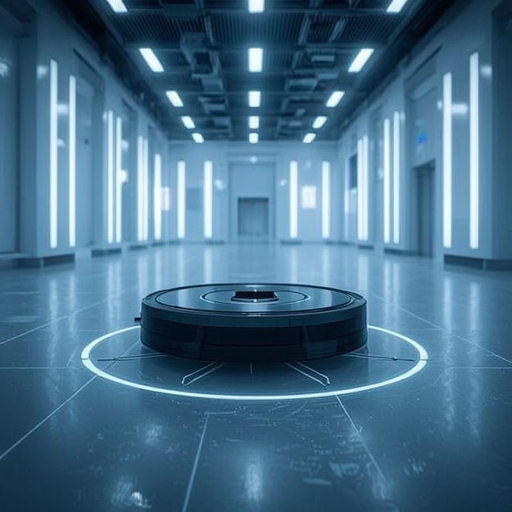
iRobot, the well-known technology company responsible for creating the famed Roomba robotic vacuum, has formally submitted for Chapter 11 bankruptcy protection in the United States. In its filing, the company announced that it has reached an agreement to be acquired entirely by its existing contract manufacturing partner, Picea Robotics, thereby marking a significant turning point in the history of consumer robotics and automated home cleaning technology. Picea, which is based in China and operates as a major original design manufacturer, had already taken over iRobot’s $190 million loan earlier in the month. Under the newly approved restructuring plan, Picea has agreed not only to forgive that loan but also to cancel an additional $161.5 million in outstanding debt owed to it by iRobot for the production of the company’s robotic products. In exchange for wiping out these substantial liabilities, Picea will assume full ownership of iRobot, bringing the entirety of the Roomba brand and its associated technology under its corporate umbrella.
This naturally raises an important question for many—who exactly is Picea Robotics? The company, officially named Shenzhen Picea Robotics and also operating under the brand 3irobotix, stands among the world’s most influential original design manufacturers specializing in robotic vacuum technology. Picea’s parent company lists globally recognized consumer electronics brands such as iRobot, Shark, and Anker (the parent company of the Eufy vacuum line) as corporate partners on its official site, showcasing its extensive industry reach. Within technology forums such as Reddit, speculation has emerged suggesting that Picea may also be behind Dyson’s recently introduced robotic vacuum model, the Dyson Spot & Scrub Ai. Although these claims remain unverified, The Verge has reached out to both Picea and Dyson for confirmation, demonstrating the level of public curiosity surrounding Picea’s growing manufacturing influence.
To better understand the context behind this acquisition, it is useful to recall iRobot’s situation earlier in 2024. Following the complete collapse of its planned acquisition by Amazon, iRobot found itself in a precarious financial position and faced urgent pressure to reorganize. The company announced a strategic plan to offload non-core engineering operations and relocate certain development activities overseas in an attempt to significantly reduce manufacturing costs. As part of that shift, iRobot formally partnered with Picea Robotics as its contract manufacturer, ultimately unveiling a new generation of Roomba devices in the subsequent year. Despite the initial anticipation surrounding these models, the redesigned Roombas—specifically the 505 and 205 editions—were met with mixed reviews. Many industry observers noted that these new versions bore little resemblance, technologically or stylistically, to the groundbreaking original Roomba designs. They instead closely mirrored typical mid-range robotic vacuums produced by numerous manufacturers, featuring standard Lidar navigation systems and only minor aesthetic differences. Independent testing of these models revealed notable performance shortcomings, amplifying doubts about whether iRobot’s updated lineup could re-establish its former market dominance.
As for Picea Robotics itself, the firm functions as a subsidiary of Picea Corp., which maintains extensive research, development, and production capabilities across multiple facilities situated in both China and Vietnam. According to its self-reported metrics, Picea has produced and sold over twenty million robotic vacuum cleaners to date—an achievement underscoring both its industrial scale and its growing technological prowess. In addition to serving as a behind-the-scenes manufacturer for various global brands, Picea recently launched a proprietary product line under its own 3i label. These vacuums integrate advanced engineering concepts, including an innovative dust-compacting mechanism comparable to that found in the Roomba 205.
In personal testing of several 3i models, including the company’s flagship 3i S10 Ultra, the machines proved to be highly capable and technologically sophisticated cleaning systems. The S10 Ultra features a particularly innovative water-recycling process: by employing a built-in dehumidifier, it continuously replenishes its clean water reservoir, enabling longer and more efficient cleaning cycles. The device also integrates cutting-edge dirt-detection algorithms that use precision green-light scanning to identify and repeatedly scrub away stubborn stains. This cleaning behavior bears a strong resemblance to the adaptive features showcased in Dyson’s most recent robotic vacuum models, demonstrating the degree to which Picea’s engineering has reached parity with some of the industry’s leading competitors.
Despite iRobot’s public assurance that it intends to maintain normal business operations throughout the bankruptcy process, the long-term direction of the Roomba brand under full Picea ownership remains uncertain. The acquisition signals more than just a financial realignment—it also represents a larger shift in global manufacturing dynamics. What can be stated with confidence, however, is that Chinese-owned and operated robotics manufacturers continue to strengthen their hold over the global market for intelligent home-cleaning devices, increasingly shaping both the technological development and the economic structure of the robotic vacuum industry.
Sourse: https://www.theverge.com/news/844474/who-is-picea-robotics-company-owns-irobot