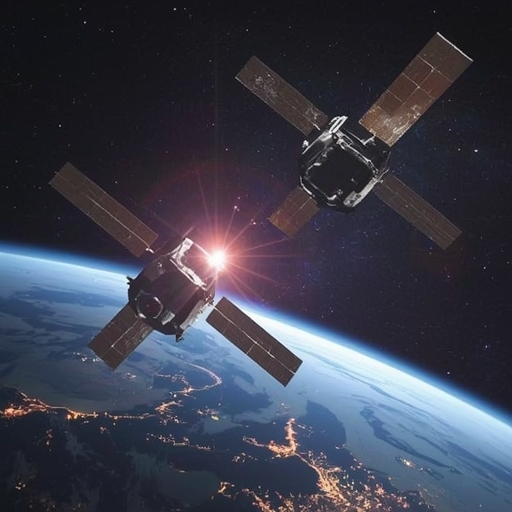
A potentially catastrophic space collision was averted only by a narrow margin last week, underscoring the increasing fragility of the orbital environment encircling our planet. The incident occurred when a recently deployed Chinese satellite came alarmingly close—within just a few hundred meters—of one of the approximately 9,000 operational Starlink satellites currently orbiting in low Earth orbit (LEO). This narrowly avoided event again highlights the mounting risks of overcrowding in near-Earth space and the urgency of transparent coordination among operators managing vast satellite constellations. SpaceX, the private aerospace company overseeing the Starlink network, has publicly attributed the close approach to the failure of the other satellite operator to proactively share critical positional and orbital data—specifically, the mathematical parameters known as ephemeris that define a satellite’s trajectory and altitude. Without access to these data points, even advanced collision-avoidance systems can falter in predicting and mitigating threats.
Michael Nicolls, Vice President of Starlink Engineering, articulated this concern in a statement posted online, emphasizing that when satellite operators withhold or fail to communicate their satellites’ ephemeris data, the risk of dangerously close encounters between orbiting objects increases substantially. He elaborated by referencing a recent launch from the Jiuquan Satellite Launch Center, located in northwestern China, which sent nine small satellites into orbit. According to Nicolls, no evident coordination or deconfliction efforts were made with existing orbital assets, culminating in a perilous approach distance of approximately 200 meters between one of these newly deployed spacecraft and the Starlink satellite designated STARLINK-6079 (56120) at an altitude of roughly 560 kilometers above Earth’s surface.
In theory and practice, Starlink satellites possess the sophisticated capability to autonomously adjust their orbital paths, allowing them to sidestep potential collisions with debris or other spacecraft. This automated system relies heavily on accurate, up-to-date information about surrounding orbital objects. However, its efficacy depends entirely on the availability of such information—if an object’s location is unknown or unreported, even highly intelligent onboard systems cannot preemptively react. Demonstrating both the scale of Starlink’s constellation and the challenges of maintaining spatial safety, SpaceX disclosed that during the first half of 2025 alone, Starlink units conducted more than 144,000 autonomous avoidance maneuvers, each designed to protect the network from possible conjunctions or debris encounters.
The Chinese satellite involved in the recent near-miss was launched by CAS Space, a commercial space company based in Guangzhou. Following Nicolls’s statement, CAS Space issued a response via the social platform X, acknowledging ongoing communication with relevant parties to gather further details about the event. The organization clarified that its launch protocols strictly adhere to established safety procedures: prior to every mission, launch windows are selected using a comprehensive, ground-based space awareness system specifically designed to avoid known satellites and orbital debris. This, they noted, is an obligatory requirement for all CAS Space missions. Nevertheless, the company appeared to distance itself from responsibility, noting that the incident took place roughly 48 hours after payload separation, well after the completion of their launch mission, thereby implying limited operational control over the satellite at that time.
While individual accountability remains contested in this particular event, the broader implications are unambiguous. Low Earth orbit is becoming progressively saturated with human-made objects—more than 24,000 active satellites and fragments of debris are currently tracked, reflecting a 76 percent increase since 2019, according to the science publication Space. If existing trends persist, projections suggest that by the end of this decade upward of 70,000 satellites could be functioning within the same densely populated orbital shell. The vast majority of these new entrants will belong to proliferating space-based internet constellations operated by both governmental entities and private corporations across the United States, China, and Europe. Each addition multiplies the complexity of orbital traffic management and heightens the potential for hazardous interactions.
Unsurprisingly, news of the narrowly avoided collision has reignited global concern over the sustainability of Earth’s orbital environment. The incident serves as a vivid reminder of how a single misstep—or an uncoordinated launch—could cascade into a calamitous chain reaction known as Kessler syndrome. This scenario, long theorized by astrophysicists, envisions a self-perpetuating cycle of collisions generating debris that, in turn, triggers further collisions, ultimately rendering low Earth orbit unusable for decades or even centuries. The episode thus reinforces a growing consensus among scientists and industry leaders alike: international cooperation, standardized data-sharing frameworks, and transparent communication channels are not merely idealistic aspirations but immediate necessities to ensure the continued viability of humanity’s presence in space.
Sourse: https://www.theverge.com/news/844502/starlink-and-chinese-satellites-nearly-collided-last-week