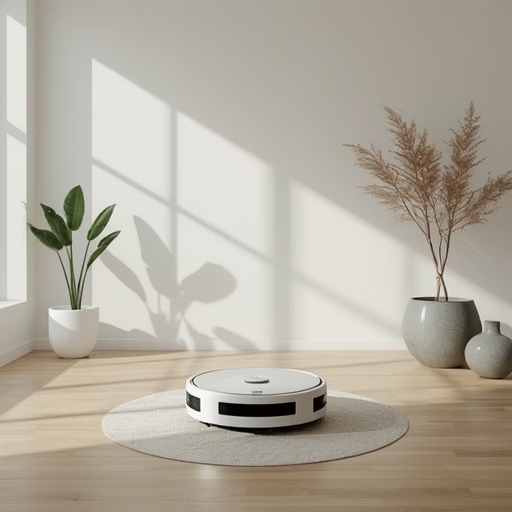
For countless individuals, iRobot’s Roomba represented their first tangible encounter with a robotic assistant designed for domestic use—a genuine glimpse into the long-promised future of automated living. When I purchased my own Roomba back in 2005, the experience felt almost transformative, as though one of my childhood fantasies had suddenly taken a small but concrete step toward reality. It was as if the futuristic lifestyle portrayed in the animated world of *The Jetsons*—where mechanical helpers handled household chores—were materializing within my own home. The robot, a compact, circular device priced at an admittedly hefty $300, rolled elegantly across my floors, diligently collecting dust and debris while I was away. The concept itself—of outsourcing one of my most despised tasks to an autonomous machine—was irresistible. In practice, however, the early iterations of the Roomba demanded frequent supervision; I often spent more time rescuing it from tangled cords or thresholds than it actually spent cleaning. Nevertheless, its operation evoked a thrilling sense of technological progress, offering a captivating, if imperfect, preview of the highly capable robot vacuums that would evolve in the years to come.
My enthusiasm for this innovation was far from unique. Robot vacuums swiftly evolved from tech curiosities into mainstream household staples, establishing themselves as symbols of modern convenience. In fact, the brand name “Roomba” became so culturally embedded that it effectively turned generic—people now routinely use it to refer to any autonomous floor-cleaning robot, whether manufactured by Ecovacs, Roborock, or another competitor. Yet despite this widespread recognition and brand dominance, iRobot, the creator of Roomba, recently filed for bankruptcy, transferring control of its operations to its Chinese manufacturing partner, Picea Robotics. The company insists that existing Roombas will continue to perform their duties reliably for the time being, though such assurances carry an implicit fragility. The looming question, then, is inescapable: how did an enterprise once regarded as the most successful household robotics company in the world descend so dramatically into financial collapse?
According to Colin Angle—iRobot’s cofounder and recently departed CEO—the cause lies not within technical failings but in the realm of policy. In his view, governmental intervention, particularly in the form of regulatory barriers, dealt a devastating blow to the company’s viability. In a candid interview with *The Verge*, Angle lamented that restrictive oversight had stifled innovation and penalized the very pioneers who had defined consumer robotics: “We created this industry, built its foundation, and then handed it to others through decisions not grounded in competitive fairness.” His statement referenced both the U.S. and European regulators who, in 2023, blocked Amazon’s proposed acquisition of iRobot as part of a broader campaign to limit the influence of so-called Big Tech. While Angle attributes iRobot’s decline to regulatory interference, critics hold an opposing perspective: they argue the company became complacent, relying excessively on its early successes and a formidable patent portfolio to fend off rivals rather than consistently pushing the boundaries of invention. The truth, as is often the case in complex technological narratives, lies somewhere between these two poles—a tension between idealistic visions of a smart, fully automated home and the more grounded reality of consumer preferences and practical constraints.
Founded in 1990 by a trio of inventive MIT roboticists—Colin Angle, Helen Greiner, and Rodney Brooks—iRobot began as an enterprise devoted to artificial intelligence research and robotic platform development. Its founders imagined not merely machines, but adaptable toolkits that could serve as the bedrock for countless robotic applications. “We came to realize,” Angle later reflected, “that a platform only gains significance when it produces something people genuinely desire and are willing to welcome into their daily lives.” In its formative decade, iRobot’s ambitions remained largely academic and experimental, supported by government-funded programs that allowed the company to refine its technologies in extreme and hazardous environments. Collaborations with agencies such as NASA led to landmark achievements—including contributions to the Mars Sojourner Rover—while other projects focused on terrestrial risks: mine detection, bomb disposal, and search-and-rescue operations using machines like the PackBot, which played a crucial role during the 9/11 recovery efforts. These efforts forged iRobot’s technical credibility and underscored a poignant theme: before robots could inhabit the comfort of our homes, they first had to conquer the dangers of the wider world.
By 1999, having accumulated both technical expertise and financial backing, iRobot was finally poised to embark on its most ambitious endeavor yet—creating a robotic cleaner for the consumer market. Under the leadership of engineer Joe Jones, another MIT alumnus, the team designed what would soon become a cultural phenomenon: the Roomba vacuuming robot. Introduced in 2002 at a retail price of $200 and sold through upscale gadget outlets like Brookstone and The Sharper Image, the Roomba immediately captured the public’s imagination. Angle recalls a pivotal moment when a buyer from Brookstone called him shortly after launch, asking how quickly he could produce more units—a clear indication of burgeoning demand. The product, although technologically simple by today’s standards, represented a shift in lifestyle aspiration. The early Roomba was equipped with rudimentary sensors for collision and drop detection, allowing it to navigate rooms in seemingly haphazard yet effective patterns, collecting dust while avoiding stairs. Building on this breakthrough, iRobot swiftly expanded its consumer robotics portfolio with specialized variants: the Dirt Dog for workshops, the Looj for gutters, and the Verro for pools.
The company’s success culminated in a 2005 public offering valued at over $100 million—a milestone that validated its strategic pivot toward consumer robotics. Over the next decade, iRobot diversified into adjacent categories, investing in autonomous lawn mowers and acquiring the air purification startup Aeris. However, these ventures failed to replicate the Roomba’s success; projects such as the Terra lawn robot never reached market, and Aeris struggled against giants like Dyson. As iRobot explored these side avenues, formidable competitors emerged—Ecovacs, Roborock, Neato, Dyson, and SharkNinja among them—quickly catching up in robotics innovation. For a time, iRobot relied on its extensive patents, particularly its dual-roller brush design, to preserve its market dominance. But when those protections began to expire in 2023, the competitive landscape shifted decisively, removing one of the company’s most effective defenses.
By the mid-2010s, iRobot was actively refining its technology, integrating Wi-Fi connectivity, developing companion mobile apps, and equipping newer models with basic object recognition capabilities. The 2018 release of the Roomba i7 marked a technical high point: retailing for nearly $1,000, this version could map rooms, remember floor plans, clean targeted areas, and even empty its dustbin autonomously—a significant leap toward household intelligence. Yet the moment of triumph proved fleeting. That same year, a tidal wave of competition arrived from China. Companies like Roborock, benefiting from abundant capital, supportive industrial policy, and dominance in their domestic markets, began producing powerful yet more affordable alternatives. By 2022, iRobot’s once commanding 88-percent market share had plummeted to around 30 percent, even though cumulative global sales surpassed 40 million units.
External forces compounded these pressures. The COVID-19 pandemic initially provided a short-term boost in home-related consumer spending, but subsequent supply chain disruptions and tariffs introduced under the Trump administration sharply inflated production costs. Unable to compete on price, iRobot was forced to increase retail prices, further eroding its appeal among cost-conscious consumers. Financial declines soon followed: revenue dropped from $1.18 billion in 2022 to $891 million the following year, with operating losses reaching $285 million.
Despite mounting setbacks, debate over the company’s trajectory persisted. Detractors contended that iRobot had misread market trends, particularly in its adherence to camera-based vSLAM navigation technology long after rivals had transitioned to lidar systems. They also criticized its slow adoption of multifunctional cleaners that could vacuum and mop simultaneously—a combination that rapidly became standard. Angle conceded that underestimating that feature was a misstep, acknowledging that “the consumer ultimately decides.” However, he steadfastly defended iRobot’s camera-first approach. In his view, lidar sensors, while effective for mapping static environments, lacked the perceptual depth necessary for intelligent adaptation—a critical quality for any robot aspiring to truly understand and care for its surroundings. When new CEO Gary Cohen assumed leadership in 2024 and promptly shifted the company toward lidar-based designs, Angle publicly called it a mistake, insisting that true home intelligence required vision-driven perception rather than laser precision.
Ironically, the same cognitive sophistication Angle envisioned for future Roombas was precisely what attracted Amazon’s attention. In 2022, the tech giant proposed a $1.7 billion acquisition, envisioning iRobot’s spatial mapping capabilities as integral to the evolution of the Alexa ecosystem. The move, however, reignited regulatory scrutiny and public unease over privacy and competition. After nearly two years of limbo under antitrust review, the merger was ultimately abandoned in early 2024—a decision that, according to Angle, effectively sealed iRobot’s fate. Stripped of strategic direction, faced with dwindling morale, and adapting to relentless competition, iRobot downsized drastically: shuttering secondary projects, dismissing nearly one-third of its workforce, and launching a final, ultimately uninspired product line of lidar-based combination cleaners that bore little resemblance to the once-iconic Roomba. Just a day after unveiling the new models, the company warned investors of impending bankruptcy. Nine months later, that prediction came true.
For Angle, the company’s collapse symbolizes more than a corporate misfortune—it epitomizes a broader loss for American innovation. He argues that the inability of startups to pursue meaningful mergers and acquisitions has a chilling effect on technological entrepreneurship, discouraging risk-taking and slowing progress within emerging fields like robotics. Yet from another perspective, iRobot’s downfall was not a failure of imagination but of timing. The company’s ambitions for intelligent home companions anticipated the era of AI-enhanced domestic automation we are only beginning to enter. Unfortunately, the world it envisioned arrived just a little too late for its own survival. If someday our homes are managed by sentient robotic assistants—machines capable of care as much as convenience—then the spirit and legacy of iRobot’s pioneering work will undoubtedly live on, even if the original company no longer stands to witness that future.
Sourse: https://www.theverge.com/tech/844964/how-irobot-invented-the-roomba-and-lost-the-future-of-home-robotics