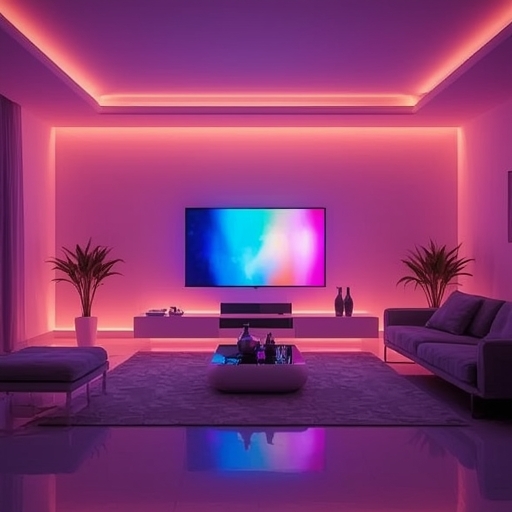
Marking what is widely expected to be the first in a series of major technology announcements, LG has officially confirmed that it will introduce its inaugural flagship RGB television in 2026—a move that cements its commitment to next-generation display innovation. This revelation does not come as a total surprise to industry followers, given that the company’s so-called “premium LCD TV with Micro RGB technology” had already garnered an impressive CES 2026 Innovation Award back in November, hinting strongly at forthcoming commercial availability. What is now clear beyond speculation is that LG plans to bring this new Micro RGB evo TV to market in three expansive screen sizes—100, 86, and 75 inches—with specific details on U.S. pricing to be disclosed at a later stage.
The Micro RGB evo TV will be powered by a refined iteration of LG’s acclaimed Alpha 11 processor, a sophisticated chip architecture that has until now been reserved exclusively for the brand’s most elite OLED models—such as the distinguished LG G5 series. This processing unit promises advanced image handling, superior motion control, and exceptional color reproduction. The television has also obtained certification from Intertek, a globally recognized testing and certification organization, confirming that the display reaches full 100 percent gamut coverage across the BT.2020, DCI-P3, and Adobe RGB color standards. This signifies an ability to render an extraordinary range of hues with precise fidelity—an achievement that positions the model firmly within the upper echelons of professional-grade display performance. Although LG has not yet disclosed specific brightness specifications, expectations within the industry suggest that its peak luminance could easily surpass 5,000 nits, ensuring dazzling highlights and superb contrast even in bright environments.
From the perspective of broader industry trends, it appears increasingly evident that CES 2026—and the year as a whole—will represent a pivotal moment for RGB television technology. Several manufacturers are likely to unveil their own flagship models employing similar innovations. This momentum can be traced back to early catalysts during CES 2025, when Hisense showcased the massive 116-inch 116UX model, capturing attention for both scale and quality, while Samsung impressed audiences with its own 115-inch Micro RGB television, which subsequently saw an official market release in August. As the next CES approaches, analysts and enthusiasts alike anticipate that additional competitors will unveil smaller-format versions designed to challenge LG’s newcomer directly. When I attended Samsung’s showcase in August, a company representative teased that “exciting things are ahead for Micro RGB,” suggesting that fresh developments were well underway. Meanwhile, TCL has already presented two RGB television models tailored specifically for the Chinese market, and Sony is poised to join the movement with the launch of its TrueRGB TV in early 2026.
It is critical, however, to draw a clear distinction between micro RGB and microLED technologies, which are often conflated in discussions of emerging display formats. True microLED panels utilize minute red, green, and blue light-emitting diodes as individual subpixels, producing self-emissive lighting at a microscopic level. By contrast, the micro RGB systems being developed by LG—and likewise adopted by Samsung, Hisense, and soon Sony and TCL—employ substantially smaller LEDs clustered in triads of red, green, and blue that act as localized backlighting zones illuminating multiple pixels simultaneously. Despite their extremely compact size—giving rise to the “micro” designation—these discrete colored LEDs substantially enhance color accuracy and gamut coverage. However, because they do not generate color per pixel directly, the displays still rely on traditional color filters to refine and produce the final image output. In comparison, conventional LED televisions typically depend upon a uniform blue or white backlight, which limits the precision with which colors can be expressed on screen.
Early hands-on demonstrations of RGB LED implementations from brands such as Hisense and Samsung have been remarkably impressive. The visual performance they deliver—featuring intense vibrancy, striking contrast, and a sense of depth and dimensionality rarely seen in current display systems—has elevated them above most commercially available models today. Nevertheless, their spectacular capabilities have come at a prohibitive cost, with existing large-format versions carrying price tags in the tens of thousands of dollars, effectively placing them well beyond the reach of the average household. Now, with LG’s entry into the field and the subsequent rollout of smaller, more accessible screen sizes across multiple manufacturers, the landscape appears set for a gradual reduction in pricing. As a result, the dream of experiencing premium-grade RGB LED image quality in ordinary living rooms may finally be drawing near—a transformation that could redefine the expectations of high-end television for years to come.
Sourse: https://www.theverge.com/news/844885/lg-micro-rgb-evo-led-tv-ces-2026