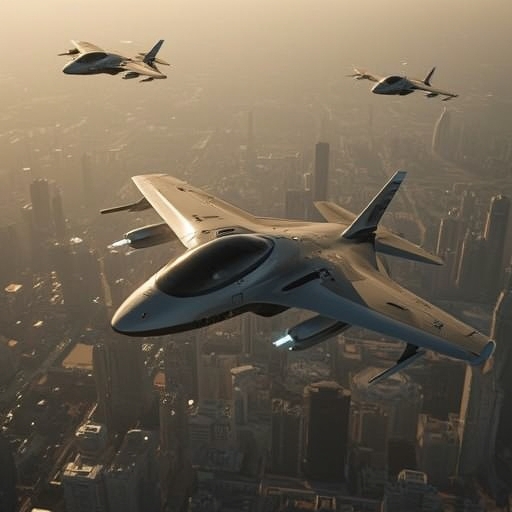
A growing number of prominent U.S. technology companies are placing their hopes on soon obtaining regulatory approval to operate fleets of flying taxis—innovative aerial vehicles envisioned to carry passengers on short, rapid commercial routes such as the brief journey from Manhattan to LaGuardia Airport. However, these firms are not limiting their ambitions to urban mobility alone; with an eye toward securing lucrative defense contracts, they are also adapting their burgeoning air‑taxi technology for potential military use, redesigning craft to meet the demanding conditions of modern battlefields and reconnaissance missions.
These futuristic aircraft, often referred to as air taxis or VTOLs (Vertical Take‑Off and Landing vehicles), are distinguished by a hybrid configuration combining the attributes of both helicopters and airplanes. Their wings and multiple propellers enable them to ascend and descend vertically like a helicopter—ideal for congested environments with limited runway space—while also allowing them to achieve efficient horizontal flight similar to an airplane. Although passengers in the United States cannot yet summon a flying taxi with the ease of ordering a ride-share car, experts suggest that such services could become a reality within the next few years, signaling a major transformation in urban and regional transportation.
Within the Pentagon, a notable shift in strategic focus has occurred. Defense leaders, recognizing the speed and ingenuity of the private technology sector, have begun to argue that traditional defense contractors no longer deliver new weapons or aerial systems with sufficient speed or cost‑efficiency to meet the urgent and evolving threats of the 21st‑century global landscape. As a result, the Department of Defense has publicly committed billions of dollars to accelerate innovation by partnering with commercial tech pioneers. Among its recent initiatives are official requests for information regarding hybrid and autonomous VTOL systems—aircraft capable of taking off vertically, flying autonomously, and landing without conventional infrastructure.
Prominent air‑taxi manufacturers such as Archer Aviation, Joby Aviation, and Beta Technologies have presented compelling visions of how these gas‑electric hybrid aircraft could serve military objectives. They argue that such vehicles, reminiscent of the sleek airborne machines long imagined in classic futuristic media, could transport cargo, equipment, or even small payloads much more quietly and economically than helicopters currently deployed in the field. Some prototype designs incorporate advanced autonomous navigation systems that enable the aircraft to automatically detect obstacles, identify threats, and chart safer flight paths. These capabilities could render them invaluable for tasks including intelligence gathering, surveillance, reconnaissance, and logistics support in environments where human pilots would face significant risk.
The competitive race to dominate this emerging VTOL market extends far beyond the United States. American air‑taxi makers now find themselves contending with innovative Chinese companies such as EHang, which is rapidly developing similar autonomous aerial technologies. While China has already secured a dominant position in the global market for small combat drones, the race for supremacy in the larger, passenger‑ or cargo‑carrying VTOL segment remains open, with U.S. firms striving to lead the next revolution in both civilian and military aviation.
Beta Technologies’ chief executive, Kyle Clark, has described the potential military advantage in bold terms, asserting that once these aircraft can surpass helicopters in both range and speed, they will represent tools of strategic superiority—capabilities that could outmatch anything competitors like China might field. For commercial use, most current air‑taxi models are fully electric, offering quiet, zero‑emission flights ideal for metropolitan travel. Yet for defense purposes, engineers are replacing pure electric systems with hybrid engines, which combine fuel combustion with electric propulsion. This modification significantly extends range and payload capacity—essential attributes for military logistics and tactical operations. Executives from both Joby and Beta emphasize that this hybrid approach enables heavier loads and longer distances, addressing the Pentagon’s operational needs more directly than civilian designs could.
In their military configurations, these advanced air vehicles are often engineered for autonomous or semi‑autonomous flight. For instance, in Beta’s battlefield prototype, human operators simply input destination coordinates prior to launch. The aircraft’s artificial intelligence system then calculates the optimal route, analyzes potential threats, and navigates independently to its goal. By eliminating the need for onboard pilots, these military variants become substantially lighter and more efficient, as they no longer require seating, cockpit controls, or the complex avionics and safety mechanisms mandated for passenger transport.
Securing contracts with the U.S. Department of Defense would not only represent a landmark achievement for these companies but would also mark their official entry into the expanding category of dual‑use enterprises—private firms that supply both commercial markets and government defense agencies. Joby has already forged a partnership with the established defense contractor L3Harris to develop a military‑grade VTOL and successfully completed the test flight of its prototype late last year. Likewise, Archer Aviation is collaborating with Anduril Industries on a separate U.S. defense‑oriented VTOL project. Notably, Anduril is simultaneously working with the Emirati defense conglomerate Edge Group to co‑develop a similar autonomous aerial system called Omen, highlighting the global and highly collaborative nature of this technological frontier.
Nevertheless, one of the most formidable obstacles facing every aspiring air‑taxi operator remains regulatory approval. Before any widespread commercial service can commence, these companies must secure certification from the Federal Aviation Administration (FAA), a process renowned for its rigor and complexity. Recognizing the importance of innovation, recent policy initiatives have sought to streamline this path. Under an FAA program introduced in September by Transportation Secretary Sean Duffy, select VTOL manufacturers are allowed to conduct both piloted and unmanned test flights even before full federal certification is granted—an experimental policy designed to accelerate the transition from prototype to market readiness.
Among these competitors, Joby currently leads the race toward commercial certification, having successfully completed four of the FAA’s five required stages—a significant milestone that places it on the cusp of operational clearance. Both Joby and Archer have publicly stated their aspirations to begin commercial passenger service as early as 2026, signaling that the age of urban air mobility could be imminent. In parallel, the Pentagon must determine separately when these aircraft meet its own stringent standards for defense deployment, a step that Archer’s CEO Adam Goldstein notes is essential before military integration can occur.
In sum, the ongoing convergence of civilian aerospace innovation and defense modernization signals a profound transformation in the future of flight. What began as an effort to ease urban congestion by lifting commuters above city streets is now evolving into a strategic enterprise that could redefine the tools and tactics of modern warfare. As American companies race to perfect the technologies of hybrid propulsion, autonomy, and vertical flight, the skies themselves are becoming the next great arena for technological competition—and perhaps, ultimately, for national security advantage.
Sourse: https://www.businessinsider.com/tech-companies-want-flying-taxis-on-the-battlefield-2025-12