I can vividly recall the period in my life when I owned a car, back when I was living in Queens. At first, what should have been a convenience rapidly became an ongoing ordeal, because simply avoiding parking tickets in that borough was nothing short of a waking nightmare. Anyone who has navigated New York City’s labyrinth of regulations can attest that the anxiety of parking there is practically a rite of passage. This all-consuming stress, however, lifted somewhat after I learned of what felt like a secret neighborhood “cheat code.” Just a few blocks from my apartment, there existed a somewhat hidden street where, astonishingly, one could leave a car without being subjected to the endless demands of alternate side parking, scheduled cleaning hours, or any of the numerous caveats that normally apply. Naturally, I wasted no time shifting my vehicle to that sanctuary, effectively attempting to forget its existence until the precise moment I needed to drive again.
Yet, even with that apparent solution, the car lingered heavily on my mind every single day. I constantly speculated about its fate in my absence. Was it still safe and intact? Had some careless driver sideswiped and reduced it to twisted metal? Perhaps, in more fanciful moments, I wondered whether it had been whisked away by interstellar visitors or overrun by rogue wildlife—improbable but entertaining scenarios, such as a colony of rats declaring my old sedan their sovereign kingdom, cheekily dubbed “Ratopia.” My musings, however whimsical, underscored a serious point: leaving one’s car unattended invariably spawns anxiety, no matter how rational or irrational. Since omnipresence is beyond human capacity, the next best thing is the reassurance that a vigilant eye remains trained on your vehicle even when you are far away.
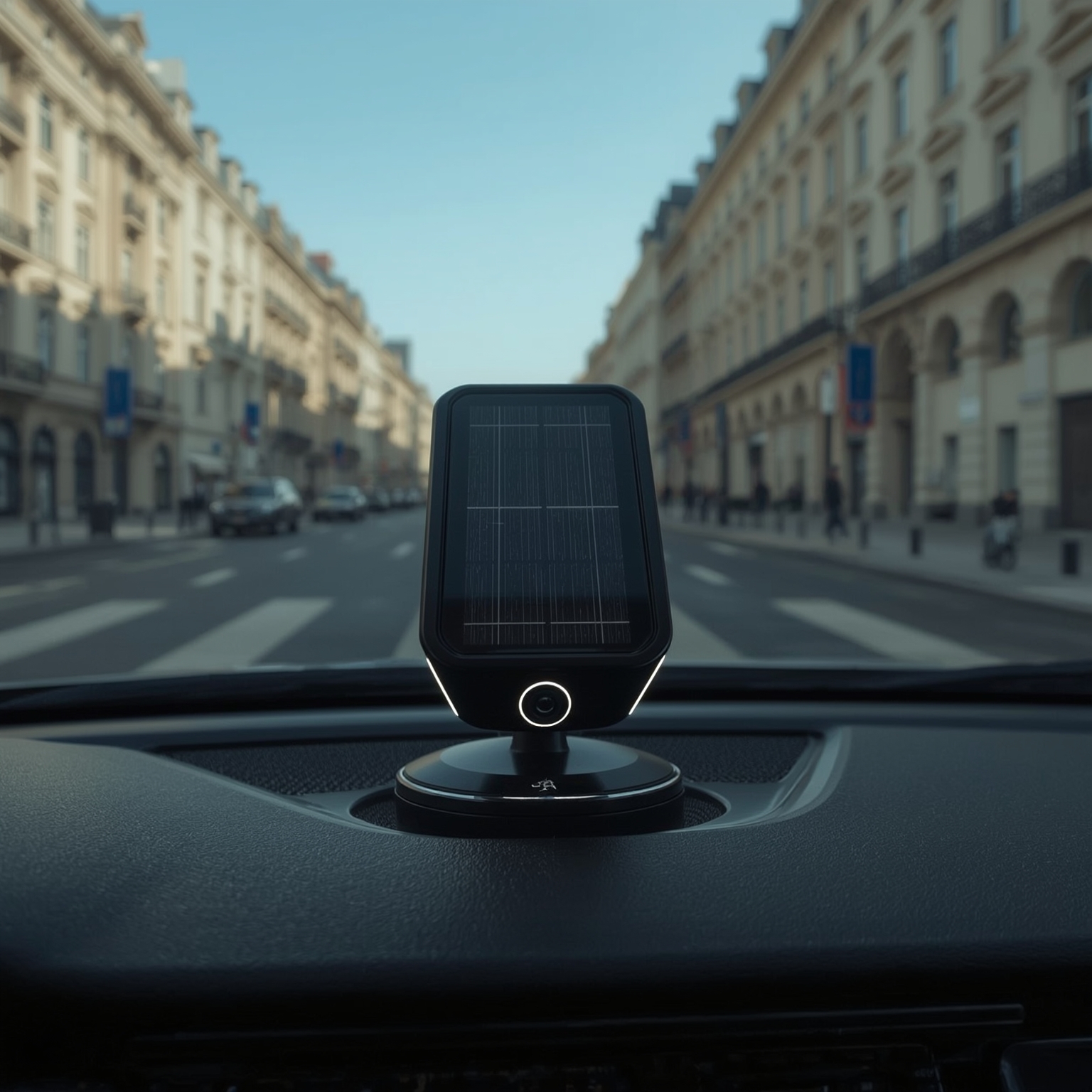
This is precisely where new technology enters the picture. Baseus, the same company that has recently attracted attention by releasing an innovative lineup of wireless earbuds and headphones at the IFA tradeshow, has unveiled a particularly intriguing gadget that seems almost custom-made for such predicaments. It is a solar-powered dashcam, marketed as the PrimeTrip VD1, which is not just a single device but actually comprises both front and rear cameras to cover the entire vehicle. What sets it apart, according to the company, is that it represents the very first so-called “hardwire-free parking monitor.” Rather than relying on a car’s internal electrical system for energy, which often requires professional installation and creates potential drain on the vehicle’s battery, the device makes use of Baseus’s proprietary “Solar Sync System.” This system employs a compact yet highly efficient solar panel that continuously harvests and stores energy, thereby sustaining the dashcam without tethering it to the vehicle’s own power lines.
That being said, it would be misleading to imagine that the device is entirely maintenance-free or without limitations. Baseus specifies that the PrimeTrip VD1 is capable of offering up to fourteen days of standby monitoring while the car is parked. Considering it operates completely independently of the vehicle’s battery, that is a remarkably generous duration. To conserve its energy reserves, the dashcam has been engineered with an intelligent motion detection system. Instead of running ceaselessly, which would exhaust the power quickly, the camera smartly remains dormant until it perceives motion or detects the shock of an external impact. At that precise point, both the front- and rear-facing lenses automatically activate and record a half-minute clip. The storage capacity, while finite, is sufficient for up to twenty such detected events—yielding a total archive of forty clips at thirty seconds each. Although footage cannot be viewed in real time, since this iteration does not include cellular or 5G connectivity, the recorded material can nonetheless be conveniently accessed by downloading it to a smartphone application via Wi-Fi.
There are, however, nuances worth noting for potential users, particularly regarding image resolution. The front camera proudly supports crisp 4K resolution, making it the more detailed of the two, while the rear option records in Full HD, or 1080p. This distinction reflects the device’s prioritization of forward-facing clarity, which is the angle most likely to capture incidents involving collisions, theft attempts, or other significant hazards.
As it happens, I no longer own a vehicle myself, yet I cannot help but speculate that—if I still did—the Baseus PrimeTrip VD1 would be exactly the type of product I would consider adopting. It strikes a balance between affordability and intelligent functionality, offering a measure of reassurance without forcing investment in a luxury automobile merely to access comprehensive surveillance features. For example, electric vehicles from Tesla come with highly sophisticated, factory-installed monitoring systems. While undeniably powerful, such systems reside beyond the financial reach of many drivers. In contrast, the Baseus solution creates a more attainable middle ground. Though it may not entirely abolish the unease of leaving one’s car unattended for long periods, it does provide an invaluable support system—whether that means alerting you after a minor bump, or at the very least, offering verified proof that someone made off with your catalytic converter. Sometimes, even partial peace of mind is worth far more than its cost in dollars.
Sourse: https://gizmodo.com/this-solar-powered-dashcam-watches-your-car-while-youre-off-finding-yourself-in-europe-2000658129