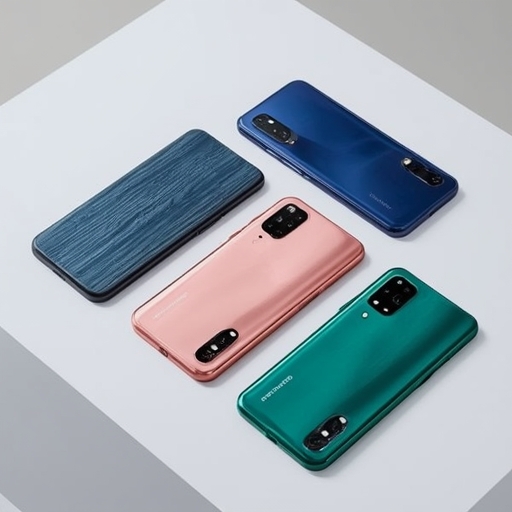
Just a year or two ago, whenever a review unit arrived at my doorstep, I could almost predict with absolute certainty that it would be dressed in the usual shades of monotony: matte black, dull gray, or occasionally, as a rare concession to variety, a minimalist white. That era of aesthetic restraint seems almost quaint now, because 2025 has broken from that dreary uniformity in striking fashion. The smartphones that have come across my desk this year have not only reimagined color but have embraced design as a form of individual expression. I’ve encountered devices clad in rich, tactile wooden backs—featuring authentic grain patterns rather than printed imitations—and others that shimmer in deep, reflective blues reminiscent of evening oceans. Many of these models arrive with matching, color-coordinated crossbody straps and an assortment of magnetic accessories designed with care and flair. For an industry that once seemed complacent in producing an endless stream of anonymous black rectangles, 2025 has ushered in a refreshing renaissance of creativity, championing bold hues and fashion-conscious detailing that transform phones from tools into personal statements.
It is, of course, important to remember that phones haven’t always been purely functional, joyless objects. There was a time when individuality and playfulness were integral to their identity. Who could forget the vibrant magenta gleam of the original Motorola Razr—a design that became nothing short of iconic? And then came Nokia’s exuberantly neon yellow Lumia series, impossible to overlook and deliberately intended to stand out in a sea of monochrome devices. Even Apple, long known for its reserved aesthetics, once dabbled in spirited experimentation with the iPhone XR lineup of 2018, which included punchy shades of orange, yellow, and blue. My husband, for instance, clung to his yellow iPhone XR far longer than its hardware warranted, simply because its sunny finish radiated a charm that newer devices failed to capture. Somewhere over the past half-decade, however, the industry collectively decided that maturity and seriousness required visual austerity, and those playful design choices quietly vanished.
In this renewed landscape, if there is one company deserving of particular recognition for restoring a sense of style to smartphones, it is Motorola. The brand’s Razr Ultra foldable, especially in its MountainTrail finish, stands as one of this year’s most aesthetically satisfying devices. Perhaps I am drawn to it in part because of the nostalgic resonance it carries—its wooden back subtly evokes the beloved Moto X lineage. The bronze-toned side rails lend a refined contrast, and the tactile satisfaction of hearing its hinge snap shut creates a delightful sensory experience that feels almost ceremonial. Yet Motorola’s design ingenuity extends beyond the foldable category. Over the past year, the company has been boldly experimenting with distinctive finishes and vivid color palettes. It’s a pity that the same meticulous attention hasn’t extended to its software, which remains cluttered with ads and preinstalled applications. Nevertheless, when it comes to crafting hardware that delights both the eye and the hand, Motorola is indisputably ahead of the curve.
Even the companies historically resistant to visual exuberance have begun loosening their grip on subtlety. Apple, traditionally synonymous with restrained design, surprised consumers in 2025 with the audacious release of the Cosmic Orange iPhone 17 Pro—clearly aimed at those unafraid to make a confident design statement. The standard iPhone 17 lineup, too, has been graced with colors that finally feel vibrant and intentional, marking a welcome departure from the muted, almost washed-out tones of the iPhone 15 generation. Meanwhile, Google has also decided to join the celebration of individuality, introducing its foldable model in colors beyond its habitual black-and-white comfort zone. The launch of shades like the misty gray Moonstone and the understated greenish-yellow Jade demonstrates that even tech purists can appreciate a little artistry.
This design revival hasn’t stopped with the devices themselves. In 2025, manufacturers collectively seemed to rediscover that the ecosystem of accessories—cases, straps, mounts, and more—can play a role not merely in function but in fashion. Apple’s newest iPhones debuted alongside an elegantly designed crossbody strap accessory, offered in a curated palette of complementary shades tailored to match the accompanying cases. Later in the year, in collaboration with the renowned fashion designer Issey Miyake, Apple introduced what it whimsically calls the iPhone Pocket—a crossbody sleeve that resembles a knitted sock, available in minimalist designs starting at a lofty $229. Though undeniably expensive and perhaps impractical for the average user, this piece transcends utility, serving as a luxury statement for those who view technology as an integral part of their personal style. Not to be outdone, Google revealed its new line of magnetic accessories under the Pixelsnap brand to accompany the Pixel 10 series, which now integrates a ring of magnets cleverly reminiscent of Apple’s MagSafe system. Among these accessories, the sleek ring grip became my personal favorite; not only does it reduce the hand fatigue that inevitably comes from extended device use, but it also imbues the phone with aesthetic character. For someone like me, who typically avoids bulky cases, this accessory achieves the rare balance between elegance and practicality.
Of course, not everyone is inclined toward flamboyant colors or elaborate design features, and that’s perfectly acceptable. There remains a valid preference for understated minimalism and utilitarian simplicity. Yet I believe it’s equally reasonable to care about the visual presence of an object we interact with constantly. After all, these devices occupy our line of sight thousands of times each day—they accompany us to meals, commutes, and conversations, becoming extensions of our identity. In that sense, it only feels logical that we might want them to reflect our tastes and personalities, just as our wardrobes or home furnishings do. Whatever creative spark inspired manufacturers this year to reintroduce imagination, color, and a fashion-forward sensibility into their designs, I can only hope that the momentum continues into 2026. The return of beauty and individuality to our most used gadget feels not just refreshing but long overdue.
Sourse: https://www.theverge.com/tech/842190/2025-smartphones-design-color-fashion


