Laura Dern was only about six years old when a moment of sheer revelation struck her on a film set — a scene that would unknowingly determine the rest of her life. It was during her summer break, while accompanying her mother, the acclaimed actress Diane Ladd, who was working under the direction of Martin Scorsese on his 1974 romantic drama *Alice Doesn’t Live Here Anymore*. The young girl found herself nestled at the heart of cinematic creation, absorbing the craft and energy that pulsed around her. Scorsese, even at that tender age, recognized her curiosity and granted her a rare privilege: permission to peer directly into the magic of filmmaking from the front row. Laura knelt quietly by the slightly ajar bathroom door as her mother and Ellen Burstyn delivered an emotionally charged improvised scene. The child observed the subtle interplay of truth and performance, the fragile line between emotion and artifice. In that moment, watching these powerful women under Scorsese’s intimate direction, she experienced an epiphany. As she later told *Business Insider*, she thought, ‘Whatever that is that they’re doing, I want to be part of that world.’ It was not merely admiration; it was the awakening of vocation.
Being the daughter of two formidable actors — Diane Ladd and Bruce Dern — Laura grew up enveloped in the rhythms and rituals of cinema. She learned her first lessons about artistry by osmosis, gleaning insight not only from her parents’ example but also from observing the towering figures who directed them. Filmmakers such as Alfred Hitchcock and Scorsese became her invisible mentors, shaping her understanding of storytelling, screen presence, and the meticulous craft that defines timeless performances. By her teenage years, Dern had already translated that early fascination into her own professional path. Her unique magnetism and emotional transparency soon caught the attention of visionary director David Lynch, who found in her both muse and collaborator. Lynch cast her in three of his most singular works — including *Blue Velvet* and *Wild at Heart* — and later brought her back decades later for *Twin Peaks: The Return*. Her versatility likewise drew directors from very different creative worlds, including Steven Spielberg, who tapped her to portray the resilient paleobotanist Ellie Sattler in the groundbreaking blockbuster *Jurassic Park*.
Over more than forty years of consistently reinvention-rich work, Dern, now in her late fifties, has inhabited an astonishing spectrum of characters. She has embodied everything from an imperious CEO mother whose excess hides vulnerability in *Big Little Lies*, to a commanding rebel admiral in *Star Wars: The Last Jedi*. In 2020, she achieved one of the crowning milestones of an already celebrated career: winning the Academy Award for her portrayal of Nora Fanshaw, the incisive and fiercely intelligent divorce lawyer in Noah Baumbach’s *Marriage Story*. Yet if asked to reveal the secret behind maintaining such longevity and range, Dern deflects attention away from her own artistry and instead credits her keen instinct for choosing collaborators. To her, the directors she works with are the gravitational centers of each project — visionaries who possess a storytelling mastery that is theirs alone, continually pushing her to evolve and deepen her craft.
That sensitivity to creative vision is what drew her to *Is This Thing On?*, the most recent film directed by Bradley Cooper, now in theaters. Though Cooper is best known for his performances in front of the camera, his earlier directorial efforts, *A Star Is Born* and *Maestro*, convinced Dern that he possesses a rare, chameleon-like cinematic language. She marveled that, even over just three films, Cooper has demonstrated an ability to reinvent the grammar of each story — a mark of a true filmmaker rather than an actor dabbling in direction. In *Is This Thing On?*, she portrays Tess, a woman navigating the emotional wreckage of a relationship nearing collapse. Across from her, Will Arnett’s character, Alex, processes his turmoil through stand-up comedy, using humor as both confession and shield. Dern described the film as an intimate and unapologetically truthful exploration of how people rediscover themselves in middle age — a time in life often neglected by cinema, yet rich with possibility. For her, the film offered a profound study in emotional nuance, one that allowed her to explore, once again, the complexities that exist between human hearts.
In a recent *Business Insider* ‘Role Play’ interview, Dern revisited some of the defining moments that shaped her artistic identity. She recalled how the acting bug first bit her amid the cinematic alchemy of Martin Scorsese’s set, and how, in the same summer, visiting Alfred Hitchcock’s production of *Family Plot*, she uncovered another revelation — the comedic warmth of her father, Bruce Dern. Hitchcock, ever the enigmatic craftsman, had a miniature director’s chair built for young Laura so she could sit beside him and quietly observe as her father worked. It was there that she witnessed her father’s uncanny ability to make Hitchcock double over with laughter, a side of him she had never before recognized. The experience taught her how filmmaking could reveal hidden dimensions of even those closest to us.
When Dern speaks of her collaborations with David Lynch, her reverence borders on the spiritual. Of all their projects, she cites *Inland Empire* as perhaps the most transformative experience of her career. Unlike a conventional production, it unfolded over three years with minimal crew, often just Lynch, a handheld camcorder, and Dern herself exploring the boundaries of performance and perception. The film demanded that she play multiple intertwined roles — sometimes simultaneously — blurring the frontier between fiction and identity. To her, it was the most radical, blissful, and creatively liberating period of her artistic life. Even years later, remnants of characters like Lula from *Wild at Heart* remain alive within her. Those characters became mirrors through which she encountered aspects of herself — sensuality, daring, and passionate freedom — that she had not previously known. For Dern, Lynch was the rare collaborator who could illuminate invisible corners of her psyche, bringing to life emotions she might never have otherwise discovered.
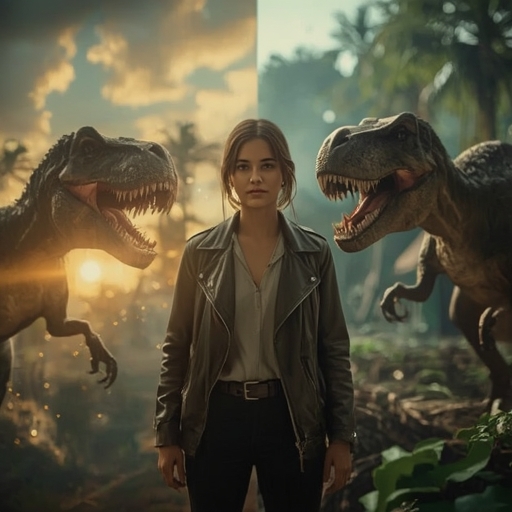
Her recollections of *Jurassic Park* reveal a similar blend of wonder and uncertainty. In an era before modern visual effects had matured, actors were often asked to respond to what would later be digitally created. She recalls Spielberg improvising cues for the cast in spontaneous, often humorous ways — even mimicking the roar of a T-Rex through a megaphone to set the mood. During filming, doubts inevitably crept in; with so much of the spectacle hinging on unseen computer-generated creatures, no one could be sure how convincing it would appear. But when Dern and her co-stars finally gathered to watch the completed film, and the dinosaurs emerged from the screen in breathtaking realism, the entire cast — Spielberg included — reacted with childlike awe. What began as uncertainty transformed into astonishment; art and technology had joined forces to evoke genuine, primal emotion.
Dern’s Oscar-winning role in *Marriage Story* also represented a culmination of her evolution as an actor deeply invested in process. She and director Noah Baumbach engaged in nearly a year of exploratory conversations, discussing modern marriage, the painful architecture of divorce, and the emotional manipulations that can surface during legal and personal battles alike. These dialogues gradually crystallized into the film’s now-famous monologue on gender, expectation, and the inequities woven into societal perceptions of women. When Baumbach finally handed her the finished script, Dern recalls weeping at the sincere truth of his words. The speech — simultaneously biting, funny, and devastatingly direct — resonated with her on every level. Among its sharp lines is one she helped conceptualize, later acknowledged by Baumbach as a favorite; it’s a testament to the trust and creative kinship that defines their collaboration. For Dern, Baumbach, like Lynch and now Cooper, belongs to a rare fraternity of filmmakers who become family — directors who invite vulnerability, celebrate authenticity, and understand how to draw from her the courage that has defined her singular path through modern cinema.
Thus, from that formative day hidden behind a bathroom door observing her mother on set, to commanding the screen in stories of surrealism, science, heartbreak, and rebirth, Laura Dern’s trajectory reflects the essence of artistic fearlessness. Her career stands as a living dialogue between instinct and intellect, discipline and spontaneity, reminding audiences and fellow artists alike that the heart of great acting lies not in imitation, but in emotional discovery.
Sourse: https://www.businessinsider.com/laura-dern-best-movies-tv-shows-jurassic-park-david-lynch-2025-12


