The modern resurgence of retro-inspired technology has produced handheld recreations so adept at mimicking the nostalgic charm of the Game Boy that they successfully capture not only its visual essence and tactile feedback but also the remarkable sense of portability that defined the original. Yet for all the appeal of carrying a dedicated gaming device, a practical challenge emerges in everyday life: my pockets are already dominated by a far more essential companion, a smartphone — a powerful, highly compact machine that functions simultaneously as a communications hub, productivity device, entertainment system, and essentially a digital extension of my life, all concentrated beneath the glossy surface of a 6.3-inch AMOLED display. Considering that this modern device already houses an advanced processor capable of rendering complex graphical experiences and presenting them with visual clarity, the obvious question surfaces: why should it not also transform seamlessly into a legitimate handheld gaming console whenever and wherever the opportunity arises?
Enter the MCON, a collapsible controller engineered by young innovator Josh King and brought into the marketplace through the seasoned peripheral design company OhSnap. Hyped extensively for reimagining what a mobile controller can be, the MCON presents itself as a potential turning point — perhaps even persuasive enough to allow players like me to finally leave behind dedicated portable systems when stepping out the door.
I was first introduced to the MCON at CES 2025, though what I encountered there was still a very early prototype fashioned primarily from rough 3D-printed components. Despite its rudimentary construction at the time, the concept immediately held promise: compact, tactile, and clever in execution. Later in the year, at IFA 2025, I made the extra effort to hunt down OhSnap’s modest booth, buried among the sprawling exhibition halls, in order to see the latest iteration. What I found was a more polished unit composed of glossy black finished plastics and transparent highlights — a version finally intended for release after the company’s remarkably successful Kickstarter campaign. Impressively, the hardware retained the practicality of its collapsing form factor while adding refinement and durability.
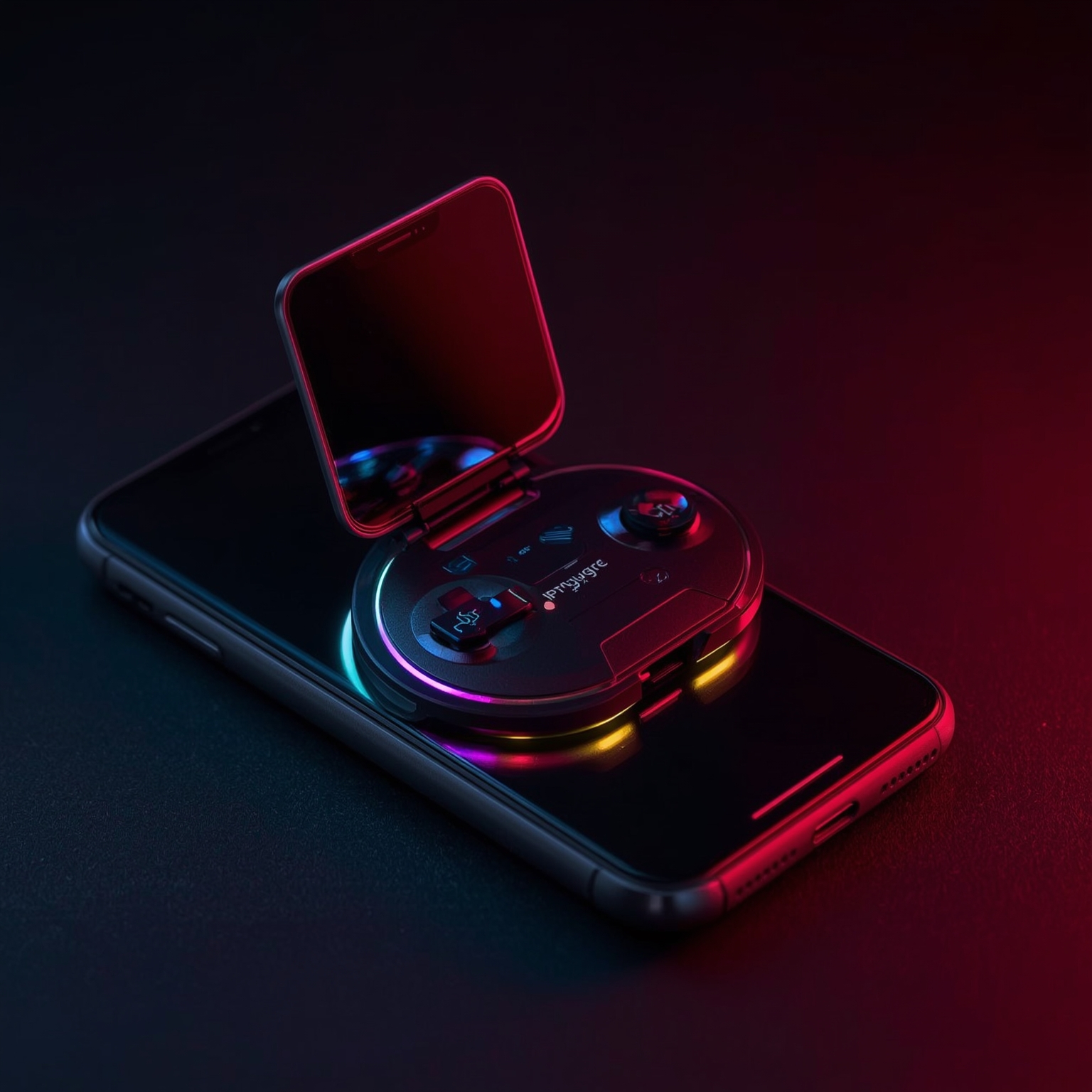
Unlike common mobile gaming controllers such as the Backbone, 8BitDo’s handheld peripherals, or a Razer Kishi — all of which essentially split an Xbox-style controller in half to accommodate a smartphone in between — the MCON refuses to simply imitate console hardware. Traditional designs can be competent, and in some cases offer extra room spacious enough to hold even larger devices like an iPad up to 13 inches, but they cannot escape a fundamental inconvenience: they are slim enough to transport in a bag, yet far too unwieldy to disappear into a pocket. By contrast, MCON is different. Its ingenious structure allows it to collapse to roughly the same footprint as the smartphone itself, compact enough that it may slide comfortably into a purse, a jacket or cargo pant pocket, though perhaps still too bulky for the narrow confines of slim denim. Connection is handled through Bluetooth, while physical attachment leverages a MagSafe-style magnetic docking system, eliminating the clutter of cords or reliance on a USB-C port.
In practical terms, MCON functions like a hybrid of legendary handheld designs: one might compare it to a clamshell-style Nintendo DS or the experimental PSP Go with its sliding faceplate, though notably absent here is any independent display or processor. Instead, the structure remains purely a controller. With a single click of a spring-loaded mechanism, the faceplate dramatically slides outward, immediately presenting a conventional control scheme: dual thumbsticks, four primary action buttons, and a directional pad. Additional fold-out wings extend from the base to provide a fuller controller grip, though purists who once endured the austerity of early Game Boy ergonomics can happily play without them. Another subtle benefit of this design is how it naturally props the phone at an angle, allowing for a more comfortable seated experience — and in doing so, offering advantages over bulkier Steam Deck-like devices or even a hypothetical successor to the Nintendo Switch.
The production-intended model that I tested reflected meaningful refinements in usability. Most striking were the drift-resistant tunnel magnetoresistance (TMR) joysticks, which despite sitting deeper into the chassis, offered generous range and precision while avoiding the cramped feel that often plagues smaller controllers. Buttons carried a satisfying tactile response, shallow yet crisp in their click, though the bustle of the convention floor prevented me from gauging their true acoustic qualities. Perhaps the greatest surprise lay in the triggers: though they appeared almost too thin and closely embedded into the body, they nevertheless offered a depth of travel that felt unexpectedly responsive. While I personally desired slightly firmer resistance, the experience was still leagues ahead of the lifeless, overly clicky triggers found on many clam-shell handheld devices.
Admittedly, there were still imperfections in this pre-release iteration. Collapsing the unit again after use demanded more effort than seemed ideal, with the sliding panels grinding faintly along their rails. Though the expansion motion was brisk and satisfying, folding it back required two hands; OhSnap assured me this stiffness would be minimized prior to finalized production. The lone title I had the chance to test, Warped Kart Racers, accelerates automatically for players, offering only limited insight into the controller’s performance. Nevertheless, the broader appeal of the MCON extends far beyond such casual racers. Cloud gaming, with the rise of increasingly stable connections, appears an especially natural use case. Even more enticing, however, is its potential for retro game emulation: the MagSafe dock can reposition vertically, perfectly suited for classic Game Boy-inspired emulator sessions, such as when running software like Delta on iOS.
Ultimately, the MCON seems precisely the type of device designed for modern commuting — something compact enough to live in your bag or pocket, ready to emerge during idle transit, serving as a shield of escapism during crowded train rides or long waits. Quick collapsibility would be invaluable: a one-handed motion to stow the device away when life interrupts gameplay. According to OhSnap, the MCON is expected to officially launch in late October, at which point the question shall finally be answered: can my heavily relied-upon smartphone evolve from indispensable pocket computer into the true successor to the handheld Game Boy experience I have long been waiting to reclaim?
Sourse: https://gizmodo.com/this-pop-out-phone-controller-could-reinvent-how-we-think-of-mobile-gaming-2000657772